Revelation
Name
The Revelation to John is also known as the Apocalypse or the Apocalypse of John, from the Greek word apokalypsis meaning “disclosure” or “unveiling.” The book presents itself as a work of prophecy (1.3; 22.10). The word “apocalypse” is used to describe a large number of Jewish writings from as early as 250 bce as well as for later Christian writings that share similarities with Revelation.
Canonical Status
With its vivid visions of the consummation of God's divine plan of judgment and salvation, the book of Revelation brings the canon of the New Testament to a close. Though Revelation is not the only early Christian apocalypse, it is the only one that was included in the canon of the New Testament. The question of whether it should be considered orthodox and canonical was a matter of controversy in the early centuries of Christianity. Eusebius of Caesarea (ca. 263–339 ce), for example, writes that some reject Revelation but that others accept it as genuine (Hist. eccl. 3.25.4–5). The third-century writer Dionysius of Alexandria maintained that Revelation could be considered orthodox only if read allegorically.
Authorship
The author of the book of Revelation identifies himself by name as John (1.1,4,9; 22.8). This distinguishes Revelation from other Jewish and Christian apocalypses, which are pseudonymous, that is, written in the name of some revered figure from antiquity (e.g., Apoc. Bar., Apoc. Zeph.). While some ancient authorities (e.g., Justin, Dialogue with Trypho 81.4) suggested that this author is the apostle John, the son of Zebedee (see Mk 3.17), internal evidence from the book itself is inconclusive. Among ancient interpreters, Dionysius of Alexandria maintained that Revelation could not have been written by the same John to whom the Gospel according to John was attributed.
The author's familiarity with the Jerusalem Temple and its rituals and furnishings, the depth of his knowledge of the Hebrew Bible (of the 405 verses in Revelation, some 275 include allusions to passages in the Hebrew Bible, or to its Greek translation, the Septuagint), as well as his adoption of a literary genre that was familiar in late Second Temple Judaism, combine to suggest that the John of Revelation may have been a Jewish Christian who fled to the Diaspora as a consequence of the First Jewish Revolt against the Romans (66–73 ce). His self-identification to the “seven churches that are in Asia” (1.4) as “your brother who share with you in Jesus the persecution and the kingdom and the patient endurance” (1.9) suggests that he was well known to his audience, probably because he exercised a prophetic ministry among them (see 22.9). He mentions the twelve apostles as figures from the past (21.14), and does not refer to himself as one of them. This makes an identification of the John of the book of Revelation with the apostle of that name highly questionable, as is any connection of the John of the Revelation with the Gospel according to John or with the Letters of John.
Date of Composition and Historical Context
There are two main positions regarding the date of the Revelation to John. The first is that the book was composed between 64 and 70 ce, prior to the destruction of the Jerusalem Temple by the Romans in 70 ce, and was prompted by the persecution of Christians toward the end of the reign of the Roman emperor Nero (54–68 ce). The second view is that while the book of Revelation draws on traditional material and on sources written prior to the fall of Jerusalem (e.g., chs 11 and 12), it probably reached its final form toward the end of the reign of the Roman emperor Domitian (81–96 ce). The book is addressed to “the seven churches that are in Asia” (1.4), Christian communities in the Roman proconsular province of Asia, located in the western portion of present-day Turkey (see map on p. 2208). The book demonstrates its author's familiarity with the specific situation of each of the seven communities, beginning with Ephesus, the administrative capital of the province. The seven cities were complex and diverse in economic, social, political, and religious terms. There is no clear evidence that Christians faced organized and widespread persecution sanctioned by Roman imperial authorities at the time the book was written. Yet, more locally, it seems that Christians in the province of Asia lived under the threat of oppression, even the danger of being “slaughtered for the word of God and the testimony they had given” (6.9). One such victim was Antipas, identified by name in the message to the church at Pergamum (2.13). John establishes his own solidarity with his audience's predicament, sharing with them “the persecution and the kingdom and the patient endurance” (1.9), finding himself on the island of Patmos “because of the word of God and the testimony of Jesus” (1.9). According to many commentators, including a number of early Christian writers (e.g., Eusebius, Hist. eccl. 3.18), John had been exiled to Patmos as punishment for his testimony to Jesus. However, because there is no evidence that Patmos served as a place of exile, others suggest that John simply traveled to Patmos in the course of his prophetic activity.
A variety of competing viewpoints vied for the attention of the late first-century communities to whom the book of Revelation was originally addressed. John exhorts them to stand firm in their convictions, to resist “with patient endurance” (2.2,19; 3.10) and at any cost the overwhelming pressures to accommodation and compromise with the dominant culture. The destruction of Jerusalem by the Romans in 70 ce gave John ample cause to identify Rome as Babylon, recalling the Babylonian destruction of Jerusalem in 586 bce. The breadth and depth of Rome's political and economic power found religious expression in the widespread worship of the emperor in the provinces of Asia, with temples built in honor of the emperor and of Rome personified as the goddess Roma. The book of Revelation takes sides in a battle over sovereignty, where the Roman emperor competes with God and Christ in a contest for the allegiance of the faithful. Warning that those who worship the emperor, symbolized by “the beast” (13.1–10), will suffer ultimate defeat, the book urges its audience to “hold fast to the faith of Jesus” (14.12) and thereby to share in Jesus's victory over death.
Literary History
Interpreters of the book of Revelation through the centuries have puzzled over how to explain the many parallel passages and apparent repetitions throughout the book. For example, the number seven figures prominently throughout the book as a way of ordering the sequence of the book's visionary narratives: seven seals, seven bowls, seven trumpets. Some interpreters understand this as a matter of recapitulation, the repeated description of the same events from several different vantage points. Thus the series of seven trumpets (8.16–9.21; 11.14–19) and seven bowls (16.1–21) furnish two parallel perspectives on God's cataclysmic judgment against the world and its inhabitants. Other interpreters have sought to unravel the complex literary structure of the Apocalypse by appealing to source theories, arguing that the book is a composite that reflects significant editorial work by a final author who drew on earlier material, including some written sources.
Structure and Contents
The structure of the Revelation to John is widely debated, yet there is general agreement that it involves a series of parallel, interconnected, and yet ever progressing sections. It begins with a prologue (1.1–3), an epistolary salutation (1.4–8), and an inaugural vision (1.9–20), which are followed by messages to each of the seven churches (2.1–3.22). There follows (4.1–5.14) a vision of God enthroned and of Jesus depicted as a Lamb (5.6) having seven horns and seven eyes, who receives the seven-sealed scroll from the hand of God. A series of sevenfold visions commences at 6.1, beginning with the opening of each of the seven seals (6.1–8.5), followed by the sounding of each of seven trumpets (8.6–11.19). The sounding of the seventh trumpet is followed by the vision of the woman, the child, and the dragon (12.1–17), the vision of the two beasts (13.1–18), and a threefold vision of the victory, and vindication of the faithful (14.1–20). These are followed by a final sevenfold series, the outpouring of the bowls of divine wrath (16.1–21). 17.1–18.24 presents the vision of the fall of Babylon, followed by the great doxology of 19.1–10 that also looks forward to the eschatological victory (19.11–21), the defeat of Satan (20.1–10), the last judgment (20.11–15), and the vision of the new Jerusalem (21.1–22.5). The book concludes with an epilogue (22.6–21).
Interpretation
Over the centuries, the book of Revelation has been understood from a wide variety of approaches, ranging from literal readings of the book as predictive prophecy to readings that recognize in its utopian language the promise of hope in the midst of present-day situations of suffering and oppression. There have been three main tendencies in the interpretation of Revelation: historical, predictive-prophetic, and symbolic. For those who interpret the book historically, Revelation refers to events that took place during the first century ce, taking a stance in opposition to the power and influence of the Roman Empire. The predictive-prophetic interpretation of the book reads Revelation for clues about the future, especially with regard to God's impending judgment on the world. Those who prefer a symbolic interpretation of the book understand the book neither as a window to the past nor as a visionary presentation of what is yet to come in the future, but instead as a work that offers to readers of every time and place the vision of a universe symbolically transformed.
Revelation is a work of extremes, ranging from soaring heights of hymnody inspired by biblical psalms and canticles to the gruesome language of plagues, warfare, and bloodshed. It uses the dualistic language characteristic of the apocalyptic genre to paint vivid portraits of the opposing sides in the eschatological conflict that will culminate in the definitive victory of God and the final defeat of all who oppose God. With its symbolic numbers and colors, animals, and angelic and demonic beings, replete with echoes and images drawn from the literature of the ancient Near East, the Jewish scriptures, Greece, and Rome, the book of Revelation is so notoriously complex that Jerome (345–420 ce) remarked that it contains as many mysteries as it contains words. Origen (185–254 ce) exclaimed, “Who can read the revelations granted to John without being amazed at the hidden depth of the ineffable mysteries, a depth apparent even to the person who does not understand what the text says?” (First Principles 4.2.4). Many centuries later, the English author D. H. Lawrence (1885–1930) wrote, “When we read Revelation, we feel at once there are meanings behind meanings.”
The symbolic visions of the book are hardly self-explanatory, and even John reports the need for the intervention of an angelic mediator to explain the meaning of the mystery disclosed to him (17.7). This characteristic, common in other works of the same literary genre, serves to emphasize that there are transcendent levels of meaning that must be carefully discerned. The true significance of events on earth is to be sought above and beyond what is immediately apparent, and it is ultimately to God that believers must turn to strengthen their resolve to resist accommodation and persevere in the face of adversity.
Jean-Pierre Ruiz
1
The revelation of Jesus Christ, which God gave him to show his servantsa what must soon take place; he madeb it known by sending his angel to his servantc John, 2who testified to the word of God and to the testimony of Jesus Christ, even to all that he saw.
3Blessed is the one who reads aloud the words of the prophecy, and blessed are those who hear and who keep what is written in it; for the time is near.
4John to the seven churches that are in Asia:
Grace to you and peace from him who is and who was and who is to come, and from the seven spirits who are before his throne, 5and from Jesus Christ, the faithful witness, the firstborn of the dead, and the ruler of the kings of the earth.
To him who loves us and freeda us from our sins by his blood, 6and madeb us to be a kingdom, priests servingc his God and Father, to him be glory and dominion forever and ever. Amen.
7Look! He is coming with the clouds;
every eye will see him,
even those who pierced him;
and on his account all the tribes of the earth will wail.
So it is to be. Amen.
8“I am the Alpha and the Omega,” says the Lord God, who is and who was and who is to come, the Almighty.
9I, John, your brother who share with you in Jesus the persecution and the kingdom and the patient endurance, was on the island called Patmos because of the word of God and the testimony of Jesus.d 10I was in the spirite on the Lord's day, and I heard behind me a loud voice like a trumpet 11saying, “Write in a book what you see and send it to the seven churches, to Ephesus, to Smyrna, to Pergamum, to Thyatira, to Sardis, to Philadelphia, and to Laodicea.”
12Then I turned to see whose voice it was that spoke to me, and on turning I saw seven golden lampstands, 13and in the midst of the lampstands I saw one like the Son of Man, clothed with a long robe and with a golden sash across his chest. 14His head and his hair were white as white wool, white as snow; his eyes were like a flame of fire, 15his feet were like burnished bronze, refined as in a furnace, and his voice was like the sound of many waters. 16In his right hand he held seven stars, and from his mouth came a sharp, two-edged sword, and his face was like the sun shining with full force.
17When I saw him, I fell at his feet as though dead. But he placed his right hand on me, saying, “Do not be afraid; I am the first and the last, 18and the living one. I was dead, and see, I am alive forever and ever; and I have the keys of Death and of Hades. 19Now write what you have seen, what is, and what is to take place after this. 20As for the mystery of the seven stars that you saw in my right hand, and the seven golden lampstands: the seven stars are the angels of the seven churches, and the seven lampstands are the seven churches.
2
“To the angel of the church in Ephesus write: These are the words of him who holds the seven stars in his right hand, who walks among the seven golden lampstands: 2“I know your works, your toil and your patient endurance. I know that you cannot tolerate evildoers; you have tested those who claim to be apostles but are not, and have found them to be false. 3I also know that you are enduring patiently and bearing up for the sake of my name, and that you have not grown weary. 4But I have this against you, that you have abandoned the love you had at first. 5Remember then from what you have fallen; repent, and do the works you did at first. If not, I will come to you and remove your lampstand from its place, unless you repent. 6Yet this is to your credit: you hate the works of the Nicolaitans, which I also hate. 7Let anyone who has an ear listen to what the Spirit is saying to the churches. To everyone who conquers, I will give permission to eat from the tree of life that is in the paradise of God.
8“And to the angel of the church in Smyrna write: These are the words of the first and the last, who was dead and came to life:
9“I know your affliction and your poverty, even though you are rich. I know the slander on the part of those who say that they are Jews and are not, but are a synagogue of Satan. 10Do not fear what you are about to suffer. Beware, the devil is about to throw some of you into prison so that you may be tested, and for ten days you will have affliction. Be faithful until death, and I will give you the crown of life. 11Let anyone who has an ear listen to what the Spirit is saying to the churches. Whoever conquers will not be harmed by the second death.
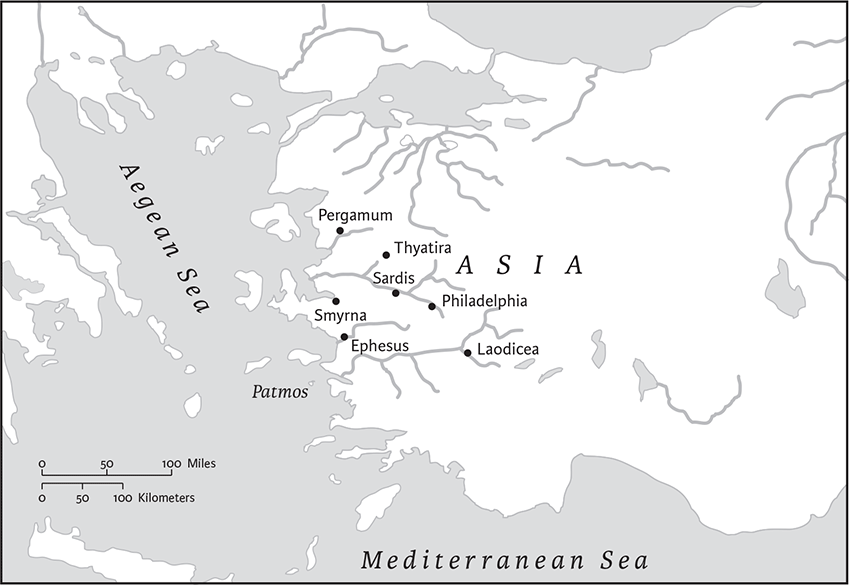
Chs 2–3: The seven churches.
12“And to the angel of the church in Pergamum write: These are the words of him who has the sharp two-edged sword:
13“I know where you are living, where Satan's throne is. Yet you are holding fast to my name, and you did not deny your faith in mea even in the days of Antipas my witness, my faithful one, who was killed among you, where Satan lives. 14But I have a few things against you: you have some there who hold to the teaching of Balaam, who taught Balak to put a stumbling block before the people of Israel, so that they would eat food sacrificed to idols and practice fornication. 15So you also have some who hold to the teaching of the Nicolaitans. 16Repent then. If not, I will come to you soon and make war against them with the sword of my mouth. 17Let anyone who has an ear listen to what the Spirit is saying to the churches. To everyone who conquers I will give some of the hidden manna, and I will give a white stone, and on the white stone is written a new name that no one knows except the one who receives it.
18“And to the angel of the church in Thyatira write: These are the words of the Son of God, who has eyes like a flame of fire, and whose feet are like burnished bronze:
19“I know your works—your love, faith, service, and patient endurance. I know that your last works are greater than the first. 20But I have this against you: you tolerate that woman Jezebel, who calls herself a prophet and is teaching and beguiling my servantsa to practice fornication and to eat food sacrificed to idols. 21I gave her time to repent, but she refuses to repent of her fornication. 22Beware, I am throwing her on a bed, and those who commit adultery with her I am throwing into great distress, unless they repent of her doings; 23and I will strike her children dead. And all the churches will know that I am the one who searches minds and hearts, and I will give to each of you as your works deserve. 24But to the rest of you in Thyatira, who do not hold this teaching, who have not learned what some call ‘the deep things of Satan,’ to you I say, I do not lay on you any other burden; 25only hold fast to what you have until I come. 26To everyone who conquers and continues to do my works to the end,
28even as I also received authority from my Father. To the one who conquers I will also give the morning star. 29Let anyone who has an ear listen to what the Spirit is saying to the churches.
3
And to the angel of the church in Sardis write: These are the words of him who has the seven spirits of God and the seven stars:
“I know your works; you have a name of being alive, but you are dead. 2Wake up, and strengthen what remains and is on the point of death, for I have not found your works perfect in the sight of my God. 3Remember then what you received and heard; obey it, and repent. If you do not wake up, I will come like a thief, and you will not know at what hour I will come to you. 4Yet you have still a few persons in Sardis who have not soiled their clothes; they will walk with me, dressed in white, for they are worthy. 5If you conquer, you will be clothed like them in white robes, and I will not blot your name out of the book of life; I will confess your name before my Father and before his angels. 6Let anyone who has an ear listen to what the Spirit is saying to the churches.
7“And to the angel of the church in Philadelphia write:
These are the words of the holy one, the true one,
who has the key of David,
who opens and no one will shut,
who shuts and no one opens:
8“I know your works. Look, I have set before you an open door, which no one is able to shut. I know that you have but little power, and yet you have kept my word and have not denied my name. 9I will make those of the synagogue of Satan who say that they are Jews and are not, but are lying—I will make them come and bow down before your feet, and they will learn that I have loved you. 10Because you have kept my word of patient endurance, I will keep you from the hour of trial that is coming on the whole world to test the inhabitants of the earth. 11I am coming soon; hold fast to what you have, so that no one may seize your crown. 12If you conquer, I will make you a pillar in the temple of my God; you will never go out of it. I will write on you the name of my God, and the name of the city of my God, the new Jerusalem that comes down from my God out of heaven, and my own new name. 13Let anyone who has an ear listen to what the Spirit is saying to the churches.
14“And to the angel of the church in Laodicea write: The words of the Amen, the faithful and true witness, the origina of God's creation:
15“I know your works; you are neither cold nor hot. I wish that you were either cold or hot. 16So, because you are lukewarm, and neither cold nor hot, I am about to spit you out of my mouth. 17For you say, ‘I am rich, I have prospered, and I need nothing.’ You do not realize that you are wretched, pitiable, poor, blind, and naked. 18Therefore I counsel you to buy from me gold refined by fire so that you may be rich; and white robes to clothe you and to keep the shame of your nakedness from being seen; and salve to anoint your eyes so that you may see. 19I reprove and discipline those whom I love. Be earnest, therefore, and repent. 20Listen! I am standing at the door, knocking; if you hear my voice and open the door, I will come in to you and eat with you, and you with me. 21To the one who conquers I will give a place with me on my throne, just as I myself conquered and sat down with my Father on his throne. 22Let anyone who has an ear listen to what the Spirit is saying to the churches.”
4
After this I looked, and there in heaven a door stood open! And the first voice, which I had heard speaking to me like a trumpet, said, “Come up here, and I will show you what must take place after this.” 2At once I was in the spirit,b and there in heaven stood a throne, with one seated on the throne! 3And the one seated there looks like jasper and carnelian, and around the throne is a rainbow that looks like an emerald. 4Around the throne are twenty-four thrones, and seated on the thrones are twenty-four elders, dressed in white robes, with golden crowns on their heads. 5Coming from the throne are flashes of lightning, and rumblings and peals of thunder, and in front of the throne burn seven flaming torches, which are the seven spirits of God; 6and in front of the throne there is something like a sea of glass, like crystal.
Around the throne, and on each side of the throne, are four living creatures, full of eyes in front and behind: 7the first living creature like a lion, the second living creature like an ox, the third living creature with a face like a human face, and the fourth living creature like a flying eagle. 8And the four living creatures, each of them with six wings, are full of eyes all around and inside. Day and night without ceasing they sing,
“Holy, holy, holy,
the Lord God the Almighty,
who was and is and is to come.”
9And whenever the living creatures give glory and honor and thanks to the one who is seated on the throne, who lives forever and ever, 10the twenty-four elders fall before the one who is seated on the throne and worship the one who lives forever and ever; they cast their crowns before the throne, singing,
11“You are worthy, our Lord and God,
to receive glory and honor and power,
for you created all things,
and by your will they existed and were created.”
5
Then I saw in the right hand of the one seated on the throne a scroll written on the inside and on the back, sealeda with seven seals; 2and I saw a mighty angel proclaiming with a loud voice, “Who is worthy to open the scroll and break its seals?” 3And no one in heaven or on earth or under the earth was able to open the scroll or to look into it. 4And I began to weep bitterly because no one was found worthy to open the scroll or to look into it. 5Then one of the elders said to me, “Do not weep. See, the Lion of the tribe of Judah, the Root of David, has conquered, so that he can open the scroll and its seven seals.”
6Then I saw between the throne and the four living creatures and among the elders a Lamb standing as if it had been slaughtered, having seven horns and seven eyes, which are the seven spirits of God sent out into all the earth. 7He went and took the scroll from the right hand of the one who was seated on the throne. 8When he had taken the scroll, the four living creatures and the twenty-four elders fell before the Lamb, each holding a harp and golden bowls full of incense, which are the prayers of the saints. 9They sing a new song:
11Then I looked, and I heard the voice of many angels surrounding the throne and the living creatures and the elders; they numbered myriads of myriads and thousands of thousands, 12singing with full voice,
“Worthy is the Lamb that was slaughtered
to receive power and wealth and wisdom and might
and honor and glory and blessing!”
13Then I heard every creature in heaven and on earth and under the earth and in the sea, and all that is in them, singing,
“To the one seated on the throne and to the Lamb
be blessing and honor and glory and might
forever and ever!”
14And the four living creatures said, “Amen!” And the elders fell down and worshiped.
6
Then I saw the Lamb open one of the seven seals, and I heard one of the four living creatures call out, as with a voice of thunder, “Come!”c 2I looked, and there was a white horse! Its rider had a bow; a crown was given to him, and he came out conquering and to conquer.
3When he opened the second seal, I heard the second living creature call out, “Come!”c4And out camed another horse, bright red; its rider was permitted to take peace from the earth, so that people would slaughter one another; and he was given a great sword.
5When he opened the third seal, I heard the third living creature call out, “Come!”c I looked, and there was a black horse! Its rider held a pair of scales in his hand, 6and I heard what seemed to be a voice in the midst of the four living creatures saying, “A quart of wheat for a day's pay,e and three quarts of barley for a day's pay,e but do not damage the olive oil and the wine!”
7When he opened the fourth seal, I heard the voice of the fourth living creature call out, “Come!”c8I looked and there was a pale green horse! Its rider's name was Death, and Hades followed with him; they were given authority over a fourth of the earth, to kill with sword, famine, and pestilence, and by the wild animals of the earth.
9When he opened the fifth seal, I saw under the altar the souls of those who had been slaughtered for the word of God and for the testimony they had given; 10they cried out with a loud voice, “Sovereign Lord, holy and true, how long will it be before you judge and avenge our blood on the inhabitants of the earth?” 11They were each given a white robe and told to rest a little longer, until the number would be complete both of their fellow servantsa and of their brothers and sisters,b who were soon to be killed as they themselves had been killed.
12When he opened the sixth seal, I looked, and there came a great earthquake; the sun became black as sackcloth, the full moon became like blood, 13and the stars of the sky fell to the earth as the fig tree drops its winter fruit when shaken by a gale. 14The sky vanished like a scroll rolling itself up, and every mountain and island was removed from its place. 15Then the kings of the earth and the magnates and the generals and the rich and the powerful, and everyone, slave and free, hid in the caves and among the rocks of the mountains, 16calling to the mountains and rocks, “Fall on us and hide us from the face of the one seated on the throne and from the wrath of the Lamb; 17for the great day of their wrath has come, and who is able to stand?”
7
After this I saw four angels standing at the four corners of the earth, holding back the four winds of the earth so that no wind could blow on earth or sea or against any tree. 2I saw another angel ascending from the rising of the sun, having the seal of the living God, and he called with a loud voice to the four angels who had been given power to damage earth and sea, 3saying, “Do not damage the earth or the sea or the trees, until we have marked the servantsa of our God with a seal on their foreheads.”
4And I heard the number of those who were sealed, one hundred forty-four thousand, sealed out of every tribe of the people of Israel:
5From the tribe of Judah twelve thousand sealed,
from the tribe of Reuben twelve thousand,
from the tribe of Gad twelve thousand,
6from the tribe of Asher twelve thousand,
from the tribe of Naphtali twelve thousand,
from the tribe of Manasseh twelve thousand,
7from the tribe of Simeon twelve thousand,
from the tribe of Levi twelve thousand,
from the tribe of Issachar twelve thousand,
8from the tribe of Zebulun twelve thousand,
from the tribe of Joseph twelve thousand,
from the tribe of Benjamin twelve thousand sealed.
9After this I looked, and there was a great multitude that no one could count, from every nation, from all tribes and peoples and languages, standing before the throne and before the Lamb, robed in white, with palm branches in their hands. 10They cried out in a loud voice, saying,
“Salvation belongs to our God who is seated on the throne, and to the Lamb!”
11And all the angels stood around the throne and around the elders and the four living creatures, and they fell on their faces before the throne and worshiped God, 12singing,
“Amen! Blessing and glory and wisdom
and thanksgiving and honor
and power and might
be to our God forever and ever! Amen.”
13Then one of the elders addressed me, saying, “Who are these, robed in white, and where have they come from?” 14I said to him, “Sir, you are the one that knows.” Then he said to me, “These are they who have come out of the great ordeal; they have washed their robes and made them white in the blood of the Lamb.
15For this reason they are before the throne of God,
and worship him day and night within his temple,
and the one who is seated on the throne will shelter them.
16They will hunger no more, and thirst no more;
the sun will not strike them,
nor any scorching heat;
17for the Lamb at the center of the throne will be their shepherd,
and he will guide them to springs of the water of life,
and God will wipe away every tear from their eyes.”
8
When the Lamb opened the seventh seal, there was silence in heaven for about half an hour. 2And I saw the seven angels who stand before God, and seven trumpets were given to them.
3Another angel with a golden censer came and stood at the altar; he was given a great quantity of incense to offer with the prayers of all the saints on the golden altar that is before the throne. 4And the smoke of the incense, with the prayers of the saints, rose before God from the hand of the angel. 5Then the angel took the censer and filled it with fire from the altar and threw it on the earth; and there were peals of thunder, rumblings, flashes of lightning, and an earthquake.
6Now the seven angels who had the seven trumpets made ready to blow them.
7The first angel blew his trumpet, and there came hail and fire, mixed with blood, and they were hurled to the earth; and a third of the earth was burned up, and a third of the trees were burned up, and all green grass was burned up.
8The second angel blew his trumpet, and something like a great mountain, burning with fire, was thrown into the sea. 9A third of the sea became blood, a third of the living creatures in the sea died, and a third of the ships were destroyed.
10The third angel blew his trumpet, and a great star fell from heaven, blazing like a torch, and it fell on a third of the rivers and on the springs of water. 11The name of the star is Wormwood. A third of the waters became wormwood, and many died from the water, because it was made bitter.
12The fourth angel blew his trumpet, and a third of the sun was struck, and a third of the moon, and a third of the stars, so that a third of their light was darkened; a third of the day was kept from shining, and likewise the night.
13Then I looked, and I heard an eagle crying with a loud voice as it flew in midheaven, “Woe, woe, woe to the inhabitants of the earth, at the blasts of the other trumpets that the three angels are about to blow!”
9
And the fifth angel blew his trumpet, and I saw a star that had fallen from heaven to earth, and he was given the key to the shaft of the bottomless pit; 2he opened the shaft of the bottomless pit, and from the shaft rose smoke like the smoke of a great furnace, and the sun and the air were darkened with the smoke from the shaft. 3Then from the smoke came locusts on the earth, and they were given authority like the authority of scorpions of the earth. 4They were told not to damage the grass of the earth or any green growth or any tree, but only those people who do not have the seal of God on their foreheads. 5They were allowed to torture them for five months, but not to kill them, and their torture was like the torture of a scorpion when it stings someone. 6And in those days people will seek death but will not find it; they will long to die, but death will flee from them.
7In appearance the locusts were like horses equipped for battle. On their heads were what looked like crowns of gold; their faces were like human faces, 8their hair like women's hair, and their teeth like lions’ teeth; 9they had scales like iron breastplates, and the noise of their wings was like the noise of many chariots with horses rushing into battle. 10They have tails like scorpions, with stingers, and in their tails is their power to harm people for five months. 11They have as king over them the angel of the bottomless pit; his name in Hebrew is Abaddon,a and in Greek he is called Apollyon.b
12The first woe has passed. There are still two woes to come.
13Then the sixth angel blew his trumpet, and I heard a voice from the fourc horns of the golden altar before God, 14saying to the sixth angel who had the trumpet, “Release the four angels who are bound at the great river Euphrates.” 15So the four angels were released, who had been held ready for the hour, the day, the month, and the year, to kill a third of humankind. 16The number of the troops of cavalry was two hundred million; I heard their number. 17And this was how I saw the horses in my vision: the riders wore breastplates the color of fire and of sapphirea and of sulfur; the heads of the horses were like lions’ heads, and fire and smoke and sulfur came out of their mouths. 18By these three plagues a third of humankind was killed, by the fire and smoke and sulfur coming out of their mouths. 19For the power of the horses is in their mouths and in their tails; their tails are like serpents, having heads; and with them they inflict harm.
20The rest of humankind, who were not killed by these plagues, did not repent of the works of their hands or give up worshiping demons and idols of gold and silver and bronze and stone and wood, which cannot see or hear or walk. 21And they did not repent of their murders or their sorceries or their fornication or their thefts.
10
And I saw another mighty angel coming down from heaven, wrapped in a cloud, with a rainbow over his head; his face was like the sun, and his legs like pillars of fire. 2He held a little scroll open in his hand. Setting his right foot on the sea and his left foot on the land, 3he gave a great shout, like a lion roaring. And when he shouted, the seven thunders sounded. 4And when the seven thunders had sounded, I was about to write, but I heard a voice from heaven saying, “Seal up what the seven thunders have said, and do not write it down.” 5Then the angel whom I saw standing on the sea and the land
raised his right hand to heaven
6and swore by him who lives forever and ever,
who created heaven and what is in it, the earth and what is in it, and the sea and what is in it: “There will be no more delay, 7but in the days when the seventh angel is to blow his trumpet, the mystery of God will be fulfilled, as he announced to his servantsb the prophets.”
8Then the voice that I had heard from heaven spoke to me again, saying, “Go, take the scroll that is open in the hand of the angel who is standing on the sea and on the land.” 9So I went to the angel and told him to give me the little scroll; and he said to me, “Take it, and eat; it will be bitter to your stomach, but sweet as honey in your mouth.” 10So I took the little scroll from the hand of the angel and ate it; it was sweet as honey in my mouth, but when I had eaten it, my stomach was made bitter.
11Then they said to me, “You must prophesy again about many peoples and nations and languages and kings.”
11
Then I was given a measuring rod like a staff, and I was told, “Come and measure the temple of God and the altar and those who worship there, 2but do not measure the court outside the temple; leave that out, for it is given over to the nations, and they will trample over the holy city for forty-two months. 3And I will grant my two witnesses authority to prophesy for one thousand two hundred sixty days, wearing sackcloth.”
4These are the two olive trees and the two lampstands that stand before the Lord of the earth. 5And if anyone wants to harm them, fire pours from their mouth and consumes their foes; anyone who wants to harm them must be killed in this manner. 6They have authority to shut the sky, so that no rain may fall during the days of their prophesying, and they have authority over the waters to turn them into blood, and to strike the earth with every kind of plague, as often as they desire.
7When they have finished their testimony, the beast that comes up from the bottomless pit will make war on them and conquer them and kill them, 8and their dead bodies will lie in the street of the great city that is propheticallya called Sodom and Egypt, where also their Lord was crucified. 9For three and a half days members of the peoples and tribes and languages and nations will gaze at their dead bodies and refuse to let them be placed in a tomb; 10and the inhabitants of the earth will gloat over them and celebrate and exchange presents, because these two prophets had been a torment to the inhabitants of the earth.
11But after the three and a half days, the breathb of life from God entered them, and they stood on their feet, and those who saw them were terrified. 12Then theyc heard a loud voice from heaven saying to them, “Come up here!” And they went up to heaven in a cloud while their enemies watched them. 13At that moment there was a great earthquake, and a tenth of the city fell; seven thousand people were killed in the earthquake, and the rest were terrified and gave glory to the God of heaven.
14The second woe has passed. The third woe is coming very soon.
15Then the seventh angel blew his trumpet, and there were loud voices in heaven, saying,
“The kingdom of the world has become the kingdom of our Lord
and of his Messiah,d
and he will reign forever and ever.”
16Then the twenty-four elders who sit on their thrones before God fell on their faces and worshiped God, 17singing,
“We give you thanks, Lord God Almighty,
who are and who were,
for you have taken your great power
and begun to reign.
18The nations raged,
but your wrath has come,
and the time for judging the dead,
for rewarding your servants,a the prophets
and saints and all who fear your name,
both small and great,
and for destroying those who destroy the earth.”
19Then God's temple in heaven was opened, and the ark of his covenant was seen within his temple; and there were flashes of lightning, rumblings, peals of thunder, an earthquake, and heavy hail.
12
A great portent appeared in heaven: a woman clothed with the sun, with the moon under her feet, and on her head a crown of twelve stars. 2She was pregnant and was crying out in birth pangs, in the agony of giving birth. 3Then another portent appeared in heaven: a great red dragon, with seven heads and ten horns, and seven diadems on his heads. 4His tail swept down a third of the stars of heaven and threw them to the earth. Then the dragon stood before the woman who was about to bear a child, so that he might devour her child as soon as it was born. 5And she gave birth to a son, a male child, who is to ruleb all the nations with a rod of iron. But her child was snatched away and taken to God and to his throne; 6and the woman fled into the wilderness, where she has a place prepared by God, so that there she can be nourished for one thousand two hundred sixty days.
7And war broke out in heaven; Michael and his angels fought against the dragon. The dragon and his angels fought back, 8but they were defeated, and there was no longer any place for them in heaven. 9The great dragon was thrown down, that ancient serpent, who is called the Devil and Satan, the deceiver of the whole world—he was thrown down to the earth, and his angels were thrown down with him.
10Then I heard a loud voice in heaven, proclaiming,
“Now have come the salvation and the power
and the kingdom of our God
and the authority of his Messiah,a
for the accuser of our comradesb has been thrown down,
who accuses them day and night before our God.
11But they have conquered him by the blood of the Lamb
and by the word of their testimony,
for they did not cling to life even in the face of death.
12Rejoice then, you heavens
and those who dwell in them!
But woe to the earth and the sea,
for the devil has come down to you
with great wrath,
because he knows that his time is short!”
13So when the dragon saw that he had been thrown down to the earth, he pursuedc the woman who had given birth to the male child. 14But the woman was given the two wings of the great eagle, so that she could fly from the serpent into the wilderness, to her place where she is nourished for a time, and times, and half a time. 15Then from his mouth the serpent poured water like a river after the woman, to sweep her away with the flood. 16But the earth came to the help of the woman; it opened its mouth and swallowed the river that the dragon had poured from his mouth. 17Then the dragon was angry with the woman, and went off to make war on the rest of her children, those who keep the commandments of God and hold the testimony of Jesus.
18Then the dragond took his stand on the sand of the seashore.
13
1And I saw a beast rising out of the sea, having ten horns and seven heads; and on its horns were ten diadems, and on its heads were blasphemous names. 2And the beast that I saw was like a leopard, its feet were like a bear's, and its mouth was like a lion's mouth. And the dragon gave it his power and his throne and great authority. 3One of its heads seemed to have received a death-blow, but its mortal wounde had been healed. In amazement the whole earth followed the beast. 4They worshiped the dragon, for he had given his authority to the beast, and they worshiped the beast, saying, “Who is like the beast, and who can fight against it?”
5The beast was given a mouth uttering haughty and blasphemous words, and it was allowed to exercise authority for forty-two months. 6It opened its mouth to utter blasphemies against God, blaspheming his name and his dwelling, that is, those who dwell in heaven. 7Also it was allowed to make war on the saints and to conquer them.a It was given authority over every tribe and people and language and nation, 8and all the inhabitants of the earth will worship it, everyone whose name has not been written from the foundation of the world in the book of life of the Lamb that was slaughtered.b
Here is a call for the endurance and faith of the saints.
11Then I saw another beast that rose out of the earth; it had two horns like a lamb and it spoke like a dragon. 12It exercises all the authority of the first beast on its behalf, and it makes the earth and its inhabitants worship the first beast, whose mortal woundc had been healed. 13It performs great signs, even making fire come down from heaven to earth in the sight of all; 14and by the signs that it is allowed to perform on behalf of the beast, it deceives the inhabitants of earth, telling them to make an image for the beast that had been wounded by the swordd and yet lived; 15and it was allowed to give breathe to the image of the beast so that the image of the beast could even speak and cause those who would not worship the image of the beast to be killed. 16Also it causes all, both small and great, both rich and poor, both free and slave, to be marked on the right hand or the forehead, 17so that no one can buy or sell who does not have the mark, that is, the name of the beast or the number of its name. 18This calls for wisdom: let anyone with understanding calculate the number of the beast, for it is the number of a person. Its number is six hundred sixtysix.f
14
Then I looked, and there was the Lamb, standing on Mount Zion! And with him were one hundred forty-four thousand who had his name and his Father's name written on their foreheads. 2And I heard a voice from heaven like the sound of many waters and like the sound of loud thunder; the voice I heard was like the sound of harpists playing on their harps, 3and they sing a new song before the throne and before the four living creatures and before the elders. No one could learn that song except the one hundred forty-four thousand who have been redeemed from the earth. 4It is these who have not defiled themselves with women, for they are virgins; these follow the Lamb wherever he goes. They have been redeemed from humankind as first fruits for God and the Lamb, 5and in their mouth no lie was found; they are blameless.
6Then I saw another angel flying in mid-heaven, with an eternal gospel to proclaim to those who livea on the earth—to every nation and tribe and language and people. 7He said in a loud voice, “Fear God and give him glory, for the hour of his judgment has come; and worship him who made heaven and earth, the sea and the springs of water.”
8Then another angel, a second, followed, saying, “Fallen, fallen is Babylon the great! She has made all nations drink of the wine of the wrath of her fornication.”
9Then another angel, a third, followed them, crying with a loud voice, “Those who worship the beast and its image, and receive a mark on their foreheads or on their hands, 10they will also drink the wine of God's wrath, poured unmixed into the cup of his anger, and they will be tormented with fire and sulfur in the presence of the holy angels and in the presence of the Lamb. 11And the smoke of their torment goes up forever and ever. There is no rest day or night for those who worship the beast and its image and for anyone who receives the mark of its name.”
12Here is a call for the endurance of the saints, those who keep the commandments of God and hold fast to the faith ofb Jesus.
13And I heard a voice from heaven saying, “Write this: Blessed are the dead who from now on die in the Lord.” “Yes,” says the Spirit, “they will rest from their labors, for their deeds follow them.”
14Then I looked, and there was a white cloud, and seated on the cloud was one like the Son of Man, with a golden crown on his head, and a sharp sickle in his hand! 15Another angel came out of the temple, calling with a loud voice to the one who sat on the cloud, “Use your sickle and reap, for the hour to reap has come, because the harvest of the earth is fully ripe.” 16So the one who sat on the cloud swung his sickle over the earth, and the earth was reaped.
17Then another angel came out of the temple in heaven, and he too had a sharp sickle. 18Then another angel came out from the altar, the angel who has authority over fire, and he called with a loud voice to him who had the sharp sickle, “Use your sharp sickle and gather the clusters of the vine of the earth, for its grapes are ripe.” 19So the angel swung his sickle over the earth and gathered the vintage of the earth, and he threw it into the great wine press of the wrath of God. 20And the wine press was trodden outside the city, and blood flowed from the wine press, as high as a horse's bridle, for a distance of about two hundred miles.a
15
Then I saw another portent in heaven, great and amazing: seven angels with seven plagues, which are the last, for with them the wrath of God is ended.
2And I saw what appeared to be a sea of glass mixed with fire, and those who had conquered the beast and its image and the number of its name, standing beside the sea of glass with harps of God in their hands. 3And they sing the song of Moses, the servantb of God, and the song of the Lamb:
5After this I looked, and the temple of the tentd of witness in heaven was opened, 6and out of the temple came the seven angels with the seven plagues, robed in pure bright linen,e with golden sashes across their chests. 7Then one of the four living creatures gave the seven angels seven golden bowls full of the wrath of God, who lives forever and ever; 8and the temple was filled with smoke from the glory of God and from his power, and no one could enter the temple until the seven plagues of the seven angels were ended.
16
Then I heard a loud voice from the temple telling the seven angels, “Go and pour out on the earth the seven bowls of the wrath of God.”
2So the first angel went and poured his bowl on the earth, and a foul and painful sore came on those who had the mark of the beast and who worshiped its image.
3The second angel poured his bowl into the sea, and it became like the blood of a corpse, and every living thing in the sea died.
4The third angel poured his bowl into the rivers and the springs of water, and they became blood. 5And I heard the angel of the waters say,
8The fourth angel poured his bowl on the sun, and it was allowed to scorch people with fire; 9they were scorched by the fierce heat, but they cursed the name of God, who had authority over these plagues, and they did not repent and give him glory.
10The fifth angel poured his bowl on the throne of the beast, and its kingdom was plunged into darkness; people gnawed their tongues in agony, 11and cursed the God of heaven because of their pains and sores, and they did not repent of their deeds.
12The sixth angel poured his bowl on the great river Euphrates, and its water was dried up in order to prepare the way for the kings from the east. 13And I saw three foul spirits like frogs coming from the mouth of the dragon, from the mouth of the beast, and from the mouth of the false prophet. 14These are demonic spirits, performing signs, who go abroad to the kings of the whole world, to assemble them for battle on the great day of God the Almighty. 15(“See, I am coming like a thief! Blessed is the one who stays awake and is clothed,a not going about naked and exposed to shame.”) 16And they assembled them at the place that in Hebrew is called Harmagedon.
17The seventh angel poured his bowl into the air, and a loud voice came out of the temple, from the throne, saying, “It is done!” 18And there came flashes of lightning, rumblings, peals of thunder, and a violent earthquake, such as had not occurred since people were upon the earth, so violent was that earthquake. 19The great city was split into three parts, and the cities of the nations fell. God remembered great Babylon and gave her the wine-cup of the fury of his wrath. 20And every island fled away, and no mountains were to be found; 21and huge hailstones, each weighing about a hundred pounds,b dropped from heaven on people, until they cursed God for the plague of the hail, so fearful was that plague.
17
Then one of the seven angels who had the seven bowls came and said to me, “Come, I will show you the judgment of the great whore who is seated on many waters, 2with whom the kings of the earth have committed fornication, and with the wine of whose fornication the inhabitants of the earth have become drunk.” 3So he carried me away in the spiritc into a wilderness, and I saw a woman sitting on a scarlet beast that was full of blasphemous names, and it had seven heads and ten horns. 4The woman was clothed in purple and scarlet, and adorned with gold and jewels and pearls, holding in her hand a golden cup full of abominations and the impurities of her fornication; 5and on her forehead was written a name, a mystery: “Babylon the great, mother of whores and of earth's abominations.” 6And I saw that the woman was drunk with the blood of the saints and the blood of the witnesses to Jesus.
When I saw her, I was greatly amazed. 7But the angel said to me, “Why are you so amazed? I will tell you the mystery of the woman, and of the beast with seven heads and ten horns that carries her. 8The beast that you saw was, and is not, and is about to ascend from the bottomless pit and go to destruction. And the inhabitants of the earth, whose names have not been written in the book of life from the foundation of the world, will be amazed when they see the beast, because it was and is not and is to come.
9“This calls for a mind that has wisdom: the seven heads are seven mountains on which the woman is seated; also, they are seven kings, 10of whom five have fallen, one is living, and the other has not yet come; and when he comes, he must remain only a little while. 11As for the beast that was and is not, it is an eighth but it belongs to the seven, and it goes to destruction. 12And the ten horns that you saw are ten kings who have not yet received a kingdom, but they are to receive authority as kings for one hour, together with the beast. 13These are united in yielding their power and authority to the beast; 14they will make war on the Lamb, and the Lamb will conquer them, for he is Lord of lords and King of kings, and those with him are called and chosen and faithful.”
15And he said to me, “The waters that you saw, where the whore is seated, are peoples and multitudes and nations and languages. 16And the ten horns that you saw, they and the beast will hate the whore; they will make her desolate and naked; they will devour her flesh and burn her up with fire. 17For God has put it into their hearts to carry out his purpose by agreeing to give their kingdom to the beast, until the words of God will be fulfilled. 18The woman you saw is the great city that rules over the kings of the earth.”
18
After this I saw another angel coming down from heaven, having great authority; and the earth was made bright with his splendor. 2He called out with a mighty voice,
“Fallen, fallen is Babylon the great!
It has become a dwelling place of demons,
a haunt of every foul spirit,
a haunt of every foul bird,
a haunt of every foul and hateful beast.a
3For all the nations have drunkb
of the wine of the wrath of her fornication,
and the kings of the earth have committed fornication with her,
and the merchants of the earth have grown rich from the powera of her luxury.”
4Then I heard another voice from heaven saying,
“Come out of her, my people,
so that you do not take part in her sins,
and so that you do not share in her plagues;
5for her sins are heaped high as heaven,
and God has remembered her iniquities.
6Render to her as she herself has rendered,
and repay her double for her deeds;
mix a double draught for her in the cup she mixed.
7As she glorified herself and lived luxuriously,
so give her a like measure of torment and grief.
Since in her heart she says,
‘I rule as a queen;
I am no widow,
and I will never see grief,’
8therefore her plagues will come in a single day—
pestilence and mourning and famine—
and she will be burned with fire;
for mighty is the Lord God who judges her.”
9And the kings of the earth, who committed fornication and lived in luxury with her, will weep and wail over her when they see the smoke of her burning; 10they will stand far off, in fear of her torment, and say,
“Alas, alas, the great city,
Babylon, the mighty city!
For in one hour your judgment has come.”
11And the merchants of the earth weep and mourn for her, since no one buys their cargo anymore, 12cargo of gold, silver, jewels and pearls, fine linen, purple, silk and scarlet, all kinds of scented wood, all articles of ivory, all articles of costly wood, bronze, iron, and marble, 13cinnamon, spice, incense, myrrh, frankincense, wine, olive oil, choice flour and wheat, cattle and sheep, horses and chariots, slaves—and human lives.b
14“The fruit for which your soul longed
has gone from you,
and all your dainties and your splendor
are lost to you,
never to be found again!”
15The merchants of these wares, who gained wealth from her, will stand far off, in fear of her torment, weeping and mourning aloud,
And all shipmasters and seafarers, sailors and all whose trade is on the sea, stood far off 18and cried out as they saw the smoke of her burning,
“What city was like the great city?”
19And they threw dust on their heads, as they wept and mourned, crying out,
“Alas, alas, the great city,
where all who had ships at sea
grew rich by her wealth!
For in one hour she has been laid waste.”
20Rejoice over her, O heaven, you saints and apostles and prophets! For God has given judgment for you against her.
21Then a mighty angel took up a stone like a great millstone and threw it into the sea, saying,
“With such violence Babylon the great city
will be thrown down,
and will be found no more;
22and the sound of harpists and minstrels
and of flutists and trumpeters
will be heard in you no more;
and an artisan of any trade
will be found in you no more;
and the sound of the millstone
will be heard in you no more;
23and the light of a lamp
will shine in you no more;
and the voice of bridegroom and bride
will be heard in you no more;
for your merchants were the magnates of the earth,
and all nations were deceived by your sorcery.
24And in youa was found the blood of prophets and of saints,
and of all who have been slaughtered on earth.”
19
After this I heard what seemed to be the loud voice of a great multitude in heaven, saying,
“Hallelujah!
Salvation and glory and power to our God,
2for his judgments are true and just;
he has judged the great whore
who corrupted the earth with her fornication,
and he has avenged on her the blood of his servants.”b
3Once more they said,
“Hallelujah!
The smoke goes up from her forever and ever.”
4And the twenty-four elders and the four living creatures fell down and worshiped God who is seated on the throne, saying,
“Amen. Hallelujah!”
5And from the throne came a voice saying,
“Praise our God,
all you his servants,b
and all who fear him,
small and great.”
6Then I heard what seemed to be the voice of a great multitude, like the sound of many waters and like the sound of mighty thunder-peals, crying out,
for the fine linen is the righteous deeds of the saints.
9And the angel saidc to me, “Write this: Blessed are those who are invited to the marriage supper of the Lamb.” And he said to me, “These are true words of God.” 10Then I fell down at his feet to worship him, but he said to me, “You must not do that! I am a fellow servantd with you and your comradese who hold the testimony of Jesus.f Worship God! For the testimony of Jesusf is the spirit of prophecy.”
11Then I saw heaven opened, and there was a white horse! Its rider is called Faithful and True, and in righteousness he judges and makes war. 12His eyes are like a flame of fire, and on his head are many diadems; and he has a name inscribed that no one knows but himself. 13He is clothed in a robe dipped ing blood, and his name is called The Word of God. 14And the armies of heaven, wearing fine linen, white and pure, were following him on white horses. 15From his mouth comes a sharp sword with which to strike down the nations, and he will rulea them with a rod of iron; he will tread the wine press of the fury of the wrath of God the Almighty. 16On his robe and on his thigh he has a name inscribed, “King of kings and Lord of lords.”
17Then I saw an angel standing in the sun, and with a loud voice he called to all the birds that fly in midheaven, “Come, gather for the great supper of God, 18to eat the flesh of kings, the flesh of captains, the flesh of the mighty, the flesh of horses and their riders—flesh of all, both free and slave, both small and great.” 19Then I saw the beast and the kings of the earth with their armies gathered to make war against the rider on the horse and against his army. 20And the beast was captured, and with it the false prophet who had performed in its presence the signs by which he deceived those who had received the mark of the beast and those who worshiped its image. These two were thrown alive into the lake of fire that burns with sulfur. 21And the rest were killed by the sword of the rider on the horse, the sword that came from his mouth; and all the birds were gorged with their flesh.
20
Then I saw an angel coming down from heaven, holding in his hand the key to the bottomless pit and a great chain. 2He seized the dragon, that ancient serpent, who is the Devil and Satan, and bound him for a thousand years, 3and threw him into the pit, and locked and sealed it over him, so that he would deceive the nations no more, until the thousand years were ended. After that he must be let out for a little while.
4Then I saw thrones, and those seated on them were given authority to judge. I also saw the souls of those who had been beheaded for their testimony to Jesusb and for the word of God. They had not worshiped the beast or its image and had not received its mark on their foreheads or their hands. They came to life and reigned with Christ a thousand years. 5(The rest of the dead did not come to life until the thousand years were ended.) This is the first resurrection. 6Blessed and holy are those who share in the first resurrection. Over these the second death has no power, but they will be priests of God and of Christ, and they will reign with him a thousand years.
7When the thousand years are ended, Satan will be released from his prison 8and will come out to deceive the nations at the four corners of the earth, Gog and Magog, in order to gather them for battle; they are as numerous as the sands of the sea. 9They marched up over the breadth of the earth and surrounded the camp of the saints and the beloved city. And fire came down from heavena and consumed them. 10And the devil who had deceived them was thrown into the lake of fire and sulfur, where the beast and the false prophet were, and they will be tormented day and night forever and ever.
11Then I saw a great white throne and the one who sat on it; the earth and the heaven fled from his presence, and no place was found for them. 12And I saw the dead, great and small, standing before the throne, and books were opened. Also another book was opened, the book of life. And the dead were judged according to their works, as recorded in the books. 13And the sea gave up the dead that were in it, Death and Hades gave up the dead that were in them, and all were judged according to what they had done. 14Then Death and Hades were thrown into the lake of fire. This is the second death, the lake of fire; 15and anyone whose name was not found written in the book of life was thrown into the lake of fire.
21
Then I saw a new heaven and a new earth; for the first heaven and the first earth had passed away, and the sea was no more. 2And I saw the holy city, the new Jerusalem, coming down out of heaven from God, prepared as a bride adorned for her husband. 3And I heard a loud voice from the throne saying,
5And the one who was seated on the throne said, “See, I am making all things new.” Also he said, “Write this, for these words are trustworthy and true.” 6Then he said to me, “It is done! I am the Alpha and the Omega, the beginning and the end. To the thirsty I will give water as a gift from the spring of the water of life. 7Those who conquer will inherit these things, and I will be their God and they will be my children. 8But as for the cowardly, the faithless,f the polluted, the murderers, the fornicators, the sorcerers, the idolaters, and all liars, their place will be in the lake that burns with fire and sulfur, which is the second death.”
9Then one of the seven angels who had the seven bowls full of the seven last plagues came and said to me, “Come, I will show you the bride, the wife of the Lamb.” 10And in the spirita he carried me away to a great, high mountain and showed me the holy city Jerusalem coming down out of heaven from God. 11It has the glory of God and a radiance like a very rare jewel, like jasper, clear as crystal. 12It has a great, high wall with twelve gates, and at the gates twelve angels, and on the gates are inscribed the names of the twelve tribes of the Israelites; 13on the east three gates, on the north three gates, on the south three gates, and on the west three gates. 14And the wall of the city has twelve foundations, and on them are the twelve names of the twelve apostles of the Lamb.
15The angelb who talked to me had a measuring rod of gold to measure the city and its gates and walls. 16The city lies foursquare, its length the same as its width; and he measured the city with his rod, fifteen hundred miles;c its length and width and height are equal. 17He also measured its wall, one hundred forty-four cubitsd by human measurement, which the angel was using. 18The wall is built of jasper, while the city is pure gold, clear as glass. 19The foundations of the wall of the city are adorned with every jewel; the first was jasper, the second sapphire, the third agate, the fourth emerald, 20the fifth onyx, the sixth carnelian, the seventh chrysolite, the eighth beryl, the ninth topaz, the tenth chrysoprase, the eleventh jacinth, the twelfth amethyst. 21And the twelve gates are twelve pearls, each of the gates is a single pearl, and the street of the city is pure gold, transparent as glass.
22I saw no temple in the city, for its temple is the Lord God the Almighty and the Lamb. 23And the city has no need of sun or moon to shine on it, for the glory of God is its light, and its lamp is the Lamb. 24The nations will walk by its light, and the kings of the earth will bring their glory into it. 25Its gates will never be shut by day—and there will be no night there. 26People will bring into it the glory and the honor of the nations. 27But nothing unclean will enter it, nor anyone who practices abomination or falsehood, but only those who are written in the Lamb's book of life.
22
Then the angela showed me the river of the water of life, bright as crystal, flowing from the throne of God and of the Lamb 2through the middle of the street of the city. On either side of the river is the tree of lifeb with its twelve kinds of fruit, producing its fruit each month; and the leaves of the tree are for the healing of the nations. 3Nothing accursed will be found there any more. But the throne of God and of the Lamb will be in it, and his servantsc will worship him; 4they will see his face, and his name will be on their foreheads. 5And there will be no more night; they need no light of lamp or sun, for the Lord God will be their light, and they will reign forever and ever.
6And he said to me, “These words are trustworthy and true, for the Lord, the God of the spirits of the prophets, has sent his angel to show his servantsc what must soon take place.”
7“See, I am coming soon! Blessed is the one who keeps the words of the prophecy of this book.”
8I, John, am the one who heard and saw these things. And when I heard and saw them, I fell down to worship at the feet of the angel who showed them to me; 9but he said to me, “You must not do that! I am a fellow servantd with you and your comradese the prophets, and with those who keep the words of this book. Worship God!”
10And he said to me, “Do not seal up the words of the prophecy of this book, for the time is near. 11Let the evildoer still do evil, and the filthy still be filthy, and the righteous still do right, and the holy still be holy.”
12“See, I am coming soon; my reward is with me, to repay according to everyone's work. 13I am the Alpha and the Omega, the first and the last, the beginning and the end.”
14Blessed are those who wash their robes,f so that they will have the right to the tree of life and may enter the city by the gates. 15Outside are the dogs and sorcerers and fornicators and murderers and idolaters, and everyone who loves and practices falsehood.
16“It is I, Jesus, who sent my angel to you with this testimony for the churches. I am the root and the descendant of David, the bright morning star.”
17The Spirit and the bride say, “Come.”
And let everyone who hears say, “Come.”
And let everyone who is thirsty come.
Let anyone who wishes take the water of life as a gift.
18I warn everyone who hears the words of the prophecy of this book: if anyone adds to them, God will add to that person the plagues described in this book; 19if anyone takes away from the words of the book of this prophecy, God will take away that person's share in the tree of life and in the holy city, which are described in this book.
20The one who testifies to these things says, “Surely I am coming soon.”
Amen. Come, Lord Jesus!
21The grace of the Lord Jesus be with all the saints. Amen.a