Joshua
Name and Location in Canon
The book is named after Joshua, depicted as the apprentice and successor to Moses; according to it, Joshua was the military commander in the conquest of Canaan and the administrator of the allotment of that land to the Israelite tribes. In Num 13.16, Moses renames Hoshea (Heb hoshe˓a, “salvation”) Joshua (Heb yehoshu˓a, “the Lord is salvation/help”), adding the divine name Yahweh to his name.
The book of Joshua is the sixth book in both the Jewish and Christian canons, the first book of the Former Prophets or the first book of the so‐called Historical Books, respectively (see “Introduction to the Historical Books”, pp. 315–19.)
Authorship and Date of Composition
The authorship of the book of Joshua is unknown. Some types of sources for the book’s composition are identifiable (for example, the border descriptions and city lists in chs 14–19), though their origin and date are disputed. The historiographic materials used in the book of Joshua correspond to those found in the ancient Near East as a whole. These include traditional stories, etiologies, boundary and town lists, summary accounts and lists, accounts patterned after redundant annalistic documents, poetry (from the Book of Jashar, 10.12–13) and burial reports. These have been woven together with ritual and covenantal materials and other matters of priestly interest to communicate the book’s message.
Connections between the book of Joshua and the preceding books led many scholars, through the midtwentieth century, to posit a “Hexateuch” (six books), with the book of Joshua completing the first five books of the Bible, the Pentateuch—the Hexateuch having as its main theme the promise of the land and its eventual conquest. These scholars generally understood Joshua to be comprised of Pentateuchal sources: a prophetic historical narrative (JE) constituting most of (1–12); a priestly version (P), recounting the conquest and division of the land (13–22); and a group of Deuteronomistic additions and editing. From the period following the World War II, many scholars viewed Joshua as part of a large historical work, the Deuteronomistic History, extending from Deuteronomy through 2 Kings; this work is viewed as separate from the first four books (Genesis through Numbers), which were called the Tetrateuch (four books). This view downplayed connections with the Pentateuchal sources and stressed the book’s connections in vocabulary and theology with Deuteronomy and the following books of the Former Prophets. More recently, a few scholars have treated Joshua as a middle book in a still larger composition from Genesis through 2 Kings (an Enneateuch, nine books). At the beginning of the twenty‐first century, an erosion of the Deuteronomistic History hypothesis has led some scholars to propose that Joshua was an independent book written during the postexilic period. While the final edition may date from the postexilic period, one major early edition may date to the late seventh century bce.
Structure and Contents
The book of Joshua describes a conquest of Canaan and its allotment to the Israelite tribes. Through well‐known traditional stories (e.g., Rahab and the scouts, the crossing of the Jordan River, the capture of Jericho) as well as nonnarrative lists and ritual texts, the book portrays the fulfillment of God’s covenantal promise to Israel’s ancestors that their descendants would possess the land. Moreover, these stories challenge the book’s readers to live in obedience to the Deuteronomic covenant so that they also will receive God’s blessings in the land.
The book is somewhat symmetrical, as the following outline illustrates:
| I. The conquest | 1.1–12.24 |
| A. Preparation for the conquest | 1.1–5.12 |
| The commission of Joshua | 1.1–18 |
| Story of the scouts and Rahab | 2.1–24 |
| The crossing of the Jordan | 3.1–5.1 |
| Final preparatory events at Gilgal | 5.2–12 |
| B. Conquest of the land | 5.13–12.24 |
| Central campaign | 5.13–8.35 |
| Jericho | 5.13–6.27 |
| Achan and Ai | 7.1–8.29 |
| Covenant renewal as land grant: Shechem | 8.30–35 |
| The southern and northern campaigns | 9.1–11.15 |
| Introductory statement | 9.1–2 |
| Southern campaign | 9.3–10.43 |
| Northern campaign | 11.1–15 |
| Summary of total conquest | 11.16–23 |
| A selective list of defeated cities’ kings | 12.1–24 |
| II. The allotment of the land | 13.1–24.33 |
| B.′ Division of the land | 13.1–21.45 |
| Land remaining | 13.1–7 |
| Transjordanian tribal allotment | 13.8–33 |
| Cisjordanian tribal allotment | 14.1–19.51 |
| Introduction to the process of allotment | 14.1–5 |
| Judah and Joseph allotments | 14.6–17.18 |
| Seven other tribal allotments | 18.1–19.51 |
| Summary of the process of allotment | 19.51 |
| Allotments to persons of marginal status | 20.1–21.42 |
| Cities of refuge | 20.1–9 |
| Levitical cities | 21.1–42 |
| Ironic conclusion | 21.43–45 |
| A.′Epilogue to the conquest and allotment | 22.1–24.33 |
| Misunderstanding with the Transjordanian tribes | 22.1–34 |
| Concluding charges | 23.1–24.28 |
| Appendixes | 24.29–33 |
Interpretation
The book should not be read as straightforward history—it telescopes and simplifies what was a long and complex process of occupation of the land by the Israelite tribes. Some details are lacking (e.g., how the Israelites came into possession of Shechem, 8.30–35), while the other events narrated in the book are selectively arranged to heighten the book’s message. Thus the book’s presentation of reality does not necessarily reflect the course of events. For example, a main theme of the book is a swift and complete conquest of the land, while most archaeological evidence suggests its gradual settlement (see also 15.63; 16.10; 17.12–13; Judg 1). Consequently, archaeological excavations, together with sociological and anthropological analyses, must be used alongside the book to understand the early history of Israel in the land.
Several literary devices and themes characterize the book. First, the structure of the book (see outline) has two main divisions: the conquest (1.1–12.24) and the allotment of the land (13.1–24.33). Each main division contains two subdivisions: A: preparations for the conquest (1.1–5.12) and B: the conquest’s campaigns (5.13–12.24); B′: the allotment of the conquered land (13.1–21.45) and A′; epilogue to the conquest and allotment (22.1–24.33). The body of the book (5.13–21.45) is bracketed by introductory and concluding materials (1.1–5.12; 22.1–24.33). Each subdivision contains a number of units that contribute to the development of the plot and message of the book.
Second, the book follows a logical geographic arrangement. An east‐to‐west crossing into Canaan (chs 2–5) is followed by military campaigns directed at the center (chs 6–8), south (chs 9–10), and north (ch 11), concluded by a summary list (ch 12). The division of the land first covers the Transjordanian tribes (ch 13), then the south and central tribes (chs 14–17), then the northern and peripheral tribes (chs 18–19), and finally entities of marginal status (chs 20–21). At times, however, the story backtracks or repeats previously narrated details in a type of flashback. This is especially noticeable in chs 3–4 (the crossing of the Jordan) and ch 10 (the conquest of the south).
Third, typology, representing one character or event as an echo or foreshadowing of another, is utilized to portray Joshua as parallel to Moses. For example, Moses leads the Israelites out of Egypt, Joshua leads the Israelites into Canaan; Moses leads Israel in a miraculous crossing of the Red Sea (Sea of Reeds), Joshua leads Israel in a miraculous crossing of the Jordan River; Moses sends out scouts, Joshua sends out scouts; Moses allots land to the tribes east of the Jordan, Joshua allots land to the tribes west of the Jordan. This particular typology depicts Joshua as the legitimate successor of Moses.
Fourth, the law or teaching (Heb torah) of Moses plays a normative role in strategic parts of the book, and Israel’s obedience or disobedience to the law determines success or failure. This law, especially prominent in chs 1 and 23, is further specified as “the law of Moses” and refers to some form of the law or teaching attributed to Moses extant at the time that the book of Joshua was written, especially as found in Deuteronomy.
Fifth, ritual concerns dictate some of the narration, especially in the earlier chapters. For example, the crossing of the Jordan River (chs 3–4), circumcision and passover (ch 5), the conquest of Jericho (ch 6), and the implementations of the ḥerem (chs 6–8) all reflect ritual concerns that undergird the book’s land claims.
A subset of these ritual concerns is the concept of the ḥerem, which plays a significant role in the book (see 5.13–6.27; 7.6–26; 8.1–29; 10.28–39). This noun is usually translated “devoted thing” (7.1) and the related verb “utterly destroy” (10.28). The term is used primarily in contexts of warfare and destruction where the “ḥerem” stories are connected with the notion of obedience or disobedience to the Lord (cf. Deut 7; 20). Its purpose was to “drive out” or “dispossess” the Canaanites in order to carry out divine judgment on them, to protect the Israelites from Canaanite religious influence, and to fulfill the promises concerning the land. This kind of warfare is part of the political ideology that Israel shared with other nations in the ancient Near East, in which wars were dedicated to the glorification of the deity and the extension of the deity’s land and reign. In fact, the word ḥerem occurs in other Semitic languages and cultures. While it was considered a ritual category (similar to a concept of interdict or taboo), its use appears to have been linked to the administration of the distribution of war spoils. Understanding the ḥerem has posed a significant problem throughout the history of interpretation.
Finally, the book utilizes a number of different land ideologies. Some of these may be anchored in historical geography, others are purely idealistic, and some are a mixture of the two. In the book’s final form, these produce an abstract, idealized concept of the land, create tensions, and set the stage for irony. The dominant land ideology is the territory of the twelve tribes (both west and east of the Jordan) who completely fill up the land (chs 15–19; cf. Deut 4.45–49). In this view, the two‐and‐a‐half Transjordanian tribes (those settled east of the Jordan) are an integral and vital part of “all Israel.” A second, contrasting ideology restricts the true land of inheritance to the territory west of the Jordan (Cisjordan, the land of Canaan) (cf. Deut 12.10). It is this image of the land that lies behind the belief that crossing the Jordan was a step of outstanding significance (chs 3–4). This view also creates ironic tensions in 22.10–34, where the two‐and‐a‐half tribes set up an altar in Transjordan. A third ideology presents the land as claimed but not fully conquered, noting “the land that still remains to be possessed” (13.1–6); and a fourth ideology is an expansionistic, utopian Israel, which claims the distant Euphrates as the northern boundary of Israel’s inheritance (1.4; cf. Gen 15.18; Deut 1.7; 11.24). These last two notions instill the book with the flavor of unredeemed promise. The text develops two understandings of Israel’s unfulfilled expectations. On the one hand, the incomplete conquest is judged to be the result of Israel’s disobedience or military inability (15.63; 16.10; 17.12–13; 19.47); this serves as the basis for future threats to Israel’s well‐being (7.12; 23.12–13). On the other hand, the last two land ideologies function as optimistic indications of greater land blessings to Israel in the future (13.6b; 17.18; 23.5).
Thus the book of Joshua plays an important role not only in the story of the early history of Israel in the land but also in the development of the theology of the Hebrew Bible. It serves as the prologue for the remainder of the Deuteronomistic Historians’ account, which focuses on Israel’s life in the land.
K. Lawson Younger, Jr.
1 After the death of Moses the servant of the Lord, the Lord spoke to Joshua son of Nun, Moses’ assistant, saying, 2“My servant Moses is dead. Now proceed to cross the Jordan, you and all this people, into the land that I am giving to them, to the Israelites. 3Every place that the sole of your foot will tread upon I have given to you, as I promised to Moses. 4From the wilderness and the Lebanon as far as the great river, the river Euphrates, all the land of the Hittites, to the Great Sea in the west shall be your territory. 5No one shall be able to stand against you all the days of your life. As I was with Moses, so I will be with you; I will not fail you or forsake you. 6Be strong and courageous; for you shall put this people in possession of the land that I swore to their ancestors to give them. 7Only be strong and very courageous, being careful to act in accordance with all the law that my servant Moses commanded you; do not turn from it to the right hand or to the left, so that you may be successful wherever you go. 8This book of the law shall not depart out of your mouth; you shall meditate on it day and night, so that you may be careful to act in accordance with all that is written in it. For then you shall make your way prosperous, and then you shall be successful. 9I hereby command you: Be strong and courageous; do not be frightened or dismayed, for the Lord your God is with you wherever you go.”
10Then Joshua commanded the officers of the people, 11“Pass through the camp, and command the people: ‘Prepare your provisions; for in three days you are to cross over the Jordan, to go in to take possession of the land that the Lord your God gives you to possess.’”
12To the Reubenites, the Gadites, and the half‐tribe of Manasseh Joshua said, 13“Remember the word that Moses the servant of the Lord commanded you, saying, ‘The Lord your God is providing you a place of rest, and will give you this land.’ 14Your wives, your little ones, and your livestock shall remain in the land that Moses gave you beyond the Jordan. But all the warriors among you shall cross over armed before your kindred and shall help them, 15until the Lord gives rest to your kindred as well as to you, and they too take possession of the land that the Lord your God is giving them. Then you shall return to your own land and take possession of it, the land that Moses the servant of the Lord gave you beyond the Jordan to the east.”
16They answered Joshua: “All that you have commanded us we will do, and wherever you send us we will go. 17Just as we obeyed Moses in all things, so we will obey you. Only may the Lord your God be with you, as he was with Moses! 18Whoever rebels against your orders and disobeys your words, whatever you command, shall be put to death. Only be strong and courageous.”
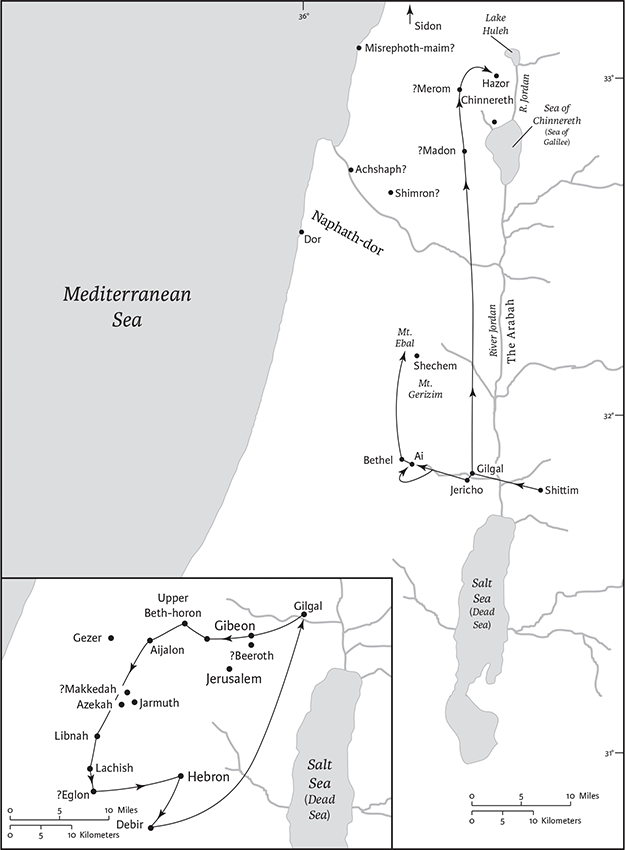
2 Then Joshua son of Nun sent two men secretly from Shittim as spies, saying, “Go, view the land, especially Jericho.” So they went, and entered the house of a prostitute whose name was Rahab, and spent the night there. 2The king of Jericho was told, “Some Israelites have come here tonight to search out the land.” 3Then the king of Jericho sent orders to Rahab, “Bring out the men who have come to you, who entered your house, for they have come only to search out the whole land.” 4But the woman took the two men and hid them. Then she said, “True, the men came to me, but I did not know where they came from. 5And when it was time to close the gate at dark, the men went out. Where the men went I do not know. Pursue them quickly, for you can overtake them.” 6She had, however, brought them up to the roof and hidden them with the stalks of flax that she had laid out on the roof. 7So the men pursued them on the way to the Jordan as far as the fords. As soon as the pursuers had gone out, the gate was shut.
8Before they went to sleep, she came up to them on the roof 9and said to the men: “I know that the Lord has given you the land, and that dread of you has fallen on us, and that all the inhabitants of the land melt in fear before you. 10For we have heard how the Lord dried up the water of the Red Seaa before you when you came out of Egypt, and what you did to the two kings of the Amorites that were beyond the Jordan, to Sihon and Og, whom you utterly destroyed. 11As soon as we heard it, our hearts melted, and there was no courage left in any of us because of you. The Lord your God is indeed God in heaven above and on earth below. 12Now then, since I have dealt kindly with you, swear to me by the Lord that you in turn will deal kindly with my family. Give me a sign of good faith 13that you will spare my father and mother, my brothers and sisters, and all who belong to them, and deliver our lives from death.” 14The men said to her, “Our life for yours! If you do not tell this business of ours, then we will deal kindly and faithfully with you when the Lord gives us the land.”
15Then she let them down by a rope through the window, for her house was on the outer side of the city wall and she resided within the wall itself. 16She said to them, “Go toward the hill country, so that the pursuers may not come upon you. Hide yourselves there three days, until the pursuers have returned; then afterward you may go your way.” 17The men said to her, “We will be released from this oath that you have made us swear to you 18if we invade the land and you do not tie this crimson cord in the window through which you let us down, and you do not gather into your house your father and mother, your brothers, and all your family. 19If any of you go out of the doors of your house into the street, they shall be responsible for their own death, and we shall be innocent; but if a hand is laid upon any who are with you in the house, we shall bear the responsibility for their death. 20But if you tell this business of ours, then we shall be released from this oath that you made us swear to you.” 21She said, “According to your words, so be it.” She sent them away and they departed. Then she tied the crimson cord in the window.
22They departed and went into the hill country and stayed there three days, until the pursuers returned. The pursuers had searched all along the way and found nothing. 23Then the two men came down again from the hill country. They crossed over, came to Joshua son of Nun, and told him all that had happened to them. 24They said to Joshua, “Truly the Lord has given all the land into our hands; moreover all the inhabitants of the land melt in fear before us.”
3 Early in the morning Joshua rose and set out from Shittim with all the Israelites, and they came to the Jordan. They camped there before crossing over. 2At the end of three days the officers went through the camp 3and commanded the people, “When you see the ark of the covenant of the Lord your God being carried by the levitical priests, then you shall set out from your place. Follow it, 4so that you may know the way you should go, for you have not passed this way before. Yet there shall be a space between you and it, a distance of about two thousand cubits; do not come any nearer to it.” 5Then Joshua said to the people, “Sanctify yourselves; for tomorrow the Lord will do wonders among you.” 6To the priests Joshua said, “Take up the ark of the covenant, and pass on in front of the people.” So they took up the ark of the covenant and went in front of the people.
7The Lord said to Joshua, “This day I will begin to exalt you in the sight of all Israel, so that they may know that I will be with you as I was with Moses. 8You are the one who shall command the priests who bear the ark of the covenant, ‘When you come to the edge of the waters of the Jordan, you shall stand still in the Jordan.’” 9Joshua then said to the Israelites, “Draw near and hear the words of the Lord your God.” 10Joshua said, “By this you shall know that among you is the living God who without fail will drive out from before you the Canaanites, Hittites, Hivites, Perizzites, Girgashites, Amorites, and Jebusites: 11the ark of the covenant of the Lord of all the earth is going to pass before you into the Jordan. 12So now select twelve men from the tribes of Israel, one from each tribe. 13When the soles of the feet of the priests who bear the ark of the Lord, the Lord of all the earth, rest in the waters of the Jordan, the waters of the Jordan flowing from above shall be cut off; they shall stand in a single heap.”
14When the people set out from their tents to cross over the Jordan, the priests bearing the ark of the covenant were in front of the people. 15Now the Jordan overflows all its banks throughout the time of harvest. So when those who bore the ark had come to the Jordan, and the feet of the priests bearing the ark were dipped in the edge of the water, 16the waters flowing from above stood still, rising up in a single heap far off at Adam, the city that is beside Zarethan, while those flowing toward the sea of the Arabah, the Dead Sea,a were wholly cut off. Then the people crossed over opposite Jericho. 17While all Israel were crossing over on dry ground, the priests who bore the ark of the covenant of the Lord stood on dry ground in the middle of the Jordan, until the entire nation finished crossing over the Jordan.
4 When the entire nation had finished crossing over the Jordan, the Lord said to Joshua: 2“Select twelve men from the people, one from each tribe, 3and command them, ‘Take twelve stones from here out of the middle of the Jordan, from the place where the priests’ feet stood, carry them over with you, and lay them down in the place where you camp tonight.’” 4Then Joshua summoned the twelve men from the Israelites, whom he had appointed, one from each tribe. 5Joshua said to them, “Pass on before the ark of the Lord your God into the middle of the Jordan, and each of you take up a stone on his shoulder, one for each of the tribes of the Israelites, 6so that this may be a sign among you. When your children ask in time to come, ‘What do those stones mean to you?’ 7then you shall tell them that the waters of the Jordan were cut off in front of the ark of the covenant of the Lord. When it crossed over the Jordan, the waters of the Jordan were cut off. So these stones shall be to the Israelites a memorial forever.”
8The Israelites did as Joshua commanded. They took up twelve stones out of the middle of the Jordan, according to the number of the tribes of the Israelites, as the Lord told Joshua, carried them over with them to the place where they camped, and laid them down there. 9(Joshua set up twelve stones in the middle of the Jordan, in the place where the feet of the priests bearing the ark of the covenant had stood; and they are there to this day.)
10The priests who bore the ark remained standing in the middle of the Jordan, until everything was finished that the Lord commanded Joshua to tell the people, according to all that Moses had commanded Joshua. The people crossed over in haste. 11As soon as all the people had finished crossing over, the ark of the Lord, and the priests, crossed over in front of the people. 12The Reubenites, the Gadites, and the half‐tribe of Manasseh crossed over armed before the Israelites, as Moses had ordered them. 13About forty thousand armed for war crossed over before the Lord to the plains of Jericho for battle.
14On that day the Lord exalted Joshua in the sight of all Israel; and they stood in awe of him, as they had stood in awe of Moses, all the days of his life.
15The Lord said to Joshua, 16“Command the priests who bear the ark of the covenant,a to come up out of the Jordan.” 17Joshua therefore commanded the priests, “Come up out of the Jordan.” 18When the priests bearing the ark of the covenant of the Lord came up from the middle of the Jordan, and the soles of the priests’ feet touched dry ground, the waters of the Jordan returned to their place and overflowed all its banks, as before.
19The people came up out of the Jordan on the tenth day of the first month, and they camped in Gilgal on the east border of Jericho. 20Those twelve stones, which they had taken out of the Jordan, Joshua set up in Gilgal, 21saying to the Israelites, “When your children ask their parents in time to come, ‘What do these stones mean?’ 22then you shall let your children know, ‘Israel crossed over the Jordan here on dry ground.’ 23For the Lord your God dried up the waters of the Jordan for you until you crossed over, as the Lord your God did to the Red Sea,b which he dried up for us until we crossed over, 24so that all the peoples of the earth may know that the hand of the Lord is mighty, and so that you may fear the Lord your God forever.”
5 When all the kings of the Amorites beyond the Jordan to the west, and all the kings of the Canaanites by the sea, heard that the Lord had dried up the waters of the Jordan for the Israelites until they had crossed over, their hearts melted, and there was no longer any spirit in them, because of the Israelites.
2At that time the Lord said to Joshua, “Make flint knives and circumcise the Israelites a second time.” 3So Joshua made flint knives, and circumcised the Israelites at Gibeath‐haaraloth.c 4This is the reason why Joshua circumcised them: all the males of the people who came out of Egypt, all the warriors, had died during the journey through the wilderness after they had come out of Egypt. 5Although all the people who came out had been circumcised, yet all the people born on the journey through the wilderness after they had come out of Egypt had not been circumcised. 6For the Israelites traveled forty years in the wilderness, until all the nation, the warriors who came out of Egypt, perished, not having listened to the voice of the Lord. To them the Lord swore that he would not let them see the land that he had sworn to their ancestors to give us, a land flowing with milk and honey. 7So it was their children, whom he raised up in their place, that Joshua circumcised; for they were uncircumcised, because they had not been circumcised on the way.
8When the circumcising of all the nation was done, they remained in their places in the camp until they were healed. 9The Lord said to Joshua, “Today I have rolled away from you the disgrace of Egypt.” And so that place is called Gilgala to this day.
10While the Israelites were camped in Gilgal they kept the passover in the evening on the fourteenth day of the month in the plains of Jericho. 11On the day after the passover, on that very day, they ate the produce of the land, unleavened cakes and parched grain. 12The manna ceased on the day they ate the produce of the land, and the Israelites no longer had manna; they ate the crops of the land of Canaan that year.
13Once when Joshua was by Jericho, he looked up and saw a man standing before him with a drawn sword in his hand. Joshua went to him and said to him, “Are you one of us, or one of our adversaries?” 14He replied, “Neither; but as commander of the army of the Lord I have now come.” And Joshua fell on his face to the earth and worshiped, and he said to him, “What do you command your servant, my lord?” 15The commander of the army of the Lord said to Joshua, “Remove the sandals from your feet, for the place where you stand is holy.” And Joshua did so.
6 Now Jericho was shut up inside and out because of the Israelites; no one came out and no one went in. 2The Lord said to Joshua, “See, I have handed Jericho over to you, along with its king and soldiers. 3You shall march around the city, all the warriors circling the city once. Thus you shall do for six days, 4with seven priests bearing seven trumpets of rams’ horns before the ark. On the seventh day you shall march around the city seven times, the priests blowing the trumpets. 5When they make a long blast with the ram’s horn, as soon as you hear the sound of the trumpet, then all the people shall shout with a great shout; and the wall of the city will fall down flat, and all the people shall charge straight ahead.” 6So Joshua son of Nun summoned the priests and said to them, “Take up the ark of the covenant, and have seven priests carry seven trumpets of rams’ horns in front of the ark of the Lord.” 7To the people he said, “Go forward and march around the city; have the armed men pass on before the ark of the Lord.”
8As Joshua had commanded the people, the seven priests carrying the seven trumpets of rams’ horns before the Lord went forward, blowing the trumpets, with the ark of the covenant of the Lord following them. 9And the armed men went before the priests who blew the trumpets; the rear guard came after the ark, while the trumpets blew continually. 10To the people Joshua gave this command: “You shall not shout or let your voice be heard, nor shall you utter a word, until the day I tell you to shout. Then you shall shout.” 11So the ark of the Lord went around the city, circling it once; and they came into the camp, and spent the night in the camp.
12Then Joshua rose early in the morning, and the priests took up the ark of the Lord. 13The seven priests carrying the seven trumpets of rams’ horns before the ark of the Lord passed on, blowing the trumpets continually. The armed men went before them, and the rear guard came after the ark of the Lord, while the trumpets blew continually. 14On the second day they marched around the city once and then returned to the camp. They did this for six days.
15On the seventh day they rose early, at dawn, and marched around the city in the same manner seven times. It was only on that day that they marched around the city seven times. 16And at the seventh time, when the priests had blown the trumpets, Joshua said to the people, “Shout! For the Lord has given you the city. 17The city and all that is in it shall be devoted to the Lord for destruction. Only Rahab the prostitute and all who are with her in her house shall live because she hid the messengers we sent. 18As for you, keep away from the things devoted to destruction, so as not to coveta and take any of the devoted things and make the camp of Israel an object for destruction, bringing trouble upon it. 19But all silver and gold, and vessels of bronze and iron, are sacred to the Lord; they shall go into the treasury of the Lord.” 20So the people shouted, and the trumpets were blown. As soon as the people heard the sound of the trumpets, they raised a great shout, and the wall fell down flat; so the people charged straight ahead into the city and captured it. 21Then they devoted to destruction by the edge of the sword all in the city, both men and women, young and old, oxen, sheep, and donkeys.
22Joshua said to the two men who had spied out the land, “Go into the prostitute’s house, and bring the woman out of it and all who belong to her, as you swore to her.” 23So the young men who had been spies went in and brought Rahab out, along with her father, her mother, her brothers, and all who belonged to her—they brought all her kindred out—and set them outside the camp of Israel. 24They burned down the city, and everything in it; only the silver and gold, and the vessels of bronze and iron, they put into the treasury of the house of the Lord. 25But Rahab the prostitute, with her family and all who belonged to her, Joshua spared. Her familyb has lived in Israel ever since. For she hid the messengers whom Joshua sent to spy out Jericho.
26Joshua then pronounced this oath, saying,
“Cursed before the Lord be anyone who tries
to build this city—this Jericho!
At the cost of his firstborn he shall lay its foundation,
and at the cost of his youngest he shall set up its gates!”
27So the Lord was with Joshua; and his fame was in all the land.
7 But the Israelites broke faith in regard to the devoted things: Achan son of Carmi son of Zabdi son of Zerah, of the tribe of Judah, took some of the devoted things; and the anger of the Lord burned against the Israelites.
2Joshua sent men from Jericho to Ai, which is near Beth‐aven, east of Bethel, and said to them, “Go up and spy out the land.” And the men went up and spied out Ai. 3Then they returned to Joshua and said to him, “Not all the people need go up; about two or three thousand men should go up and attack Ai. Since they are so few, do not make the whole people toil up there.” 4So about three thousand of the people went up there; and they fled before the men of Ai. 5The men of Ai killed about thirty‐six of them, chasing them from outside the gate as far as Shebarim and killing them on the slope. The hearts of the people melted and turned to water.
6Then Joshua tore his clothes, and fell to the ground on his face before the ark of the Lord until the evening, he and the elders of Israel; and they put dust on their heads. 7Joshua said, “Ah, Lord God! Why have you brought this people across the Jordan at all, to hand us over to the Amorites so as to destroy us? Would that we had been content to settle beyond the Jordan! 8O Lord, what can I say, now that Israel has turned their backs to their enemies! 9The Canaanites and all the inhabitants of the land will hear of it, and surround us, and cut off our name from the earth. Then what will you do for your great name?”
10The Lord said to Joshua, “Stand up! Why have you fallen upon your face? 11Israel has sinned; they have transgressed my covenant that I imposed on them. They have taken some of the devoted things; they have stolen, they have acted deceitfully, and they have put them among their own belongings. 12Therefore the Israelites are unable to stand before their enemies; they turn their backs to their enemies, because they have become a thing devoted for destruction themselves. I will be with you no more, unless you destroy the devoted things from among you. 13Proceed to sanctify the people, and say, ‘Sanctify yourselves for tomorrow; for thus says the Lord, the God of Israel, “There are devoted things among you, O Israel; you will be unable to stand before your enemies until you take away the devoted things from among you.” 14In the morning therefore you shall come forward tribe by tribe. The tribe that the Lord takes shall come near by clans, the clan that the Lord takes shall come near by households, and the household that the Lord takes shall come near one by one. 15And the one who is taken as having the devoted things shall be burned with fire, together with all that he has, for having transgressed the covenant of the Lord, and for having done an outrageous thing in Israel.’”
16So Joshua rose early in the morning, and brought Israel near tribe by tribe, and the tribe of Judah was taken. 17He brought near the clans of Judah, and the clan of the Zerahites was taken; and he brought near the clan of the Zerahites, family by family,a and Zabdi was taken. 18And he brought near his household one by one, and Achan son of Carmi son of Zabdi son of Zerah, of the tribe of Judah, was taken. 19Then Joshua said to Achan, “My son, give glory to the Lord God of Israel and make confession to him. Tell me now what you have done; do not hide it from me.” 20And Achan answered Joshua, “It is true; I am the one who sinned against the Lord God of Israel. This is what I did: 21when I saw among the spoil a beautiful mantle from Shinar, and two hundred shekels of silver, and a bar of gold weighing fifty shekels, then I coveted them and took them. They now lie hidden in the ground inside my tent, with the silver underneath.”
22So Joshua sent messengers, and they ran to the tent; and there it was, hidden in his tent with the silver underneath. 23They took them out of the tent and brought them to Joshua and all the Israelites; and they spread them out before the Lord. 24Then Joshua and all Israel with him took Achan son of Zerah, with the silver, the mantle, and the bar of gold, with his sons and daughters, with his oxen, donkeys, and sheep, and his tent and all that he had; and they brought them up to the Valley of Achor. 25Joshua said, “Why did you bring trouble on us? The Lord is bringing trouble on you today.” And all Israel stoned him to death; they burned them with fire, cast stones on them, 26and raised over him a great heap of stones that remains to this day. Then the Lord turned from his burning anger. Therefore that place to this day is called the Valley of Achor.b
8 Then the Lord said to Joshua, “Do not fear or be dismayed; take all the fighting men with you, and go up now to Ai. See, I have handed over to you the king of Ai with his people, his city, and his land. 2You shall do to Ai and its king as you did to Jericho and its king; only its spoil and its livestock you may take as booty for yourselves. Set an ambush against the city, behind it.”
3So Joshua and all the fighting men set out to go up against Ai. Joshua chose thirty thousand warriors and sent them out by night 4with the command, “You shall lie in ambush against the city, behind it; do not go very far from the city, but all of you stay alert. 5I and all the people who are with me will approach the city. When they come out against us, as before, we shall flee from them. 6They will come out after us until we have drawn them away from the city; for they will say, ‘They are fleeing from us, as before.’ While we flee from them, 7you shall rise up from the ambush and seize the city; for the Lord your God will give it into your hand. 8And when you have taken the city, you shall set the city on fire, doing as the Lord has ordered; see, I have commanded you.” 9So Joshua sent them out; and they went to the place of ambush, and lay between Bethel and Ai, to the west of Ai; but Joshua spent that night in the camp.a
10In the morning Joshua rose early and mustered the people, and went up, with the elders of Israel, before the people to Ai. 11All the fighting men who were with him went up, and drew near before the city, and camped on the north side of Ai, with a ravine between them and Ai. 12Taking about five thousand men, he set them in ambush between Bethel and Ai, to the west of the city. 13So they stationed the forces, the main encampment that was north of the city and its rear guard west of the city. But Joshua spent that night in the valley. 14When the king of Ai saw this, he and all his people, the inhabitants of the city, hurried out early in the morning to the meeting place facing the Arabah to meet Israel in battle; but he did not know that there was an ambush against him behind the city. 15And Joshua and all Israel made a pretense of being beaten before them, and fled in the direction of the wilderness. 16So all the people who were in the city were called together to pursue them, and as they pursued Joshua they were drawn away from the city. 17There was not a man left in Ai or Bethel who did not go out after Israel; they left the city open, and pursued Israel.
18Then the Lord said to Joshua, “Stretch out the sword that is in your hand toward Ai; for I will give it into your hand.” And Joshua stretched out the sword that was in his hand toward the city. 19As soon as he stretched out his hand, the troops in ambush rose quickly out of their place and rushed forward. They entered the city, took it, and at once set the city on fire. 20So when the men of Ai looked back, the smoke of the city was rising to the sky. They had no power to flee this way or that, for the people who fled to the wilderness turned back against the pursuers. 21When Joshua and all Israel saw that the ambush had taken the city and that the smoke of the city was rising, then they turned back and struck down the men of Ai. 22And the others came out from the city against them; so they were surrounded by Israelites, some on one side, and some on the other; and Israel struck them down until no one was left who survived or escaped. 23But the king of Ai was taken alive and brought to Joshua.
24When Israel had finished slaughtering all the inhabitants of Ai in the open wilderness where they pursued them, and when all of them to the very last had fallen by the edge of the sword, all Israel returned to Ai, and attacked it with the edge of the sword. 25The total of those who fell that day, both men and women, was twelve thousand—all the people of Ai. 26For Joshua did not draw back his hand, with which he stretched out the sword, until he had utterly destroyed all the inhabitants of Ai. 27Only the livestock and the spoil of that city Israel took as their booty, according to the word of the Lord that he had issued to Joshua. 28So Joshua burned Ai, and made it forever a heap of ruins, as it is to this day. 29And he hanged the king of Ai on a tree until evening; and at sunset Joshua commanded, and they took his body down from the tree, threw it down at the entrance of the gate of the city, and raised over it a great heap of stones, which stands there to this day.
30Then Joshua built on Mount Ebal an altar to the Lord, the God of Israel, 31just as Moses the servant of the Lord had commanded the Israelites, as it is written in the book of the law of Moses, “an altar of unhewna stones, on which no iron tool has been used”; and they offered on it burnt offerings to the Lord, and sacrificed offerings of well‐being. 32And there, in the presence of the Israelites, Joshuab wrote on the stones a copy of the law of Moses, which he had written. 33All Israel, alien as well as citizen, with their elders and officers and their judges, stood on opposite sides of the ark in front of the levitical priests who carried the ark of the covenant of the Lord, half of them in front of Mount Gerizim and half of them in front of Mount Ebal, as Moses the servant of the Lord had commanded at the first, that they should bless the people of Israel. 34And afterward he read all the words of the law, blessings and curses, according to all that is written in the book of the law. 35There was not a word of all that Moses commanded that Joshua did not read before all the assembly of Israel, and the women, and the little ones, and the aliens who resided among them.
9 Now when all the kings who were beyond the Jordan in the hill country and in the lowland all along the coast of the Great Sea toward Lebanon—the Hittites, the Amorites, the Canaanites, the Perizzites, the Hivites, and the Jebusites—heard of this, 2they gathered together with one accord to fight Joshua and Israel.
3But when the inhabitants of Gibeon heard what Joshua had done to Jericho and to Ai, 4they on their part acted with cunning: they went and prepared provisions,c and took worn‐out sacks for their donkeys, and wineskins, worn‐out and torn and mended, 5with worn‐out, patched sandals on their feet, and worn‐out clothes; and all their provisions were dry and moldy. 6They went to Joshua in the camp at Gilgal, and said to him and to the Israelites, “We have come from a far country; so now make a treaty with us.” 7But the Israelites said to the Hivites, “Perhaps you live among us; then how can we make a treaty with you?” 8They said to Joshua, “We are your servants.” And Joshua said to them, “Who are you? And where do you come from?” 9They said to him, “Your servants have come from a very far country, because of the name of the Lord your God; for we have heard a report of him, of all that he did in Egypt, 10and of all that he did to the two kings of the Amorites who were beyond the Jordan, King Sihon of Heshbon, and King Og of Bashan who lived in Ashtaroth. 11So our elders and all the inhabitants of our country said to us, ‘Take provisions in your hand for the journey; go to meet them, and say to them, “We are your servants; come now, make a treaty with us.”’ 12Here is our bread; it was still warm when we took it from our houses as our food for the journey, on the day we set out to come to you, but now, see, it is dry and moldy; 13these wineskins were new when we filled them, and see, they are burst; and these garments and sandals of ours are worn out from the very long journey.” 14So the leadersa partook of their provisions, and did not ask direction from the Lord. 15And Joshua made peace with them, guaranteeing their lives by a treaty; and the leaders of the congregation swore an oath to them.
16But when three days had passed after they had made a treaty with them, they heard that they were their neighbors and were living among them. 17So the Israelites set out and reached their cities on the third day. Now their cities were Gibeon, Chephirah, Beeroth, and Kiriath‐jearim. 18But the Israelites did not attack them, because the leaders of the congregation had sworn to them by the Lord, the God of Israel. Then all the congregation murmured against the leaders. 19But all the leaders said to all the congregation, “We have sworn to them by the Lord, the God of Israel, and now we must not touch them. 20This is what we will do to them: We will let them live, so that wrath may not come upon us, because of the oath that we swore to them.” 21The leaders said to them, “Let them live.” So they became hewers of wood and drawers of water for all the congregation, as the leaders had decided concerning them.
22Joshua summoned them, and said to them, “Why did you deceive us, saying, ‘We are very far from you,’ while in fact you are living among us? 23Now therefore you are cursed, and some of you shall always be slaves, hewers of wood and drawers of water for the house of my God.” 24They answered Joshua, “Because it was told to your servants for a certainty that the Lord your God had commanded his servant Moses to give you all the land, and to destroy all the inhabitants of the land before you; so we were in great fear for our lives because of you, and did this thing. 25And now we are in your hand: do as it seems good and right in your sight to do to us.” 26This is what he did for them: he saved them from the Israelites; and they did not kill them. 27But on that day Joshua made them hewers of wood and drawers of water for the congregation and for the altar of the Lord, to continue to this day, in the place that he should choose.
10 When King Adoni‐zedek of Jerusalem heard how Joshua had taken Ai, and had utterly destroyed it, doing to Ai and its king as he had done to Jericho and its king, and how the inhabitants of Gibeon had made peace with Israel and were among them, 2hea became greatly frightened, because Gibeon was a large city, like one of the royal cities, and was larger than Ai, and all its men were warriors. 3So King Adoni‐zedek of Jerusalem sent a message to King Hoham of Hebron, to King Piram of Jarmuth, to King Japhia of Lachish, and to King Debir of Eglon, saying, 4“Come up and help me, and let us attack Gibeon; for it has made peace with Joshua and with the Israelites.” 5Then the five kings of the Amorites—the king of Jerusalem, the king of Hebron, the king of Jarmuth, the king of Lachish, and the king of Eglon—gathered their forces, and went up with all their armies and camped against Gibeon, and made war against it.
6And the Gibeonites sent to Joshua at the camp in Gilgal, saying, “Do not abandon your servants; come up to us quickly, and save us, and help us; for all the kings of the Amorites who live in the hill country are gathered against us.” 7So Joshua went up from Gilgal, he and all the fighting force with him, all the mighty warriors. 8The Lord said to Joshua, “Do not fear them, for I have handed them over to you; not one of them shall stand before you.” 9So Joshua came upon them suddenly, having marched up all night from Gilgal. 10And the Lord threw them into a panic before Israel, who inflicted a great slaughter on them at Gibeon, chased them by the way of the ascent of Beth‐horon, and struck them down as far as Azekah and Makkedah. 11As they fled before Israel, while they were going down the slope of Bethhoron, the Lord threw down huge stones from heaven on them as far as Azekah, and they died; there were more who died because of the hailstones than the Israelites killed with the sword.
12On the day when the Lord gave the Amorites over to the Israelites, Joshua spoke to the Lord; and he said in the sight of Israel,
“Sun, stand still at Gibeon,
and Moon, in the valley of Aijalon.”
13And the sun stood still, and the moon stopped,
until the nation took vengeance on their enemies.
Is this not written in the Book of Jashar? The sun stopped in midheaven, and did not hurry to set for about a whole day. 14There has been no day like it before or since, when the Lord heeded a human voice; for the Lord fought for Israel.
15Then Joshua returned, and all Israel with him, to the camp at Gilgal.
16Meanwhile, these five kings fled and hid themselves in the cave at Makkedah. 17And it was told Joshua, “The five kings have been found, hidden in the cave at Makkedah.” 18Joshua said, “Roll large stones against the mouth of the cave, and set men by it to guard them; 19but do not stay there yourselves; pursue your enemies, and attack them from the rear. Do not let them enter their towns, for the Lord your God has given them into your hand.” 20When Joshua and the Israelites had finished inflicting a very great slaughter on them, until they were wiped out, and when the survivors had entered into the fortified towns, 21all the people returned safe to Joshua in the camp at Makkedah; no one dared to speaka against any of the Israelites.
22Then Joshua said, “Open the mouth of the cave, and bring those five kings out to me from the cave.” 23They did so, and brought the five kings out to him from the cave, the king of Jerusalem, the king of Hebron, the king of Jarmuth, the king of Lachish, and the king of Eglon. 24When they brought the kings out to Joshua, Joshua summoned all the Israelites, and said to the chiefs of the warriors who had gone with him, “Come near, put your feet on the necks of these kings.” Then they came near and put their feet on their necks. 25And Joshua said to them, “Do not be afraid or dismayed; be strong and courageous; for thus the Lord will do to all the enemies against whom you fight.” 26Afterward Joshua struck them down and put them to death, and he hung them on five trees. And they hung on the trees until evening. 27At sunset Joshua commanded, and they took them down from the trees and threw them into the cave where they had hidden themselves; they set large stones against the mouth of the cave, which remain to this very day.
28Joshua took Makkedah on that day, and struck it and its king with the edge of the sword; he utterly destroyed every person in it; he left no one remaining. And he did to the king of Makkedah as he had done to the king of Jericho.
29Then Joshua passed on from Makkedah, and all Israel with him, to Libnah, and fought against Libnah. 30The Lord gave it also and its king into the hand of Israel; and he struck it with the edge of the sword, and every person in it; he left no one remaining in it; and he did to its king as he had done to the king of Jericho.
31Next Joshua passed on from Libnah, and all Israel with him, to Lachish, and laid siege to it, and assaulted it. 32The Lord gave Lachish into the hand of Israel, and he took it on the second day, and struck it with the edge of the sword, and every person in it, as he had done to Libnah.
33Then King Horam of Gezer came up to help Lachish; and Joshua struck him and his people, leaving him no survivors.
34From Lachish Joshua passed on with all Israel to Eglon; and they laid siege to it, and assaulted it; 35and they took it that day, and struck it with the edge of the sword; and every person in it he utterly destroyed that day, as he had done to Lachish.
36Then Joshua went up with all Israel from Eglon to Hebron; they assaulted it, 37and took it, and struck it with the edge of the sword, and its king and its towns, and every person in it; he left no one remaining, just as he had done to Eglon, and utterly destroyed it with every person in it.
38Then Joshua, with all Israel, turned back to Debir and assaulted it, 39and he took it with its king and all its towns; they struck them with the edge of the sword, and utterly destroyed every person in it; he left no one remaining; just as he had done to Hebron, and, as he had done to Libnah and its king, so he did to Debir and its king.
40So Joshua defeated the whole land, the hill country and the Negeb and the lowland and the slopes, and all their kings; he left no one remaining, but utterly destroyed all that breathed, as the Lord God of Israel commanded. 41And Joshua defeated them from Kadesh‐barnea to Gaza, and all the country of Goshen, as far as Gibeon. 42Joshua took all these kings and their land at one time, because the Lord God of Israel fought for Israel. 43Then Joshua returned, and all Israel with him, to the camp at Gilgal.
11 When King Jabin of Hazor heard of this, he sent to King Jobab of Madon, to the king of Shimron, to the king of Achshaph, 2and to the kings who were in the northern hill country, and in the Arabah south of Chinneroth, and in the lowland, and in Naphothdor on the west, 3to the Canaanites in the east and the west, the Amorites, the Hittites, the Perizzites, and the Jebusites in the hill country, and the Hivites under Hermon in the land of Mizpah. 4They came out, with all their troops, a great army, in number like the sand on the seashore, with very many horses and chariots. 5All these kings joined their forces, and came and camped together at the waters of Merom, to fight with Israel.
6And the Lord said to Joshua, “Do not be afraid of them, for tomorrow at this time I will hand over all of them, slain, to Israel; you shall hamstring their horses, and burn their chariots with fire.” 7So Joshua came suddenly upon them with all his fighting force, by the waters of Merom, and fell upon them. 8And the Lord handed them over to Israel, who attacked them and chased them as far as Great Sidon and Misrephoth‐maim, and eastward as far as the valley of Mizpeh. They struck them down, until they had left no one remaining. 9And Joshua did to them as the Lord commanded him; he hamstrung their horses, and burned their chariots with fire.
10Joshua turned back at that time, and took Hazor, and struck its king down with the sword. Before that time Hazor was the head of all those kingdoms. 11And they put to the sword all who were in it, utterly destroying them; there was no one left who breathed, and he burned Hazor with fire. 12And all the towns of those kings, and all their kings, Joshua took, and struck them with the edge of the sword, utterly destroying them, as Moses the servant of the Lord had commanded. 13But Israel burned none of the towns that stood on mounds except Hazor, which Joshua did burn. 14All the spoil of these towns, and the livestock, the Israelites took for their booty; but all the people they struck down with the edge of the sword, until they had destroyed them, and they did not leave any who breathed. 15As the Lord had commanded his servant Moses, so Moses commanded Joshua, and so Joshua did; he left nothing undone of all that the Lord had commanded Moses.
16So Joshua took all that land: the hill country and all the Negeb and all the land of Goshen and the lowland and the Arabah and the hill country of Israel and its lowland, 17from Mount Halak, which rises toward Seir, as far as Baal‐gad in the valley of Lebanon below Mount Hermon. He took all their kings, struck them down, and put them to death. 18Joshua made war a long time with all those kings. 19There was not a town that made peace with the Israelites, except the Hivites, the inhabitants of Gibeon; all were taken in battle. 20For it was the Lord’s doing to harden their hearts so that they would come against Israel in battle, in order that they might be utterly destroyed, and might receive no mercy, but be exterminated, just as the Lord had commanded Moses.
21At that time Joshua came and wiped out the Anakim from the hill country, from Hebron, from Debir, from Anab, and from all the hill country of Judah, and from all the hill country of Israel; Joshua utterly destroyed them with their towns. 22None of the Anakim was left in the land of the Israelites; some remained only in Gaza, in Gath, and in Ashdod. 23So Joshua took the whole land, according to all that the Lord had spoken to Moses; and Joshua gave it for an inheritance to Israel according to their tribal allotments. And the land had rest from war.
12 Now these are the kings of the land, whom the Israelites defeated, whose land they occupied beyond the Jordan toward the east, from the Wadi Arnon to Mount Hermon, with all the Arabah eastward: 2King Sihon of the Amorites who lived at Heshbon, and ruled from Aroer, which is on the edge of the Wadi Arnon, and from the middle of the valley as far as the river Jabbok, the boundary of the Ammonites, that is, half of Gilead, 3and the Arabah to the Sea of Chinneroth eastward, and in the direction of Beth‐jeshimoth, to the sea of the Arabah, the Dead Sea,a southward to the foot of the slopes of Pisgah; 4and King Oga of Bashan, one of the last of the Rephaim, who lived at Ashtaroth and at Edrei 5and ruled over Mount Hermon and Salecah and all Bashan to the boundary of the Geshurites and the Maacathites, and over half of Gilead to the boundary of King Sihon of Heshbon. 6Moses, the servant of the Lord, and the Israelites defeated them; and Moses the servant of the Lord gave their land for a possession to the Reubenites and the Gadites and the half‐tribe of Manasseh.
7The following are the kings of the land whom Joshua and the Israelites defeated on the west side of the Jordan, from Baal‐gad in the valley of Lebanon to Mount Halak, that rises toward Seir (and Joshua gave their land to the tribes of Israel as a possession according to their allotments, 8in the hill country, in the lowland, in the Arabah, in the slopes, in the wilderness, and in the Negeb, the land of the Hittites, Amorites, Canaanites, Perizzites, Hivites, and Jebusites):
| 9the king of Jericho | one |
| the king of Ai, which is next to Bethel | one |
| 10the king of Jerusalem | one |
| the king of Hebron | one |
| 11the king of Jarmuth | one |
| the king of Lachish | one |
| 12the king of Eglon | one |
| the king of Gezer | one |
| 13the king of Debir | one |
| the king of Geder | one |
| 14the king of Hormah | one |
| the king of Arad | one |
| 15the king of Libnah | one |
| the king of Adullam | one |
| 16the king of Makkedah | one |
| the king of Bethel | one |
| 17the king of Tappuah | one |
| the king of Hepher | one |
| 18the king of Aphek | one |
| the king of Lasharon | one |
| 19the king of Madon | one |
| the king of Hazor | one |
| 20the king of Shimron‐meron | one |
| the king of Achshaph | one |
| 21the king of Taanach | one |
| the king of Megiddo | one |
| 22the king of Kedesh | one |
| the king of Jokneam in Carmel | one |
| 23the king of Dor in Naphath‐dor | one |
| the king of Goiim in Galilee,b | one |
| 24the king of Tirzah | one |
thirty‐one kings in all.
13 Now Joshua was old and advanced in years; and the Lord said to him, “You are old and advanced in years, and very much of the land still remains to be possessed. 2This is the land that still remains: all the regions of the Philistines, and all those of the Geshurites 3(from the Shihor, which is east of Egypt, northward to the boundary of Ekron, it is reckoned as Canaanite; there are five rulers of the Philistines, those of Gaza, Ashdod, Ashkelon, Gath, and Ekron), and those of the Avvim 4in the south; all the land of the Canaanites, and Mearah that belongs to the Sidonians, to Aphek, to the boundary of the Amorites, 5and the land of the Gebalites, and all Lebanon, toward the east, from Baal‐gad below Mount Hermon to Lebo‐hamath, 6all the inhabitants of the hill country from Lebanon to Misrephoth‐maim, even all the Sidonians. I will myself drive them out from before the Israelites; only allot the land to Israel for an inheritance, as I have commanded you. 7Now therefore divide this land for an inheritance to the nine tribes and the half‐tribe of Manasseh.”
8With the other half‐tribe of Manasseha the Reubenites and the Gadites received their inheritance, which Moses gave them, beyond the Jordan eastward, as Moses the servant of the Lord gave them: 9from Aroer, which is on the edge of the Wadi Arnon, and the town that is in the middle of the valley, and all the tableland fromb Medeba as far as Dibon; 10and all the cities of King Sihon of the Amorites, who reigned in Heshbon, as far as the boundary of the Ammonites; 11and Gilead, and the region of the Geshurites and Maacathites, and all Mount Hermon, and all Bashan to Salecah; 12all the kingdom of Og in Bashan, who reigned in Ashtaroth and in Edrei (he alone was left of the survivors of the Rephaim); these Moses had defeated and driven out. 13Yet the Israelites did not drive out the Geshurites or the Maacathites; but Geshur and Maacath live within Israel to this day.
14To the tribe of Levi alone Moses gave no inheritance; the offerings by fire to the Lord God of Israel are their inheritance, as he said to them.
15Moses gave an inheritance to the tribe of the Reubenites according to their clans. 16Their territory was from Aroer, which is on the edge of the Wadi Arnon, and the town that is in the middle of the valley, and all the tableland by Medeba; 17with Heshbon, and all its towns that are in the tableland; Dibon, and Bamoth‐baal, and Beth‐baal‐meon, 18and Jahaz, and Kedemoth, and Mephaath, 19and Kiriathaim, and Sibmah, and Zereth‐shahar on the hill of the valley, 20and Beth‐peor, and the slopes of Pisgah, and Beth‐jeshimoth, 21that is, all the towns of the tableland, and all the kingdom of King Sihon of the Amorites, who reigned in Heshbon, whom Moses defeated with the leaders of Midian, Evi and Rekem and Zur and Hur and Reba, as princes of Sihon, who lived in the land. 22Along with the rest of those they put to death, the Israelites also put to the sword Balaam son of Beor, who practiced divination. 23And the border of the Reubenites was the Jordan and its banks. This was the inheritance of the Reubenites according to their families with their towns and villages.
24Moses gave an inheritance also to the tribe of the Gadites, according to their families. 25Their territory was Jazer, and all the towns of Gilead, and half the land of the Ammonites, to Aroer, which is east of Rabbah, 26and from Heshbon to Ramath‐mizpeh and Betonim, and from Mahanaim to the territory of Debir,a 27and in the valley Beth‐haram, Beth‐nimrah, Succoth, and Zaphon, the rest of the kingdom of King Sihon of Heshbon, the Jordan and its banks, as far as the lower end of the Sea of Chinnereth, eastward beyond the Jordan. 28This is the inheritance of the Gadites according to their clans, with their towns and villages.
29Moses gave an inheritance to the halftribe of Manasseh; it was allotted to the halftribe of the Manassites according to their families. 30Their territory extended from Mahanaim, through all Bashan, the whole kingdom of King Og of Bashan, and all the settlements of Jair, which are in Bashan, sixty towns, 31and half of Gilead, and Ashtaroth, and Edrei, the towns of the kingdom of Og in Bashan; these were allotted to the people of Machir son of Manasseh according to their clans—for half the Machirites.
32These are the inheritances that Moses distributed in the plains of Moab, beyond the Jordan east of Jericho. 33But to the tribe of Levi Moses gave no inheritance; the Lord God of Israel is their inheritance, as he said to them.
14 These are the inheritances that the Israelites received in the land of Canaan, which the priest Eleazar, and Joshua son of Nun, and the heads of the families of the tribes of the Israelites distributed to them. 2Their inheritance was by lot, as the Lord had commanded Moses for the nine and one‐half tribes. 3For Moses had given an inheritance to the two and onehalf tribes beyond the Jordan; but to the Levites he gave no inheritance among them. 4For the people of Joseph were two tribes, Manasseh and Ephraim; and no portion was given to the Levites in the land, but only towns to live in, with their pasture lands for their flocks and herds. 5The Israelites did as the Lord commanded Moses; they allotted the land.
6Then the people of Judah came to Joshua at Gilgal; and Caleb son of Jephunneh the Kenizzite said to him, “You know what the Lord said to Moses the man of God in Kadesh‐barnea concerning you and me. 7I was forty years old when Moses the servant of the Lord sent me from Kadesh‐barnea to spy out the land; and I brought him an honest report. 8But my companions who went up with me made the heart of the people melt; yet I wholeheartedly followed the Lord my God. 9And Moses swore on that day, saying, ‘Surely the land on which your foot has trodden shall be an inheritance for you and your children forever, because you have wholeheartedly followed the Lord my God.’ 10And now, as you see, the Lord has kept me alive, as he said, these forty‐five years since the time that the Lord spoke this word to Moses, while Israel was journeying through the wilderness; and here I am today, eighty‐five years old. 11I am still as strong today as I was on the day that Moses sent me; my strength now is as my strength was then, for war, and for going and coming. 12So now give me this hill country of which the Lord spoke on that day; for you heard on that day how the Anakim were there, with great fortified cities; it may be that the Lord will be with me, and I shall drive them out, as the Lord said.”
13Then Joshua blessed him, and gave Hebron to Caleb son of Jephunneh for an inheritance. 14So Hebron became the inheritance of Caleb son of Jephunneh the Kenizzite to this day, because he wholeheartedly followed the Lord, the God of Israel. 15Now the name of Hebron formerly was Kiriath‐arba;a this Arba wasb the greatest man among the Anakim. And the land had rest from war.
15 The lot for the tribe of the people of Judah according to their families reached southward to the boundary of Edom, to the wilderness of Zin at the farthest south. 2And their south boundary ran from the end of the Dead Sea,c from the bay that faces southward; 3it goes out southward of the ascent of Akrabbim, passes along to Zin, and goes up south of Kadesh‐barnea, along by Hezron, up to Addar, makes a turn to Karka, 4passes along to Azmon, goes out by the Wadi of Egypt, and comes to its end at the sea. This shall be your south boundary. 5And the east boundary is the Dead Sea,c to the mouth of the Jordan. And the boundary on the north side runs from the bay of the sea at the mouth of the Jordan; 6and the boundary goes up to Beth‐hoglah, and passes along north of Beth‐arabah; and the boundary goes up to the Stone of Bohan, Reuben’s son; 7and the boundary goes up to Debir from the Valley of Achor, and so northward, turning toward Gilgal, which is opposite the ascent of Adummim, which is on the south side of the valley; and the boundary passes along to the waters of En‐shemesh, and ends at En‐rogel; 8then the boundary goes up by the valley of the son of Hinnom at the southern slope of the Jebusites (that is, Jerusalem); and the boundary goes up to the top of the mountain that lies over against the valley of Hinnom, on the west, at the northern end of the valley of Rephaim; 9then the boundary extends from the top of the mountain to the spring of the Waters of Nephtoah, and from there to the towns of Mount Ephron; then the boundary bends around to Baalah (that is, Kiriath‐jearim); 10and the boundary circles west of Baalah to Mount Seir, passes along to the northern slope of Mount Jearim (that is, Chesalon), and goes down to Beth‐shemesh, and passes along by Timnah; 11the boundary goes out to the slope of the hill north of Ekron, then the boundary bends around to Shikkeron, and passes along to Mount Baalah, and goes out to Jabneel; then the boundary comes to an end at the sea. 12And the west boundary was the Mediterranean with its coast. This is the boundary surrounding the people of Judah according to their families.
13According to the commandment of the Lord to Joshua, he gave to Caleb son of Jephunneh a portion among the people of Judah, Kiriath‐arba,a that is, Hebron (Arba was the father of Anak). 14And Caleb drove out from there the three sons of Anak: Sheshai, Ahiman, and Talmai, the descendants of Anak. 15From there he went up against the inhabitants of Debir; now the name of Debir formerly was Kiriath‐sepher. 16And Caleb said, “Whoever attacks Kiriath‐sepher and takes it, to him I will give my daughter Achsah as wife.” 17Othniel son of Kenaz, the brother of Caleb, took it; and he gave him his daughter Achsah as wife. 18When she came to him, she urged him to ask her father for a field. As she dismounted from her donkey, Caleb said to her, “What do you wish?” 19She said to him, “Give me a present; since you have set me in the land of the Negeb, give me springs of water as well.” So Caleb gave her the upper springs and the lower springs.
20This is the inheritance of the tribe of the people of Judah according to their families. 21The towns belonging to the tribe of the people of Judah in the extreme south, toward the boundary of Edom, were Kabzeel, Eder, Jagur, 22Kinah, Dimonah, Adadah, 23Kedesh, Hazor, Ithnan, 24Ziph, Telem, Bealoth, 25Hazor‐hadattah, Kerioth‐hezron (that is, Hazor), 26Amam, Shema, Moladah, 27Hazargaddah, Heshmon, Beth‐pelet, 28Hazar‐shual, Beer‐sheba, Biziothiah, 29Baalah, Iim, Ezem, 30Eltolad, Chesil, Hormah, 31Ziklag, Madmannah, Sansannah, 32Lebaoth, Shilhim, Ain, and Rimmon: in all, twenty‐nine towns, with their villages.
33And in the lowland, Eshtaol, Zorah, Ashnah, 34Zanoah, En‐gannim, Tappuah, Enam, 35Jarmuth, Adullam, Socoh, Azekah, 36Shaaraim, Adithaim, Gederah, Gederothaim: fourteen towns with their villages.
37Zenan, Hadashah, Migdal‐gad, 38Dilan, Mizpeh, Jokthe‐el, 39Lachish, Bozkath, Eglon, 40Cabbon, Lahmam, Chitlish, 41Gederoth, Beth‐dagon, Naamah, and Makkedah: sixteen towns with their villages.
42Libnah, Ether, Ashan, 43Iphtah, Ashnah, Nezib, 44Keilah, Achzib, and Mareshah: nine towns with their villages.
45Ekron, with its dependencies and its villages; 46from Ekron to the sea, all that were near Ashdod, with their villages.
47Ashdod, its towns and its villages; Gaza, its towns and its villages; to the Wadi of Egypt, and the Great Sea with its coast.
48And in the hill country, Shamir, Jattir, Socoh, 49Dannah, Kiriath‐sannah (that is, Debir), 50Anab, Eshtemoh, Anim, 51Goshen, Holon, and Giloh: eleven towns with their villages.
52Arab, Dumah, Eshan, 53Janim, Bethtappuah, Aphekah, 54Humtah, Kiriath‐arba (that is, Hebron), and Zior: nine towns with their villages.
55Maon, Carmel, Ziph, Juttah, 56Jezreel, Jokdeam, Zanoah, 57Kain, Gibeah, and Timnah: ten towns with their villages.
58Halhul, Beth‐zur, Gedor, 59Maarath, Beth‐anoth, and Eltekon: six towns with their villages.
60Kiriath‐baal (that is, Kiriath‐jearim) and Rabbah: two towns with their villages.
61In the wilderness, Beth‐arabah, Middin, Secacah, 62Nibshan, the City of Salt, and Engedi: six towns with their villages.
63But the people of Judah could not drive out the Jebusites, the inhabitants of Jerusalem; so the Jebusites live with the people of Judah in Jerusalem to this day.
16 The allotment of the Josephites went from the Jordan by Jericho, east of the waters of Jericho, into the wilderness, going up from Jericho into the hill country to Bethel; 2then going from Bethel to Luz, it passes along to Ataroth, the territory of the Archites; 3then it goes down westward to the territory of the Japhletites, as far as the territory of Lower Beth‐horon, then to Gezer, and it ends at the sea.
4The Josephites—Manasseh and Ephraim—received their inheritance.
5The territory of the Ephraimites by their families was as follows: the boundary of their inheritance on the east was Ataroth‐addar as far as Upper Beth‐horon, 6and the boundary goes from there to the sea; on the north is Michmethath; then on the east the boundary makes a turn toward Taanath‐shiloh, and passes along beyond it on the east to Janoah, 7then it goes down from Janoah to Ataroth and to Naarah, and touches Jericho, ending at the Jordan. 8From Tappuah the boundary goes westward to the Wadi Kanah, and ends at the sea. Such is the inheritance of the tribe of the Ephraimites by their families, 9together with the towns that were set apart for the Ephraimites within the inheritance of the Manassites, all those towns with their villages. 10They did not, however, drive out the Canaanites who lived in Gezer: so the Canaanites have lived within Ephraim to this day but have been made to do forced labor.
17 Then allotment was made to the tribe of Manasseh, for he was the firstborn of Joseph. To Machir the firstborn of Manasseh, the father of Gilead, were allotted Gilead and Bashan, because he was a warrior. 2And allotments were made to the rest of the tribe of Manasseh, by their families, Abiezer, Helek, Asriel, Shechem, Hepher, and Shemida; these were the male descendants of Manasseh son of Joseph, by their families.
3Now Zelophehad son of Hepher son of Gilead son of Machir son of Manasseh had no sons, but only daughters; and these are the names of his daughters: Mahlah, Noah, Hoglah, Milcah, and Tirzah. 4They came before the priest Eleazar and Joshua son of Nun and the leaders, and said, “The Lord commanded Moses to give us an inheritance along with our male kin.” So according to the commandment of the Lord he gave them an inheritance among the kinsmen of their father. 5Thus there fell to Manasseh ten portions, besides the land of Gilead and Bashan, which is on the other side of the Jordan, 6because the daughters of Manasseh received an inheritance along with his sons. The land of Gilead was allotted to the rest of the Manassites.
7The territory of Manasseh reached from Asher to Michmethath, which is east of Shechem; then the boundary goes along southward to the inhabitants of En‐tappuah. 8The land of Tappuah belonged to Manasseh, but the town of Tappuah on the boundary of Manasseh belonged to the Ephraimites. 9Then the boundary went down to the Wadi Kanah. The towns here, to the south of the wadi, among the towns of Manasseh, belong to Ephraim. Then the boundary of Manasseh goes along the north side of the wadi and ends at the sea. 10The land to the south is Ephraim’s and that to the north is Manasseh’s, with the sea forming its boundary; on the north Asher is reached, and on the east Issachar. 11Within Issachar and Asher, Manasseh had Beth‐shean and its villages, Ibleam and its villages, the inhabitants of Dor and its villages, the inhabitants of En‐dor and its villages, the inhabitants of Taanach and its villages, and the inhabitants of Megiddo and its villages (the third is Naphath).a 12Yet the Manassites could not take possession of those towns; but the Canaanites continued to live in that land. 13But when the Israelites grew strong, they put the Canaanites to forced labor, but did not utterly drive them out.
14The tribe of Joseph spoke to Joshua, saying, “Why have you given me but one lot and one portion as an inheritance, since we are a numerous people, whom all along the Lord has blessed?” 15And Joshua said to them, “If you are a numerous people, go up to the forest, and clear ground there for yourselves in the land of the Perizzites and the Rephaim, since the hill country of Ephraim is too narrow for you.” 16The tribe of Joseph said, “The hill country is not enough for us; yet all the Canaanites who live in the plain have chariots of iron, both those in Beth‐shean and its villages and those in the Valley of Jezreel.” 17Then Joshua said to the house of Joseph, to Ephraim and Manasseh, “You are indeed a numerous people, and have great power; you shall not have one lot only, 18but the hill country shall be yours, for though it is a forest, you shall clear it and possess it to its farthest borders; for you shall drive out the Canaanites, though they have chariots of iron, and though they are strong.”
18 Then the whole congregation of the Israelites assembled at Shiloh, and set up the tent of meeting there. The land lay subdued before them.
2There remained among the Israelites seven tribes whose inheritance had not yet been apportioned. 3So Joshua said to the Israelites, “How long will you be slack about going in and taking possession of the land that the Lord, the God of your ancestors, has given you? 4Provide three men from each tribe, and I will send them out that they may begin to go throughout the land, writing a description of it with a view to their inheritances. Then come back to me. 5They shall divide it into seven portions, Judah continuing in its territory on the south, and the house of Joseph in their territory on the north. 6You shall describe the land in seven divisions and bring the description here to me; and I will cast lots for you here before the Lord our God. 7The Levites have no portion among you, for the priesthood of the Lord is their heritage; and Gad and Reuben and the half‐tribe of Manasseh have received their inheritance beyond the Jordan eastward, which Moses the servant of the Lord gave them.”
8So the men started on their way; and Joshua charged those who went to write the description of the land, saying, “Go throughout the land and write a description of it, and come back to me; and I will cast lots for you here before the Lord in Shiloh.” 9So the men went and traversed the land and set down in a book a description of it by towns in seven divisions; then they came back to Joshua in the camp at Shiloh, 10and Joshua cast lots for them in Shiloh before the Lord; and there Joshua apportioned the land to the Israelites, to each a portion.
11The lot of the tribe of Benjamin according to its families came up, and the territory allotted to it fell between the tribe of Judah and the tribe of Joseph. 12On the north side their boundary began at the Jordan; then the boundary goes up to the slope of Jericho on the north, then up through the hill country westward; and it ends at the wilderness of Beth‐aven. 13From there the boundary passes along southward in the direction of Luz, to the slope of Luz (that is, Bethel), then the boundary goes down to Ataroth‐addar, on the mountain that lies south of Lower Beth‐horon. 14Then the boundary goes in another direction, turning on the western side southward from the mountain that lies to the south, opposite Beth‐horon, and it ends at Kiriath‐baal (that is, Kiriath‐jearim), a town belonging to the tribe of Judah. This forms the western side. 15The southern side begins at the outskirts of Kiriath‐jearim; and the boundary goes from there to Ephron,a to the spring of the Waters of Nephtoah; 16then the boundary goes down to the border of the mountain that overlooks the valley of the son of Hinnom, which is at the north end of the valley of Rephaim; and it then goes down the valley of Hinnom, south of the slope of the Jebusites, and downward to En‐rogel; 17then it bends in a northerly direction going on to En‐shemesh, and from there goes to Geliloth, which is opposite the ascent of Adummim; then it goes down to the Stone of Bohan, Reuben’s son; 18and passing on to the north of the slope of Beth‐arabahb it goes down to the Arabah; 19then the boundary passes on to the north of the slope of Beth‐hoglah; and the boundary ends at the northern bay of the Dead Sea,c at the south end of the Jordan: this is the southern border. 20The Jordan forms its boundary on the eastern side. This is the inheritance of the tribe of Benjamin, according to its families, boundary by boundary all around.
21Now the towns of the tribe of Benjamin according to their families were Jericho, Beth‐hoglah, Emek‐keziz, 22Beth‐arabah, Zemaraim, Bethel, 23Avvim, Parah, Ophrah, 24Chephar‐ammoni, Ophni, and Geba— twelve towns with their villages: 25Gibeon, Ramah, Beeroth, 26Mizpeh, Chephirah, Mozah, 27Rekem, Irpeel, Taralah, 28Zela, Haeleph, Jebusd (that is, Jerusalem), Gibeahe and Kiriath‐jearimf—fourteen towns with their villages. This is the inheritance of the tribe of Benjamin according to its families.
19 The second lot came out for Simeon, for the tribe of Simeon, according to its families; its inheritance lay within the inheritance of the tribe of Judah. 2It had for its inheritance Beer‐sheba, Sheba, Moladah, 3Hazar‐shual, Balah, Ezem, 4Eltolad, Bethul, Hormah, 5Ziklag, Beth‐marcaboth, Hazarsusah, 6Beth‐lebaoth, and Sharuhen—thirteen towns with their villages; 7Ain, Rimmon, Ether, and Ashan—four towns with their villages; 8together with all the villages all around these towns as far as Baalath‐beer, Ramah of the Negeb. This was the inheritance of the tribe of Simeon according to its families. 9The inheritance of the tribe of Simeon formed part of the territory of Judah; because the portion of the tribe of Judah was too large for them, the tribe of Simeon obtained an inheritance within their inheritance.
10The third lot came up for the tribe of Zebulun, according to its families. The boundary of its inheritance reached as far as Sarid; 11then its boundary goes up westward, and on to Maralah, and touches Dabbesheth, then the wadi that is east of Jokneam; 12from Sarid it goes in the other direction eastward toward the sunrise to the boundary of Chisloth‐tabor; from there it goes to Daberath, then up to Japhia; 13from there it passes along on the east toward the sunrise to Gath‐hepher, to Ethkazin, and going on to Rimmon it bends toward Neah; 14then on the north the boundary makes a turn to Hannathon, and it ends at the valley of Iphtah‐el; 15and Kattath, Nahalal, Shimron, Idalah, and Bethlehem— twelve towns with their villages. 16This is the inheritance of the tribe of Zebulun, according to its families—these towns with their villages.
17The fourth lot came out for Issachar, for the tribe of Issachar, according to its families. 18Its territory included Jezreel, Chesulloth, Shunem, 19Hapharaim, Shion, Anaharath, 20Rabbith, Kishion, Ebez, 21Remeth, Engannim, En‐haddah, Beth‐pazzez; 22the boundary also touches Tabor, Shahazumah, and Beth‐shemesh, and its boundary ends at the Jordan—sixteen towns with their villages. 23This is the inheritance of the tribe of Issachar, according to its families—the towns with their villages.
24The fifth lot came out for the tribe of Asher according to its families. 25Its boundary included Helkath, Hali, Beten, Achshaph, 26Allammelech, Amad, and Mishal; on the west it touches Carmel and Shihor‐libnath, 27then it turns eastward, goes to Beth‐dagon, and touches Zebulun and the valley of Iphtah‐el northward to Beth‐emek and Neiel; then it continues in the north to Cabul, 28Ebron, Rehob, Hammon, Kanah, as far as Great Sidon; 29then the boundary turns to Ramah, reaching to the fortified city of Tyre; then the boundary turns to Hosah, and it ends at the sea; Mahalab,a Achzib, 30Ummah, Aphek, and Rehob—twenty‐two towns with their villages. 31This is the inheritance of the tribe of Asher according to its families— these towns with their villages.
32The sixth lot came out for the tribe of Naphtali, for the tribe of Naphtali, according to its families. 33And its boundary ran from Heleph, from the oak in Zaanannim, and Adami‐nekeb, and Jabneel, as far as Lakkum; and it ended at the Jordan; 34then the boundary turns westward to Aznoth‐tabor, and goes from there to Hukkok, touching Zebulun at the south, and Asher on the west, and Judah on the east at the Jordan. 35The fortified towns are Ziddim, Zer, Hammath, Rakkath, Chinnereth, 36Adamah, Ramah, Hazor, 37Kedesh, Edrei, En‐hazor, 38Iron, Migdal‐el, Horem, Beth‐anath, and Bethshemesh—nineteen towns with their villages. 39This is the inheritance of the tribe of Naphtali according to its families—the towns with their villages.
40The seventh lot came out for the tribe of Dan, according to its families. 41The territory of its inheritance included Zorah, Eshtaol, Ir‐shemesh, 42Shaalabbin, Aijalon, Ithlah, 43Elon, Timnah, Ekron, 44Eltekeh, Gibbethon, Baalath, 45Jehud, Bene‐berak, Gath‐rimmon, 46Me‐jarkon, and Rakkon at the border opposite Joppa. 47When the territory of the Danites was lost to them, the Danites went up and fought against Leshem, and after capturing it and putting it to the sword, they took possession of it and settled in it, calling Leshem, Dan, after their ancestor Dan. 48This is the inheritance of the tribe of Dan, according to their families—these towns with their villages.
49When they had finished distributing the several territories of the land as inheritances, the Israelites gave an inheritance among them to Joshua son of Nun. 50By command of the Lord they gave him the town that he asked for, Timnath‐serah in the hill country of Ephraim; he rebuilt the town, and settled in it.
51These are the inheritances that the priest Eleazar and Joshua son of Nun and the heads of the families of the tribes of the Israelites distributed by lot at Shiloh before the Lord, at the entrance of the tent of meeting. So they finished dividing the land.
20 Then the Lord spoke to Joshua, saying, 2“Say to the Israelites, ‘Appoint the cities of refuge, of which I spoke to you through Moses, 3so that anyone who kills a person without intent or by mistake may flee there; they shall be for you a refuge from the avenger of blood. 4The slayer shall flee to one of these cities and shall stand at the entrance of the gate of the city, and explain the case to the elders of that city; then the fugitive shall be taken into the city, and given a place, and shall remain with them. 5And if the avenger of blood is in pursuit, they shall not give up the slayer, because the neighbor was killed by mistake, there having been no enmity between them before. 6The slayer shall remain in that city until there is a trial before the congregation, until the death of the one who is high priest at the time: then the slayer may return home, to the town in which the deed was done.’”
7So they set apart Kedesh in Galilee in the hill country of Naphtali, and Shechem in the hill country of Ephraim, and Kiriath‐arba (that is, Hebron) in the hill country of Judah. 8And beyond the Jordan east of Jericho, they appointed Bezer in the wilderness on the tableland, from the tribe of Reuben, and Ramoth in Gilead, from the tribe of Gad, and Golan in Bashan, from the tribe of Manasseh. 9These were the cities designated for all the Israelites, and for the aliens residing among them, that anyone who killed a person without intent could flee there, so as not to die by the hand of the avenger of blood, until there was a trial before the congregation.
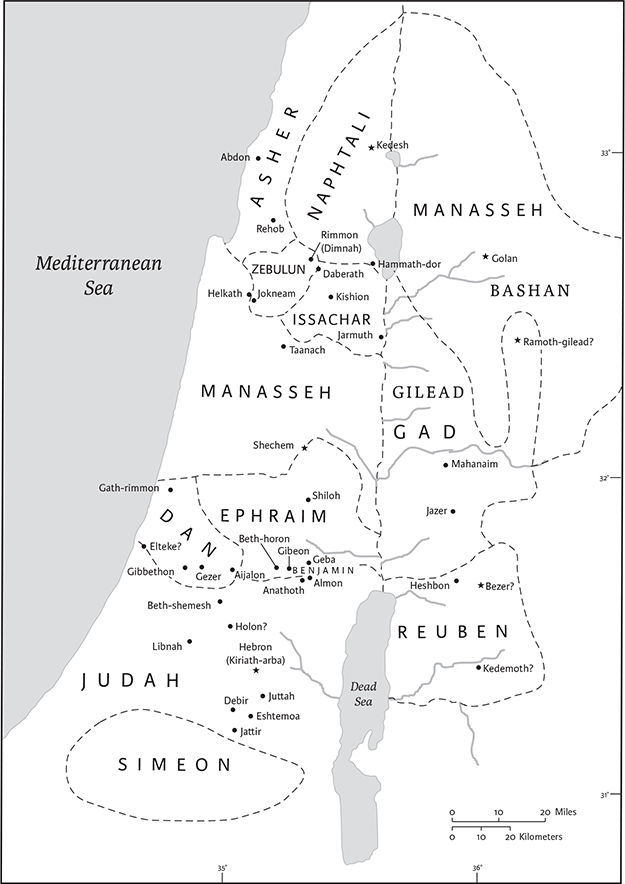
21 Then the heads of the families of the Levites came to the priest Eleazar and to Joshua son of Nun and to the heads of the families of the tribes of the Israelites; 2they said to them at Shiloh in the land of Canaan, “The Lord commanded through Moses that we be given towns to live in, along with their pasture lands for our livestock.” 3So by command of the Lord the Israelites gave to the Levites the following towns and pasture lands out of their inheritance.
4The lot came out for the families of the Kohathites. So those Levites who were descendants of Aaron the priest received by lot thirteen towns from the tribes of Judah, Simeon, and Benjamin.
5The rest of the Kohathites received by lot ten towns from the families of the tribe of Ephraim, from the tribe of Dan, and the halftribe of Manasseh.
6The Gershonites received by lot thirteen towns from the families of the tribe of Issachar, from the tribe of Asher, from the tribe of Naphtali, and from the half‐tribe of Manasseh in Bashan.
7The Merarites according to their families received twelve towns from the tribe of Reuben, the tribe of Gad, and the tribe of Zebulun.
8These towns and their pasture lands the Israelites gave by lot to the Levites, as the Lord had commanded through Moses.
9Out of the tribe of Judah and the tribe of Simeon they gave the following towns mentioned by name, 10which went to the descendants of Aaron, one of the families of the Kohathites who belonged to the Levites, since the lot fell to them first. 11They gave them Kiriath‐arba (Arba being the father of Anak), that is Hebron, in the hill country of Judah, along with the pasture lands around it. 12But the fields of the town and its villages had been given to Caleb son of Jephunneh as his holding.
13To the descendants of Aaron the priest they gave Hebron, the city of refuge for the slayer, with its pasture lands, Libnah with its pasture lands, 14Jattir with its pasture lands, Eshtemoa with its pasture lands, 15Holon with its pasture lands, Debir with its pasture lands, 16Ain with its pasture lands, Juttah with its pasture lands, and Beth‐shemesh with its pasture lands—nine towns out of these two tribes. 17Out of the tribe of Benjamin: Gibeon with its pasture lands, Geba with its pasture lands, 18Anathoth with its pasture lands, and Almon with its pasture lands— four towns. 19The towns of the descendants of Aaron—the priests—were thirteen in all, with their pasture lands.
20As to the rest of the Kohathites belonging to the Kohathite families of the Levites, the towns allotted to them were out of the tribe of Ephraim. 21To them were given Shechem, the city of refuge for the slayer, with its pasture lands in the hill country of Ephraim, Gezer with its pasture lands, 22Kibzaim with its pasture lands, and Bethhoron with its pasture lands—four towns. 23Out of the tribe of Dan: Elteke with its pasture lands, Gibbethon with its pasture lands, 24Aijalon with its pasture lands, Gathrimmon with its pasture lands—four towns. 25Out of the half‐tribe of Manasseh: Taanach with its pasture lands, and Gath‐rimmon with its pasture lands—two towns. 26The towns of the families of the rest of the Kohathites were ten in all, with their pasture lands.
27To the Gershonites, one of the families of the Levites, were given out of the half‐tribe of Manasseh, Golan in Bashan with its pasture lands, the city of refuge for the slayer, and Beeshterah with its pasture lands—two towns. 28Out of the tribe of Issachar: Kishion with its pasture lands, Daberath with its pasture lands, 29Jarmuth with its pasture lands, En‐gannim with its pasture lands—four towns. 30Out of the tribe of Asher: Mishal with its pasture lands, Abdon with its pasture lands, 31Helkath with its pasture lands, and Rehob with its pasture lands—four towns. 32Out of the tribe of Naphtali: Kedesh in Galilee with its pasture lands, the city of refuge for the slayer, Hammoth‐dor with its pasture lands, and Kartan with its pasture lands—three towns. 33The towns of the several families of the Gershonites were in all thirteen, with their pasture lands.
34To the rest of the Levites—the Merarite families—were given out of the tribe of Zebulun: Jokneam with its pasture lands, Kartah with its pasture lands, 35Dimnah with its pasture lands, Nahalal with its pasture lands—four towns. 36Out of the tribe of Reuben: Bezer with its pasture lands, Jahzah with its pasture lands, 37Kedemoth with its pasture lands, and Mephaath with its pasture lands—four towns. 38Out of the tribe of Gad: Ramoth in Gilead with its pasture lands, the city of refuge for the slayer, Mahanaim with its pasture lands, 39Heshbon with its pasture lands, Jazer with its pasture lands—four towns in all. 40As for the towns of the several Merarite families, that is, the remainder of the families of the Levites, those allotted to them were twelve in all.
41The towns of the Levites within the holdings of the Israelites were in all fortyeight towns with their pasture lands. 42Each of these towns had its pasture lands around it; so it was with all these towns.
43Thus the Lord gave to Israel all the land that he swore to their ancestors that he would give them; and having taken possession of it, they settled there. 44And the Lord gave them rest on every side just as he had sworn to their ancestors; not one of all their enemies had withstood them, for the Lord had given all their enemies into their hands. 45Not one of all the good promises that the Lord had made to the house of Israel had failed; all came to pass.
22 Then Joshua summoned the Reubenites, the Gadites, and the half‐tribe of Manasseh, 2and said to them, “You have observed all that Moses the servant of the Lord commanded you, and have obeyed me in all that I have commanded you; 3you have not forsaken your kindred these many days, down to this day, but have been careful to keep the charge of the Lord your God. 4And now the Lord your God has given rest to your kindred, as he promised them; therefore turn and go to your tents in the land where your possession lies, which Moses the servant of the Lord gave you on the other side of the Jordan. 5Take good care to observe the commandment and instruction that Moses the servant of the Lord commanded you, to love the Lord your God, to walk in all his ways, to keep his commandments, and to hold fast to him, and to serve him with all your heart and with all your soul.” 6So Joshua blessed them and sent them away, and they went to their tents.
7Now to the one half of the tribe of Manasseh Moses had given a possession in Bashan; but to the other half Joshua had given a possession beside their fellow Israelites in the land west of the Jordan. And when Joshua sent them away to their tents and blessed them, 8he said to them, “Go back to your tents with much wealth, and with very much livestock, with silver, gold, bronze, and iron, and with a great quantity of clothing; divide the spoil of your enemies with your kindred.” 9So the Reubenites and the Gadites and the half‐tribe of Manasseh returned home, parting from the Israelites at Shiloh, which is in the land of Canaan, to go to the land of Gilead, their own land of which they had taken possession by command of the Lord through Moses.
10When they came to the regiona near the Jordan that lies in the land of Canaan, the Reubenites and the Gadites and the half‐tribe of Manasseh built there an altar by the Jordan, an altar of great size. 11The Israelites heard that the Reubenites and the Gadites and the half‐tribe of Manasseh had built an altar at the frontier of the land of Canaan, in the regionb near the Jordan, on the side that belongs to the Israelites. 12And when the people of Israel heard of it, the whole assembly of the Israelites gathered at Shiloh, to make war against them.
13Then the Israelites sent the priest Phinehas son of Eleazar to the Reubenites and the Gadites and the half‐tribe of Manasseh, in the land of Gilead, 14and with him ten chiefs, one from each of the tribal families of Israel, every one of them the head of a family among the clans of Israel. 15They came to the Reubenites, the Gadites, and the half‐tribe of Manasseh, in the land of Gilead, and they said to them, 16“Thus says the whole congregation of the Lord, ‘What is this treachery that you have committed against the God of Israel in turning away today from following the Lord, by building yourselves an altar today in rebellion against the Lord? 17Have we not had enough of the sin at Peor from which even yet we have not cleansed ourselves, and for which a plague came upon the congregation of the Lord, 18that you must turn away today from following the Lord! If you rebel against the Lord today, he will be angry with the whole congregation of Israel tomorrow. 19But now, if your land is unclean, cross over into the Lord’s land where the Lord’s tabernacle now stands, and take for yourselves a possession among us; only do not rebel against the Lord, or rebel against usc by building yourselves an altar other than the altar of the Lord our God. 20Did not Achan son of Zerah break faith in the matter of the devoted things, and wrath fell upon all the congregation of Israel? And he did not perish alone for his iniquity!’”
21Then the Reubenites, the Gadites, and the half‐tribe of Manasseh said in answer to the heads of the families of Israel, 22“The Lord, God of gods! The Lord, God of gods! He knows; and let Israel itself know! If it was in rebellion or in breach of faith toward the Lord, do not spare us today 23for building an altar to turn away from following the Lord; or if we did so to offer burnt offerings or grain offerings or offerings of well‐being on it, may the Lord himself take vengeance. 24No! We did it from fear that in time to come your children might say to our children, ‘What have you to do with the Lord, the God of Israel? 25For the Lord has made the Jordan a boundary between us and you, you Reubenites and Gadites; you have no portion in the Lord.’ So your children might make our children cease to worship the Lord. 26Therefore we said, ‘Let us now build an altar, not for burnt offering, nor for sacrifice, 27but to be a witness between us and you, and between the generations after us, that we do perform the service of the Lord in his presence with our burnt offerings and sacrifices and offerings of well‐being; so that your children may never say to our children in time to come, “You have no portion in the Lord.”’ 28And we thought, If this should be said to us or to our descendants in time to come, we could say, ‘Look at this copy of the altar of the Lord, which our ancestors made, not for burnt offerings, nor for sacrifice, but to be a witness between us and you.’ 29Far be it from us that we should rebel against the Lord, and turn away this day from following the Lord by building an altar for burnt offering, grain offering, or sacrifice, other than the altar of the Lord our God that stands before his tabernacle!”
30When the priest Phinehas and the chiefs of the congregation, the heads of the families of Israel who were with him, heard the words that the Reubenites and the Gadites and the Manassites spoke, they were satisfied. 31The priest Phinehas son of Eleazar said to the Reubenites and the Gadites and the Manassites, “Today we know that the Lord is among us, because you have not committed this treachery against the Lord; now you have saved the Israelites from the hand of the Lord.”
32Then the priest Phinehas son of Eleazar and the chiefs returned from the Reubenites and the Gadites in the land of Gilead to the land of Canaan, to the Israelites, and brought back word to them. 33The report pleased the Israelites; and the Israelites blessed God and spoke no more of making war against them, to destroy the land where the Reubenites and the Gadites were settled. 34The Reubenites and the Gadites called the altar Witness;a “For,” said they, “it is a witness between us that the Lord is God.”
23 A long time afterward, when the Lord had given rest to Israel from all their enemies all around, and Joshua was old and well advanced in years, 2Joshua summoned all Israel, their elders and heads, their judges and officers, and said to them, “I am now old and well advanced in years; 3and you have seen all that the Lord your God has done to all these nations for your sake, for it is the Lord your God who has fought for you. 4I have allotted to you as an inheritance for your tribes those nations that remain, along with all the nations that I have already cut off, from the Jordan to the Great Sea in the west. 5The Lord your God will push them back before you, and drive them out of your sight; and you shall possess their land, as the Lord your God promised you. 6Therefore be very steadfast to observe and do all that is written in the book of the law of Moses, turning aside from it neither to the right nor to the left, 7so that you may not be mixed with these nations left here among you, or make mention of the names of their gods, or swear by them, or serve them, or bow yourselves down to them, 8but hold fast to the Lord your God, as you have done to this day. 9For the Lord has driven out before you great and strong nations; and as for you, no one has been able to withstand you to this day. 10One of you puts to flight a thousand, since it is the Lord your God who fights for you, as he promised you. 11Be very careful, therefore, to love the Lord your God. 12For if you turn back, and join the survivors of these nations left here among you, and intermarry with them, so that you marry their women and they yours, 13know assuredly that the Lord your God will not continue to drive out these nations before you; but they shall be a snare and a trap for you, a scourge on your sides, and thorns in your eyes, until you perish from this good land that the Lord your God has given you.
14“And now I am about to go the way of all the earth, and you know in your hearts and souls, all of you, that not one thing has failed of all the good things that the Lord your God promised concerning you; all have come to pass for you, not one of them has failed. 15But just as all the good things that the Lord your God promised concerning you have been fulfilled for you, so the Lord will bring upon you all the bad things, until he has destroyed you from this good land that the Lord your God has given you. 16If you transgress the covenant of the Lord your God, which he enjoined on you, and go and serve other gods and bow down to them, then the anger of the Lord will be kindled against you, and you shall perish quickly from the good land that he has given to you.”
24 Then Joshua gathered all the tribes of Israel to Shechem, and summoned the elders, the heads, the judges, and the officers of Israel; and they presented themselves before God. 2And Joshua said to all the people, “Thus says the Lord, the God of Israel: Long ago your ancestors—Terah and his sons Abraham and Nahor—lived beyond the Euphrates and served other gods. 3Then I took your father Abraham from beyond the River and led him through all the land of Canaan and made his offspring many. I gave him Isaac; 4and to Isaac I gave Jacob and Esau. I gave Esau the hill country of Seir to possess, but Jacob and his children went down to Egypt. 5Then I sent Moses and Aaron, and I plagued Egypt with what I did in its midst; and afterwards I brought you out. 6When I brought your ancestors out of Egypt, you came to the sea; and the Egyptians pursued your ancestors with chariots and horsemen to the Red Sea.a 7When they cried out to the Lord, he put darkness between you and the Egyptians, and made the sea come upon them and cover them; and your eyes saw what I did to Egypt. Afterwards you lived in the wilderness a long time. 8Then I brought you to the land of the Amorites, who lived on the other side of the Jordan; they fought with you, and I handed them over to you, and you took possession of their land, and I destroyed them before you. 9Then King Balak son of Zippor of Moab, set out to fight against Israel. He sent and invited Balaam son of Beor to curse you, 10but I would not listen to Balaam; therefore he blessed you; so I rescued you out of his hand. 11When you went over the Jordan and came to Jericho, the citizens of Jericho fought against you, and also the Amorites, the Perizzites, the Canaanites, the Hittites, the Girgashites, the Hivites, and the Jebusites; and I handed them over to you. 12I sent the hornetb ahead of you, which drove out before you the two kings of the Amorites; it was not by your sword or by your bow. 13I gave you a land on which you had not labored, and towns that you had not built, and you live in them; you eat the fruit of vineyards and oliveyards that you did not plant.
14“Now therefore revere the Lord, and serve him in sincerity and in faithfulness; put away the gods that your ancestors served beyond the River and in Egypt, and serve the Lord. 15Now if you are unwilling to serve the Lord, choose this day whom you will serve, whether the gods your ancestors served in the region beyond the River or the gods of the Amorites in whose land you are living; but as for me and my household, we will serve the Lord.”
16Then the people answered, “Far be it from us that we should forsake the Lord to serve other gods; 17for it is the Lord our God who brought us and our ancestors up from the land of Egypt, out of the house of slavery, and who did those great signs in our sight. He protected us along all the way that we went, and among all the peoples through whom we passed; 18and the Lord drove out before us all the peoples, the Amorites who lived in the land. Therefore we also will serve the Lord, for he is our God.”
19But Joshua said to the people, “You cannot serve the Lord, for he is a holy God. He is a jealous God; he will not forgive your transgressions or your sins. 20If you forsake the Lord and serve foreign gods, then he will turn and do you harm, and consume you, after having done you good.” 21And the people said to Joshua, “No, we will serve the Lord!” 22Then Joshua said to the people, “You are witnesses against yourselves that you have chosen the Lord, to serve him.” And they said, “We are witnesses.” 23He said, “Then put away the foreign gods that are among you, and incline your hearts to the Lord, the God of Israel.” 24The people said to Joshua, “The Lord our God we will serve, and him we will obey.” 25So Joshua made a covenant with the people that day, and made statutes and ordinances for them at Shechem. 26Joshua wrote these words in the book of the law of God; and he took a large stone, and set it up there under the oak in the sanctuary of the Lord. 27Joshua said to all the people, “See, this stone shall be a witness against us; for it has heard all the words of the Lord that he spoke to us; therefore it shall be a witness against you, if you deal falsely with your God.” 28So Joshua sent the people away to their inheritances.
29After these things Joshua son of Nun, the servant of the Lord, died, being one hundred ten years old. 30They buried him in his own inheritance at Timnath‐serah, which is in the hill country of Ephraim, north of Mount Gaash.
31Israel served the Lord all the days of Joshua, and all the days of the elders who outlived Joshua and had known all the work that the Lord did for Israel.
32The bones of Joseph, which the Israelites had brought up from Egypt, were buried at Shechem, in the portion of ground that Jacob had bought from the children of Hamor, the father of Shechem, for one hundred pieces of money;a it became an inheritance of the descendants of Joseph.
33Eleazar son of Aaron died; and they buried him at Gibeah, the town of his son Phinehas, which had been given him in the hill country of Ephraim.