Galatians

Name, Date, and Authorship

The letter is named for its recipients, multiple gatherings or “churches” of Galatia (1.2). Galatia was a region in north-central Asia Minor occupied by an originally Celtic people beginning in the third century bce. Under Roman rule Galatia was the name of a province that stretched farther south to the coast. No date of composition is indicated but the letter was probably written sometime between 50 and 58 ce. Scholars generally agree that Paul was the author. Its content, language, and style resemble sections of his later letter to the Romans.

Historical Context

Galatians paints the picture of a Christ-centered movement within Judaism. Key issues of belief, practice, and authority are subjects of dispute among its leaders. As in his other letters, Paul is a figure on the move, traveling from city to city and engaged with Gentile converts. Chapters 1–2 provide our earliest evidence about the leaders active in the years just after Jesus's death (30/33 ce) and before the catastrophic Judean rebellion against Rome (66–70 ce). Paul makes contentious claims about rivals and competitors, including Peter, those he refers to as “pillars in Jerusalem,” and a more vaguely defined faction that comes in for harsh rebuke. Disputed issues center on what it means to be a Jewish versus a Gentile follower of Christ. Though he represents himself as an iconoclast, Paul's arguments about how Gentiles should relate to traditional Jewish practices echo some strands of Jewish thought about the inclusion of Gentiles in the eschatological people of God.

Contents and Interpretation

The letter adapts standard Greco-Roman letter forms but is unusual in several respects. The opening and closing do not address particular persons, and Paul's tone is clipped and defensive from the outset. The body of the letter is marked by often harsh, antagonistic arguments about rival teachers and teachings. Major issues of dispute center on the place of Gentiles in the Jesus movement.

Galatians opens with a defense of Paul's own authority that includes an account of his own “call” to be an apostle to the Gentiles and of interactions with other leaders. Initial agreements about the gospel message and missionary activity had fallen apart. The core of the letter develops several charged, polemical arguments urging readers to side with Paul amid a flurry of competing claims. Thus, Galatians creates a picture of an embattled Paul, and his Galatian converts as misled by illegitimate teachings and teachers. The target audience is clearly made up of Gentiles, but Paul probably intends it to be overheard by the opposing teachers as well.

The issue of true and false teachings looms large from the outset. Paul portrays his own authority as having a divine rather than human source. Paul recalls his own dramatic reorientation as God called him to cease persecuting the early Jesus movement and to actively promote the gospel of Jesus Christ (1.16). This narrative emphasizes Paul's independence from the leaders in Jerusalem (1.16–17), though he visits them twice. Hints of division occur in their second meeting (2.1–10), followed by a dramatic confrontation with Peter in Antioch (2.14–15), over whether Jewish and Gentile Christ-followers should eat together. This conflict sets the stage for a series of reflections on the status of Gentiles, circumcision, the law, and the “pneuma” (“breath” or “spirit”) of Christ. These arguments are convoluted, but clearly Paul conceives of God's work in Christ as part of an apocalyptic plan for world history. Its culmination will involve the ingathering of at least some Gentiles, peoples who had been alienated from God and who some Jews considered morally depraved. Central to God's plan is an outpouring of the “pneuma” of Christ as the basis for a new way of life, one that ensures the vindication of the Gentile Christ-elect at the impending judgment.

Throughout the letter, Paul alternately rebukes and cajoles his “foolish Galatians” (3.1), but most of his ire is reserved for competing teachers. To explain the special status of Gentiles in God's plan for history, Paul offers arguments about the promises to Abraham, the status of the law, and the life of the “flesh” versus the new life of the “pneuma.” In some cases, the Jewish law is portrayed as a necessary precursor to the fulfillment of the promises to Abraham, which have only recently come to fruition with Christ. These promises are evidence that the Gentile peoples of the world will one day join the true people of God, a day that has dawned in Christ. In other cases, as with the allegory of Sarah and Hagar (4.21–31; see Gen 16; 21.1–21), Paul seems to suggest that the law has become an obstacle to becoming a true heir of Abraham through Christ. In still others, he suggests that the law is being fulfilled in some way by the Gentiles, at least by those who do his bidding (so 5.14; 6.2; Rom 8.1–4). The issue of whether Jewish followers of Christ should continue observing the law is never clearly addressed. But Paul insists that many of the law's provisions are not to be applied to Gentiles (5.2–3), especially circumcision. Paul's tone softens somewhat in chs 5 and 6, which call upon the Galatians to form a harmonious community bound by an ethic of mutuality, solidarity, and concern for others who share the “pneuma” of Christ.

Galatians has often been interpreted as a story of conflict between the new, free, and universal religion of Christianity and the confining, legalistic strictures of an exclusivistic Judaism, but this misrepresents both Judaism and Christianity. Scholars have shown that the characterization of Judaism as legalistic is misleading and that the early Christ-followers are not aptly characterized as belonging to a new religion, namely, Christianity. Careful reading also draws attention to the polemical, one-sided characterizations of persons, alleged factions, and groups in the highly charged rhetoric of this letter. Indeed, the claims about Gentile Christ-followers, assemblies, and rival teachers and teachings are best understood as identifications that Paul hopes to create in the minds of his audience, not straightforward depictions of social-historical realities.

Emma Wasserman

1

Paul an apostle—sent neither by human commission nor from human authorities, but through Jesus Christ and God the Father, who raised him from the dead—2and all the members of God's familya who are with me,

To the churches of Galatia:

3Grace to you and peace from God our Father and the Lord Jesus Christ, 4who gave himself for our sins to set us free from the present evil age, according to the will of our God and Father, 5to whom be the glory forever and ever. Amen.

6I am astonished that you are so quickly deserting the one who called you in the grace of Christ and are turning to a different gospel—7not that there is another gospel, but there are some who are confusing you and want to pervert the gospel of Christ. 8But even if we or an angela from heaven should proclaim to you a gospel contrary to what we proclaimed to you, let that one be accursed! 9As we have said before, so now I repeat, if anyone proclaims to you a gospel contrary to what you received, let that one be accursed!

10Am I now seeking human approval, or God's approval? Or am I trying to please people? If I were still pleasing people, I would not be a servantb of Christ.

11For I want you to know, brothers and sisters,c that the gospel that was proclaimed by me is not of human origin; 12for I did not receive it from a human source, nor was I taught it, but I received it through a revelation of Jesus Christ.

13You have heard, no doubt, of my earlier life in Judaism. I was violently persecuting the church of God and was trying to destroy it. 14I advanced in Judaism beyond many among my people of the same age, for I was far more zealous for the traditions of my ancestors. 15But when God, who had set me apart before I was born and called me through his grace, was pleased 16to reveal his Son to me,d so that I might proclaim him among the Gentiles, I did not confer with any human being, 17nor did I go up to Jerusalem to those who were already apostles before me, but I went away at once into Arabia, and afterwards I returned to Damascus.

18Then after three years I did go up to Jerusalem to visit Cephas and stayed with him fifteen days; 19but I did not see any other apostle except James the Lord's brother. 20In what I am writing to you, before God, I do not lie! 21Then I went into the regions of Syria and Cilicia, 22and I was still unknown by sight to the churches of Judea that are in Christ; 23they only heard it said, “The one who formerly was persecuting us is now proclaiming the faith he once tried to destroy.” 24And they glorified God because of me.

2

Then after fourteen years I went up again to Jerusalem with Barnabas, taking Titus along with me. 2I went up in response to a revelation. Then I laid before them (though only in a private meeting with the acknowledged leaders) the gospel that I proclaim among the Gentiles, in order to make sure that I was not running, or had not run, in vain. 3But even Titus, who was with me, was not compelled to be circumcised, though he was a Greek. 4But because of false believerse secretly brought in, who slipped in to spy on the freedom we have in Christ Jesus, so that they might enslave us—5we did not submit to them even for a moment, so that the truth of the gospel might always remain with you. 6And from those who were supposed to be acknowledged leaders (what they actually were makes no difference to me; God shows no partiality)—those leaders contributed nothing to me. 7On the contrary, when they saw that I had been entrusted with the gospel for the uncircumcised, just as Peter had been entrusted with the gospel for the circumcised 8(for he who worked through Peter making him an apostle to the circumcised also worked through me in sending me to the Gentiles), 9and when James and Cephas and John, who were acknowledged pillars, recognized the grace that had been given to me, they gave to Barnabas and me the right hand of fellowship, agreeing that we should go to the Gentiles and they to the circumcised. 10They asked only one thing, that we remember the poor, which was actually what I wasa eager to do.
image

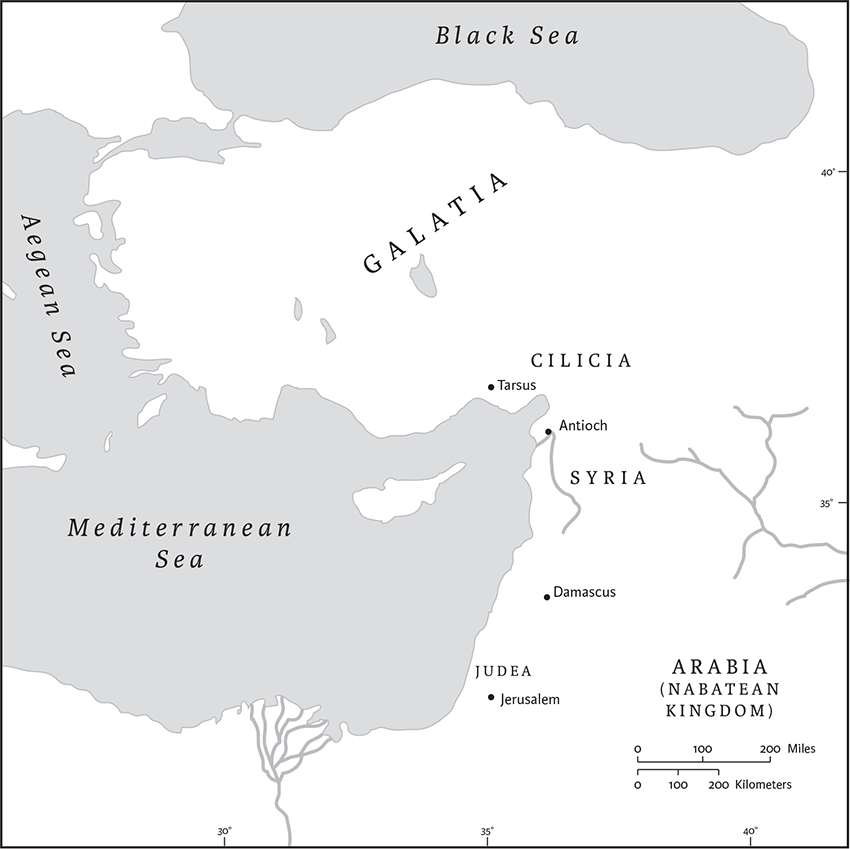
Places mentioned in Galatians 1–2

11But when Cephas came to Antioch, I opposed him to his face, because he stood self-condemned; 12for until certain people came from James, he used to eat with the Gentiles. But after they came, he drew back and kept himself separate for fear of the circumcision faction. 13And the other Jews joined him in this hypocrisy, so that even Barnabas was led astray by their hypocrisy. 14But when I saw that they were not acting consistently with the truth of the gospel, I said to Cephas before them all, “If you, though a Jew, live like a Gentile and not like a Jew, how can you compel the Gentiles to live like Jews?”b

15We ourselves are Jews by birth and not Gentile sinners; 16yet we know that a person is justifiedc not by the works of the law but through faith in Jesus Christ.d And we have come to believe in Christ Jesus, so that we might be justified by faith in Christ,e and not by doing the works of the law, because no one will be justified by the works of the law. 17But if, in our effort to be justified in Christ, we ourselves have been found to be sinners, is Christ then a servant of sin? Certainly not! 18But if I build up again the very things that I once tore down, then I demonstrate that I am a transgressor. 19For through the law I died to the law, so that I might live to God. I have been crucified with Christ; 20and it is no longer I who live, but it is Christ who lives in me. And the life I now live in the flesh I live by faith in the Son of God,a who loved me and gave himself for me. 21I do not nullify the grace of God; for if justificationb comes through the law, then Christ died for nothing.

3

You foolish Galatians! Who has bewitched you? It was before your eyes that Jesus Christ was publicly exhibited as crucified! 2The only thing I want to learn from you is this: Did you receive the Spirit by doing the works of the law or by believing what you heard? 3Are you so foolish? Having started with the Spirit, are you now ending with the flesh? 4Did you experience so much for nothing?—if it really was for nothing. 5Well then, does Godc supply you with the Spirit and work miracles among you by your doing the works of the law, or by your believing what you heard?

6Just as Abraham “believed God, and it was reckoned to him as righteousness,” 7so, you see, those who believe are the descendants of Abraham. 8And the scripture, foreseeing that God would justify the Gentiles by faith, declared the gospel beforehand to Abraham, saying, “All the Gentiles shall be blessed in you.” 9For this reason, those who believe are blessed with Abraham who believed.

10For all who rely on the works of the law are under a curse; for it is written, “Cursed is everyone who does not observe and obey all the things written in the book of the law.” 11Now it is evident that no one is justified before God by the law; for “The one who is righteous will live by faith.”d 12But the law does not rest on faith; on the contrary, “Whoever does the works of the lawe will live by them.” 13Christ redeemed us from the curse of the law by becoming a curse for us—for it is written, “Cursed is everyone who hangs on a tree”—14in order that in Christ Jesus the blessing of Abraham might come to the Gentiles, so that we might receive the promise of the Spirit through faith.

15Brothers and sisters,a I give an example from daily life: once a person's willb has been ratified, no one adds to it or annuls it. 16Now the promises were made to Abraham and to his offspring;c it does not say, “And to offsprings,”d as of many; but it says, “And to your offspring,”c that is, to one person, who is Christ. 17My point is this: the law, which came four hundred thirty years later, does not annul a covenant previously ratified by God, so as to nullify the promise. 18For if the inheritance comes from the law, it no longer comes from the promise; but God granted it to Abraham through the promise.

19Why then the law? It was added because of transgressions, until the offspringc would come to whom the promise had been made; and it was ordained through angels by a mediator. 20Now a mediator involves more than one party; but God is one.

21Is the law then opposed to the promises of God? Certainly not! For if a law had been given that could make alive, then righteousness would indeed come through the law. 22But the scripture has imprisoned all things under the power of sin, so that what was promised through faith in Jesus Christe might be given to those who believe.

23Now before faith came, we were imprisoned and guarded under the law until faith would be revealed. 24Therefore the law was our disciplinarian until Christ came, so that we might be justified by faith. 25But now that faith has come, we are no longer subject to a disciplinarian, 26for in Christ Jesus you are all children of God through faith. 27As many of you as were baptized into Christ have clothed yourselves with Christ. 28There is no longer Jew or Greek, there is no longer slave or free, there is no longer male and female; for all of you are one in Christ Jesus. 29And if you belong to Christ, then you are Abraham's offspring,a heirs according to the promise.

4

My point is this: heirs, as long as they are minors, are no better than slaves, though they are the owners of all the property; 2but they remain under guardians and trustees until the date set by the father. 3So with us; while we were minors, we were enslaved to the elemental spiritsb of the world. 4But when the fullness of time had come, God sent his Son, born of a woman, born under the law, 5in order to redeem those who were under the law, so that we might receive adoption as children. 6And because you are children, God has sent the Spirit of his Son into ourc hearts, crying, “Abba!d Father!” 7So you are no longer a slave but a child, and if a child then also an heir, through God.e

8Formerly, when you did not know God, you were enslaved to beings that by nature are not gods. 9Now, however, that you have come to know God, or rather to be known by God, how can you turn back again to the weak and beggarly elemental spirits?f How can you want to be enslaved to them again? 10You are observing special days, and months, and seasons, and years. 11I am afraid that my work for you may have been wasted.

12Friends,g I beg you, become as I am, for I also have become as you are. You have done me no wrong. 13You know that it was because of a physical infirmity that I first announced the gospel to you; 14though my condition put you to the test, you did not scorn or despise me, but welcomed me as an angel of God, as Christ Jesus. 15What has become of the goodwill you felt? For I testify that, had it been possible, you would have torn out your eyes and given them to me. 16Have I now become your enemy by telling you the truth? 17They make much of you, but for no good purpose; they want to exclude you, so that you may make much of them. 18It is good to be made much of for a good purpose at all times, and not only when I am present with you. 19My little children, for whom I am again in the pain of childbirth until Christ is formed in you, 20I wish I were present with you now and could change my tone, for I am perplexed about you.

21Tell me, you who desire to be subject to the law, will you not listen to the law? 22For it is written that Abraham had two sons, one by a slave woman and the other by a free woman. 23One, the child of the slave, was born according to the flesh; the other, the child of the free woman, was born through the promise. 24Now this is an allegory: these women are two covenants. One woman, in fact, is Hagar, from Mount Sinai, bearing children for slavery. 25Now Hagar is Mount Sinai in Arabiaa and corresponds to the present Jerusalem, for she is in slavery with her children. 26But the other woman corresponds to the Jerusalem above; she is free, and she is our mother. 27For it is written,

“Rejoice, you childless one, you who bear no children,

  burst into song and shout, you who endure no birth pangs;

for the children of the desolate woman are more numerous

  than the children of the one who is married.”

28Now you,b my friends,c are children of the promise, like Isaac. 29But just as at that time the child who was born according to the flesh persecuted the child who was born according to the Spirit, so it is now also. 30But what does the scripture say? “Drive out the slave and her child; for the child of the slave will not share the inheritance with the child of the free woman.” 31So then, friends,c we are children, not of the slave but of the free woman.

5

For freedom Christ has set us free. Stand firm, therefore, and do not submit again to a yoke of slavery.

2Listen! I, Paul, am telling you that if you let yourselves be circumcised, Christ will be of no benefit to you. 3Once again I testify to every man who lets himself be circumcised that he is obliged to obey the entire law. 4You who want to be justified by the law have cut yourselves off from Christ; you have fallen away from grace. 5For through the Spirit, by faith, we eagerly wait for the hope of righteousness. 6For in Christ Jesus neither circumcision nor uncircumcision counts for anything; the only thing that counts is faith workinga through love.

7You were running well; who prevented you from obeying the truth? 8Such persuasion does not come from the one who calls you. 9A little yeast leavens the whole batch of dough. 10I am confident about you in the Lord that you will not think otherwise. But whoever it is that is confusing you will pay the penalty. 11But my friends,b why am I still being persecuted if I am still preaching circumcision? In that case the offense of the cross has been removed. 12I wish those who unsettle you would castrate themselves!

13For you were called to freedom, brothers and sisters;b only do not use your freedom as an opportunity for selfindulgence,c but through love become slaves to one another. 14For the whole law is summed up in a single commandment, “You shall love your neighbor as yourself.” 15If, however, you bite and devour one another, take care that you are not consumed by one another.

16Live by the Spirit, I say, and do not gratify the desires of the flesh. 17For what the flesh desires is opposed to the Spirit, and what the Spirit desires is opposed to the flesh; for these are opposed to each other, to prevent you from doing what you want. 18But if you are led by the Spirit, you are not subject to the law. 19Now the works of the flesh are obvious: fornication, impurity, licentiousness, 20idolatry, sorcery, enmities, strife, jealousy, anger, quarrels, dissensions, factions, 21envy,a drunkenness, carousing, and things like these. I am warning you, as I warned you before: those who do such things will not inherit the kingdom of God.

22By contrast, the fruit of the Spirit is love, joy, peace, patience, kindness, generosity, faithfulness, 23gentleness, and self-control. There is no law against such things. 24And those who belong to Christ Jesus have crucified the flesh with its passions and desires. 25If we live by the Spirit, let us also be guided by the Spirit. 26Let us not become conceited, competing against one another, envying one another.

6

My friends,b if anyone is detected in a transgression, you who have received the Spirit should restore such a one in a spirit of gentleness. Take care that you yourselves are not tempted. 2Bear one another's burdens, and in this way you will fulfillc the law of Christ. 3For if those who are nothing think they are something, they deceive themselves. 4All must test their own work; then that work, rather than their neighbor's work, will become a cause for pride. 5For all must carry their own loads.

6Those who are taught the word must share in all good things with their teacher.

7Do not be deceived; God is not mocked, for you reap whatever you sow. 8If you sow to your own flesh, you will reap corruption from the flesh; but if you sow to the Spirit, you will reap eternal life from the Spirit. 9So let us not grow weary in doing what is right, for we will reap at harvest time, if we do not give up. 10So then, whenever we have an opportunity, let us work for the good of all, and especially for those of the family of faith.

11See what large letters I make when I am writing in my own hand! 12It is those who want to make a good showing in the flesh that try to compel you to be circumcised—only that they may not be persecuted for the cross of Christ. 13Even the circumcised do not themselves obey the law, but they want you to be circumcised so that they may boast about your flesh. 14May I never boast of anything except the cross of our Lord Jesus Christ, by whichd the world has been crucified to me, and I to the world. 15Fora neither circumcision nor uncircumcision is anything; but a new creation is everything! 16As for those who will follow this rule—peace be upon them, and mercy, and upon the Israel of God.

17From now on, let no one make trouble for me; for I carry the marks of Jesus branded on my body.

18May the grace of our Lord Jesus Christ be with your spirit, brothers and sisters.b Amen.

1.1–5: The greeting. 1: Apostle or “messenger,” lit., “one who is sent.” Only later does this become a formal designation for a specific group of Jesus's first disciples. 2: Churches of Galatia refers to “gatherings” or “assemblies” in the region. 3: A common greeting formula found also in Rom 1.7; 1 Cor 1.3; 2 Cor 1.2. 4: For our sins, Paul does not clearly construe Christ's death as an atoning sacrifice, as it later comes to be understood. The language here suggests that Christ is pivotal for establishing a new way of dealing with sin. The present evil age draws an antagonistic relationship with outsiders and alludes to the promise of a new age right on the horizon. Apocalyptic expectations about the imminent return of Christ and a time of judgment frame Paul's arguments here as in his other letters.
1.6–2.14: A recapitulation of Paul's life and ministry. The earliest and best historical source for the movement (or set of movements) that will later come to be known as “Christianity.” Unlike Acts, which presents a picture of harmony and agreement among the early leaders, Paul suggests relatively prickly meetings with others that sometimes became openly hostile.
1.6–9: Paul rebukes the Galatians. 6: Instead of the standard praise and thanksgiving to those addressed at the opening of the letter (cf. Rom 1.8–15; 1 Cor 1.4–9), Paul charges the Galatians with deserting the one who called you, that is, God (or God through Christ). Paul implies that they stand behind his teachings and guarantee their authenticity. A different gospel, the Galatians have accepted teachings that are not compatible with Paul's true and legitimate instruction. 8–9: Even if an angel from heaven revealed another teaching, that angelic gospel would still be false. The idea that lesser deities (or angels) might act as mediators of divine teachings also appears in 3.19 and was common in folk religions of Asia Minor.
1.10–12: Paul again defends his teachings as authoritative. Paul states that his teaching was directly revealed to him by Jesus Christ, implying that other teachings are of lesser value because they are of human origin.
1.13–24: Paul's call, early work among the Gentiles, and conflicts with others. 13–14: Cf. Phil 3.4–6. 15–16: Paul recounts a divine intervention that reorients his understanding of God's plan for history and his own place within it. Language such as set … born is similar to prophetic call-narratives; cf. Isa 49.1; Jer 1.5. To me (lit., “in me”), links the ideas that Christ is revealed to Paul with the gospel's proclamation to the Gentiles. 17: Arabia, most likely the Nabatean kingdom in Transjordan, whose capital was Petra. The geographic details establish Paul's distance from Jerusalem. 18: It is unclear whether the three years are to be counted from Paul's call or from his return to Damascus. Cephas, the Aramaic equivalent of “Peter” (Gk “Petros”; both names mean “rock”) and the form of the name used by Paul. 19: James, the brother of Jesus; see 1 Cor 15.7; Mk 6.3; Mt 13.55; Acts 13.55; 15.13; 21.18–19. 21: Syria, a district in the northeast corner of the Mediterranean; its capital Antioch was one of the largest and wealthiest in the Roman Empire. It was combined into a single province with the neighboring territory of Cilicia, on the southeast coast of Asia Minor. The capital of Cilicia was Tarsus, reportedly Paul's hometown (Acts 9.11). 22–24: Paul distances himself from the Judean communities despite claiming to be their equal as an apostle (cf. 1 Cor 15.8–11).
2.1–10: Paul meets with the Jerusalem leaders. The relationship of this visit with that described in Acts 15.1–29 is uncertain. 1–2: This second visit is instigated by divine revelation, again suggesting Paul's independence as an apostle. Whether the fourteen years are to be counted from his call or his first Jerusalem visit (1.18–19) is unclear. Two co-workers are named: Barnabas (also in 2.9) and Titus, an uncircumcised Gentile (see 2 Cor 2.13; 7.6,13,14; 8.6,16,23; 12.18). 3–5: Hinting at future conflicts, Paul charges that false believers surreptitiously disrupted the meeting by challenging his teachings. The remark about Titus's uncircumcision and the later conflict at Antioch (vv. 11–14) suggest that the status of Gentiles was a matter of dispute. 6–9: Paul seems to hedge on the authority of the Jerusalem leaders but portrays their interactions as conciliatory. Uncircumcised … circumcised, Gentiles and Jews (or Judeans). Paul asserts that the Jerusalem leaders agree with him in distinguishing between their outreach to the Jews and his to the Gentiles, thus supporting his decisions concerning Gentile believers. 10: The poor could allude to impoverished members of the movement. Josephus (Ant. 20.51) mentions a famine in 46/48 ce. It could also refer to some subgroup needing financial support. Paul elsewhere collects money to be sent to Jerusalem (Rom 15.25–29; 2 Cor 8.1–9.15); 1 Cor 16.1–3 mentions Galatia specifically.
2.11–14: Paul reports a confrontation with Peter at Antioch. The issue of table-fellowship raised questions about the status of Gentiles and Jews. Sharing, or not sharing, a meal typically indicated acceptance or nonacceptance. Jewish writers sometimes stereotyped Gentiles as immoral, especially sexually (see Rom 1.18–32; 1 Thess 4.5), emphasizing their alienation from the true God and their worship of idols or false gods. Many also maintain that, in spite of this alienation, the Gentiles will eventually join in worshiping the true God, though they do not agree on precisely when or how this might happen. Paul's statements throughout Galatians suggest disagreement on these points, particularly the issue of whether Gentiles should be circumcised or have a second-class status within the movement. 12: The people … from James, presumably messengers from the Jerusalem apostles who insist that Gentile Christ-followers have a lesser status. Paul will portray this division as a matter of keeping or not keeping “the law” (2.16), but it is unclear why he construes eating with Gentiles in this way. Some texts show a concern with violating dietary laws (Dan 1.8–16; Tob 1.10–13; Jdt 10.5; Letter of Aristeas 142), but there are no explicit prohibitions against eating with Gentiles in the extant literature. 14: Paul charges Peter with hypocritical behavior and here casts the issue as living “like Jews” instead of “like Gentiles.”
2.15–21: Jews and Gentiles are both justified through Christ. These verses fit within a larger set of arguments about the status of Gentiles and Jews in God's unfolding plan for human and cosmic history. Later interpreters see terms such as “works,” “law,” “justification,” and “faith” as signs pointing to major theological issues, but it remains unclear why Paul distinguishes between works of the law and justification by faith here. 15: Jews by birth, Paul identifies himself with Peter, insisting that they are Jewish by birth and that they agree on what God demands of both Jews and Gentiles in the new era that has dawned with Christ. Gentile sinners, see 2.11–14n. 16: By works Paul probably means Jewish practices that his rivals are insisting that Gentiles must observe. Whatever they are precisely, he deems them irrelevant to the larger issue of finding favor with God. Paul emphasizes Jesus's faithfulness and the radical transformation made possible by Christ's “pneuma.” Faith in Jesus Christ, better “the faithfulness of Jesus Christ.” This translation frames the issue in terms of the remarkable things that Christ has done (2.20; 3.22; Rom 3.22,26; Phil 3.9), not the convictions of individual believers. Christ's faithfulness alludes to Christ's trusting obedience to God, even to the point of death (1.4; Rom 5.18–19; Phil 2.8). 17: Paul suggests an ironic objection to his view. 18: Things that I once tore down (i.e., observance of the law) as the only path for Gentiles. 19: Through the law I died to the law, it is unclear how Paul understands the different roles played by “law” here, but he stresses a new, radical kind of transformation that reorients him around a singular good (see also Phil 3.7–11). Crucified with Christ, the death and resurrection of Christ serve as an analogy for Paul's own transformation (see also Phil 3.8); this is applied to Christ-followers in 5.24; 6.14; Rom 6.5–11; cf. 2 Cor 4.10–12. 20: Christ who lives in me, suggests a material transformation that Paul elsewhere connects with the “pneuma” (“Spirit”) of Christ; see 4.5–6; Rom 8.9–11; 1 Cor 2.13–16; 15.20–29,35–54; 2 Cor 1.22. Gave himself for me, see 1.4n.
3.1–5: Paul again addresses his Gentile audience. Paul asks the Galatians whether they received the gift of the “Spirit” (Gk “pneuma”; see 2.20n.) through following practices of the Jewish law, or through accepting the gospel proclaimed by Paul. 1: Jesus Christ was publicly exhibited as crucified, most likely a reference to Paul's graphic description of Jesus's crucifixion. 3: Ending with the flesh, an oblique reference to circumcision. Paul often opposes “pneuma” to “flesh” (e.g., 4.29; 5.16–25; 6.8; Rom 8.1–12; 3.1; 1 Cor 15.35–55; Phil 3.2–6). He typically associates the “pneuma” of Christ with heavenly, divine, and eternal things while the flesh is associated with mortal bodies and with passions and desires that cause immorality and vice (see especially 5.16–6.10; Rom 1.26,28; 7.5). 5: Miracles are associated with Paul's teaching activity and with the presence of the “pneuma” among his followers (Rom 15.19; 1 Cor 12.10; 2 Cor 12.12).
3.6–14: Abraham as a model of trusting obedience. Paul portrays Abraham's faithful obedience as a model for Gentiles. The promises to Abraham also link together God's plan for human history with the Gentile Christ-followers who can now inherit the promises. Abraham also appears as a model in Rom 4. 6: Paul appropriates Gen 15.6 here and in Rom 4.3. Those who share this trusting loyalty (believe) are now deemed children of Abraham. 8: The blessings promised to Abraham (Gen 12.3; 18.18; 22.18) are now realized among Paul's Gentiles 10: Paul's statements about the “curse” of the law draw on Deut 27.26. In Paul's time the general Jewish view was that perfect fulfillment of the law was not a requirement of belonging to God's covenant people, but observance of the law expressed faithfulness to God's covenant. It sounds strange for Paul to suggest that the law demands perfect obedience. 11–12: Quoting Hab 2.4 (as in Rom 1.17), Paul again makes faithful obedience and loyalty the key to divine reward. By contrast, the law appears ill-suited for this purpose. 13–14: Paul again draws connections between keeping the law and being under a curse, this time quoting Deut 21.23 to envision the crucifixion as a curse. Christ's death clears the way so that the promises to Abraham can be realized among the Gentiles. As elsewhere, Paul suggests that this new situation involves the gifts of Christ's “pneuma” (Spirit) and trusting loyalty (Gk “pistis,” faith).
3.15–18: The inheritance of Abraham. Paul insists that Christ is the singular heir of Abraham's promises and that these promises have priority over the law, which came centuries later (cf. Rom 5.13–14). 15: Will, the Gk means “covenant” as well as a person's document of bequest (see textual note b). 16: Offspring, lit., “seed” (see textual notes c and d). Paul uses the same Greek word as the Septuagint (LXX) text of Genesis where God makes promises to Abraham (Gen 12.7; 15.5; 17.8; 22.17). Paul contrasts the singular “seed” with the common (and in his view mistaken) interpretation of it as a plural, “seeds.” In Rom 4.16, by contrast, he interprets the “seed” as plural (NRSV “descendants”). 17–18: Paul distinguishes the promises from the giving of the law and connects the inheritance of the Gentiles with the former. His time frame of four hundred thirty years from Abraham to the giving of the law follows the LXX of Ex 12.40.
3.19–25: The purpose of the law of Moses. The law does not replace God's promise to Abraham but is a temporary means of discipline for God's people. 19: Added because of transgressions allows several interpretations: It can mean to make aware of sin (Rom 3.20; 7.7); it can also carry the sense of restraining transgressions (vv. 23–25); and it can also signify that the law provoked sin (Rom 5.20; 7.7–12). Ordained through angels some Jewish traditions claim that the Sinai law was delivered by divine mediators, not directly by God; see Deut 33.2 (LXX); Jub. 1.26–2.1; Josephus, Ant. 15.136; cf. Acts 7.38,53; Heb 2.2. A mediator, Moses (see Lev 26.46; Num 36.13). 20: An obscure verse that seems to play the mediator figure off against the idea of one, unique God; it perhaps implies that the new situation with Christ allows for more direct, unmediated access to God. 21–22: Paul raises the possible objection that the law is at odds with the promises (see 2.19–20; Rom 3.31), only to dismiss it. The promises which come through Christ are life-giving, perhaps alluding to the immortal destiny of the Christ-elect. 22: Imprisoned … under the power of sin, lit., “the scripture confined all things under sin.” This role of the law has negative connotations, but Paul construed this as a necessary prelude to the coming of Christ. Faith in Jesus Christ, better “faith of Jesus Christ” (see textual note e), emphasizes Jesus's faith or trusting loyalty as that basis for the promise; this promise of sonship accrues to the elect who believe, trust, and are loyal; see 2.16n. 24–25: The law is construed as a disciplinarian, necessary only during early phases of life. Disciplinarian, a slave who accompanied a boy to school and who often punished him for bad behavior.
3.26–29: Baptism into Christ. Through a ritual washing, the Christ-elect come to participate “in Christ” and are made into offspring of Abraham, thus fulfilling the promises. Paul may be recalling a formula used during baptism in vv. 26–28. 26: The Christ-elect become children of God and therefore coheirs with Christ (see also Rom 8.14–17). 27: This ritual produces a radical transformation (Rom 6.3–11). Clothed … with Christ, an analogy for the changed physical or social-psychological reality of the baptized; see also Rom 13.14. 28: Paul here insists that participation “in Christ” obviates common social classifications: Jew/Greek, slave/free, and male/female. It is unclear how this relates practically to social distinctions among the Christ-elect, whether in the present or in an imagined future. A similar erasure of social distinctions appears in 1 Cor 12.13 (cf. Col 3.9–11) without the phrase male and female that is taken from Gen 1.27. 29: Christ alone is Abraham's offspring or “seed” (see 3.16n.), but now Paul's elect can be united with him through ritual washing.
4.1–7: The elect become children of God through Christ. 1–2: Paul uses the analogy of a guardian (typically a slave) to explain the role of the law. During their earlier, immature phase God's elect had the law as a guardian until the appropriate time arrived for a transition of relationships. This analogy suggests that the earlier slave-like submission to the law was necessary and inevitable. 3: Elemental spirits of the world, lit., “elements (Gk “stoicheia”) of the cosmos.” “Stoicheia” can refer to the four elements (earth, water, air, and fire) as well as components or parts of some broader system or whole. Many scholars construe these as malevolent lesser beings (as suggested by the NRSV “elemental spirits”), but this is unlikely. Taking these “stoicheia” as parts of the cosmos that the Gentiles (mistakenly) worship fits with other polemics against idolatry (see v. 8; cf. Rom 1.23,25; Wis 13.3; Philo, Opif. 7; De spec. leg. 2.55). 4: Paul stresses Jesus's human birth and responsibility to the law, as if it connects to his mission to rescue others. 6–7: Abba, see textual note d; Rom 8.15. The Christ-elect receive the “pneuma” (Spirit) inside their bodies and are adopted as sons of God.
4.8–10: The Galatians risk returning to their former slave status. Paul construes keeping the law (at least in the ways his rivals would have them do) in this new, changed situation as equivalent to returning to their old ways, which involved enslavement and submission to weak and illegitimate gods. 9: Elemental spirits, see 4.3n. 10–11: Days, months, and seasons suggests that the Galatians may be observing Jewish or other festivals.
4.12–20: Paul reminds the Galatians of their close relationship. 12: Paul uses common friendship tropes to create a picture of warm, mutual relationships between himself and the Galatians. The language of imitation appears elsewhere in his letters (1 Thess 1.6; 1 Cor 4.16; 11.1; Phil 3.17) but without the emphasis on mutuality here (but see 1 Cor 9.21). 13–15: Paul may be alluding to earlier visits to Galatia. The precise nature of the infirmity is not known (see 6.17; 2 Cor 11.23–27; 12.7–10), but it exemplifies the care and self-sacrifice that formerly characterized their relationship. 16–17: Paul shifts to a tone of sharp rebuke, defends his own truth-telling, and launches another high-pitched attack on his alleged competitors and opponents. 17: They, i.e., Paul's rivals, are depicted as self-interested, insincere, and aiming to exclude Paul's Christ-elect in some way. 19: The birth imagery suggests that the Christ-elect of Galatia remain immature and unformed. Paul elsewhere uses parent/ child analogies to characterize his addressees as in need of his instruction (1 Cor 4.14; 2 Cor 6.13; 1 Thess 2.11).
4.21–5.1: The allegory of Hagar and Sarah. A polemically charged allegory that seems to cast non-Christfollowing Jews in a harshly negative light. 21: The law, construed here as the entire Pentateuch/Torah. 22–23: Summarizes key points of the story in Gen 16.1–4,15; 21.1–7. 24–26: Allegory, lit., “these things are spoken allegorically.” Paul is familiar with traditions of allegorical interpretation, which treat texts as having nonliteral meanings that can be known by those with special learning and skill. Here the women stand for two types of covenants and, upending the story told in Genesis, Hagar stands for the old covenant associated with Sinai and with Jerusalem, while Sarah represents the heavenly covenant and the true Jerusalem above. 25: Now Hagar is Mount Sinai in Arabia (see textual note a). Paul is unique in identifying Hagar directly with Mount Sinai, where the law was given to Israel. This negative identification probably targets Jews who are not part of the Christ-movement; Paul aims to associate his rivals with them in some way. 26: The Jerusalem above … our mother, images of a heavenly Jerusalem appear in some later texts, but Paul often imagines the heavens as the true home of his Christ-elect (1 Thess 4.15–17; 1 Cor 15.12–57; 2 Cor 4.16–5.5; Phil 3.14–21) 27: Paul uses language from Isa 54.1 to celebrate the Christ-elect as the true children of Sarah; see also Isa 51.2–3. 29–30: Gen 21.9–10 does not explicitly describe Ishmael persecuting Isaac; for Paul, however, this conflict becomes the basis for an attack on his rivals. 5:1 The allegory leads to exhortations about slavery versus freedom, flesh versus spirit (see 4.29).
5.2–12: Paul's case against circumcision. A Gentile who accepts circumcision is seeking righteousness in the wrong way. 2–5: Paul states unequivocally that circumcision will exclude Gentiles from the Christ-community and tie them to the demands of the law, which they cannot keep (see 2.16; 3.10–12). 6: Neither circumcision nor uncircumcision, seeming to contradict the position stated in vv. 2–5, circumcision now appears to be a matter of indifference, a point that is repeated again in 6.15 (see also 1 Cor 7.19). Among the elect, the main thing is “faith made effective through love” (see textual note a). This gives trusting obedience (Gk “pistis,” faith) a passive sense because it is instigated through love, presumably God's love. 7–8: The Galatians are deserting the true teachings of Paul. His rivals attempt to pervert the truth, which comes from The one who calls you, God through Christ. 9: Paul uses the same saying in 1 Cor 5.6. 10: Paul continues to drive a wedge between his Galatian followers and the rivals and competitors who actively seek to harm them. 11: If I am still preaching circumcision, raises a possible objection that Paul's teachings about circumcision have been inconsistent. It is unclear what role the offense of the cross plays in this subargument, but it suggests Paul's alienation and persecution by others (see 1 Cor 1.18–25). 12: Paul's polemic about his competitors comes to an apex of bitter sarcasm: his opponents should castrate themselves rather than seek to mutilate the genitals of others; see also Phil 3.2.
5.13–6.10: Ethics among the Christ-elect. In a shift of topic and tone, Paul presents a series of moral teachings that center on mutuality and solidarity.
5.13–26: The constraints on freedom among the elect. 13: Paul again uses freedom/slavery analogies. Self-indulgence, lit., “the flesh,” which Paul associates negatively with self-directed desires. The alternative is enslavement to one another for the sake of love; its opposite is strife and conflict (see v. 15). Love, mutuality, and solidarity are common ethical ideals in Stoic traditions, but Paul confines them to the elect here and in Phil 2.2–4; Rom 13.8–10; 14.7–23. 14: Returning to the law, Paul insists that the Christ-elect fulfill the law through this ethic of solidarity, here construed in terms of the command to love one's neighbor, quoting Lev 19.18 (also in Rom 13.8–10). 16–17: The life of the “pneuma” (Spirit) requires alienation from the desires of the flesh (v. 13n.; 3.3; Rom 8.1–17; cf. Rom 7.14–24), which are antithetical to the “pneuma.” Greek moral philosophy considered passions and desires the root cause of immorality. Platonic discussions of self-mastery associate these irrational (bad) desires with the flesh and body, as Paul does here; see also Rom 1.24,26; 6.12–13; 7.5; 13.13–14; 1 Cor 9.24–27. 18: Not subject to the law, although v. 14 suggests that they may fulfill it in some way. 19–23: Catalogues of vices and virtues were commonly used in Greco-Roman ethical instruction and were adapted by early Christian writers; see Rom 1.29–31; 1 Cor 6.9–10; 2 Cor 6.6–7; 12.20–21; in other early Christian literature, see Col 3.5–14; Mk 7.21–23; Mt 15.19; 1 Tim 1.9–10; 6.11; 2 Tim 3.2–5; 1 Pet 2.1; 4.3; 2 Pet 1.5–7; Rev 21.8; 22.15. Paul's virtue and vice lists are relatively conventional but he adds language about idolatry, the kingdom of God, the law, the “pneuma” (“Spirit”), and belonging to Christ. 24: The use of crucifixion as an analogy for controlling the passions is distinctive. Paul elsewhere uses death metaphors to convey domination and control (7.7–25), as does Philo (e.g., De spec. leg. 1.105–107; 2.78; Posterity 73).
6.1–10: Paul exhorts the Galatians about ethical conduct. 1: The stress is on mutuality and care for others who share the “pneuma” (Spirit) of Christ; see also Rom 15.1–7. 2: Here the Gentiles seem to fulfill the law in some way; see also 5.14; 1 Cor 9.21; Rom 8.2. 3–5: Paul again warns that self-directed behavior will lead to a bad outcome at the impending judgment. 6: Cf. 1 Cor 9.14. 7–9: Paul again warns about the ways of the flesh versus “pneuma” (Spirit), here emphasizing the possible reward of eternal life (see also Rom 8.5–8). 9: Not grow weary, see 2 Thess 3.13; in 2 Cor 4.1,16; Eph 3.13, the same verb is translated as “not lose heart.” 10: The family of faith, lit., “members of the household of faithfulness.”
6.11–18: Final warning about the dangers of rival teachers. A return to the polemical tone characteristic of the letter. 11: What large letters I make, Paul had dictated this letter to a secretary but writes the conclusion in his own hand; see 1 Cor 16.21; 2 Thess 3.17. 12–14: Paul paints an antagonistic picture of his rivals as boastful, as he does elsewhere (see Phil 3.2–4; Rom 2.17–24; 3.27; 4.2; 1 Cor 4.7; 2 Cor 11.12–13,18). He charges that their interest in circumcising the Gentiles stems from self-interested motives: to make a good showing in the flesh and to avoid persecution. They are also portrayed as hypocritical, as they do not obey the law themselves. Paul sums up his own teachings as boasting … in the cross; positive use of boasting language also appears in Rom 5.2–3,11; 1 Cor 1.29–31; 2.2 15: See 5.6. New creation, the new mode of being that is made possible by the “pneuma” (“Spirit”), given to those who are “in Christ”; cf. 2 Cor 5.17; Rom 8.19–23. 16–18: A two-part blessing. Verse 16 has the form of a traditional Jewish blessing and is conditional, bestowed on those who follow Paul's teaching; it is the counterpart to the curse in 1.8. The address brothers and sisters in v. 18 does not appear in the final blessing of Paul's other letters and expresses the hope that the former warm relationship between the apostle and the community will be restored. 16: This rule is the teaching that Paul has advocated throughout the letter. Israel of God, a phrase unique to this verse, equivalent to the “true Israel,” i.e., those who follow Paul's rule and not the teachings of his alleged rivals and opponents. 17: Marks of Jesus, perhaps the scars from injuries inflicted on Paul during his work as an apostle (2 Cor 6.4–5; 11.23–25). Paul may also be suggesting that his scars identify him as belonging to Christ like the brand marks on a slave. 18: Cf. Phil 4.23; Philem 25.
a Gk all the brothers
a Or a messenger
b Gk slave
c Gk brothers
d Gk in me
e Gk false brothers
a Or had been
b Some interpreters hold that the quotation extends into the following paragraph
c Or reckoned as righteous; and so elsewhere
d Or the faith of Jesus Christ
e Or the faith of Christ
a Or by the faith of the Son of God
b Or righteousness
c Gk he
d Or The one who is righteous through faith will live
e Gk does them
a Gk Brothers
b Or covenant (as in verse 17)
c Gk seed
d Gk seeds
e Or through the faith of Jesus Christ
a Gk seed
b Or the rudiments
c Other ancient authorities read your
d Aramaic for Father
e Other ancient authorities read an heir of God through Christ
f Or beggarly rudiments
g Gk Brothers
a Other ancient authorities read For Sinai is a mountain in Arabia
b Other ancient authorities read we
c Gk brothers
a Or made effective
b Gk brothers
c Gk the flesh
a Other ancient authorities add murder
b Gk Brothers
c Other ancient authorities read in this way fulfill
d Or through whom
a Other ancient authorities add in Christ Jesus
b Gk brothers