2 Maccabees
Title
The title Maccabees derives from Heb “maqqabi,” “hammer” (cf. Isa 44.12), the nickname given to Judas Maccabeus, the leader of the Jewish revolt that the story narrates. The original Greek title was “Book Recounting the Matters Pertaining to Maccabeus.” The titles of the two main manuscripts of this work specifically refer to “the deeds of Judas Maccabeus” (terming it, respectively, an “epistle” or an “epitome” about those deeds). This title is especially appropriate for this work, in contrast to 1 Maccabees, which develops the history of several subsequent members of the Hasmonean dynasty after Judas.
Canonical Status
Second Maccabees is part of the Roman Catholic and Eastern Orthodox canons and the Protestant Apocrypha, but has no sacred status in Judaism. The text survived as part of the Septuagint (LXX), the Greek version of the Hebrew scriptures.
Date, Authorship, and Literary History
In the introduction, the author tells us that the work is an abridgment of a longer work, now lost, written by Jason of Cyrene. Jason, who is otherwise unknown, probably wrote in the mid-second century bce, within a decade or so of the last events described in the work. The present abridgment was produced not long thereafter, around the same time as 1 Maccabees. Whereas 1 Maccabees was originally composed in Hebrew, 2 Maccabees was composed in Greek.
Structure and Contents
The body of the work (chs 4–15) deals with Judean history from King Antiochus IV Epiphanes's ascent to the Seleucid throne in 175 bce to Judas Maccabeus's victory over the Seleucid general Nicanor in 161 bce. It is prefaced (chs 1–2) by letters from Jerusalem urging the Jews of Egypt to celebrate the festival of Hanukkah, which commemorates Judas's purification and rededication of the Temple of Jerusalem in 164 bce; by the abridger's introduction (2.19–32); and by a story (ch 3) about the way the Temple was miraculously preserved from desecration in the days of Antiochus's predecessor, an episode that in its present context serves as something of an idyllic prologue to the book's main story.
Chapter 4 begins that story with the introduction of Hellenized institutions into Jerusalem, which, according to the author, engendered sinful neglect of Jewish laws. God, in response, disregarded (5.17) Jerusalem, i.e., suspended his providential care for it and thus allowed terrible things to happen, culminating in Antiochus's decrees against Judaism. These decrees then led to the noble martyrdom of those who refused to obey (chs 6–7).
Beginning in ch 8, however, God's anger changes to mercy (8.5; the pivotal verse of the book), and things dramatically improve: Judas Maccabeus wins battle after battle, Antiochus dies a terrible death (ch 9), Judas retakes Jerusalem and restores proper worship in the Temple (ch 10), and further victories bring about the repeal of Antiochus's decrees against Judaism (ch 11). More campaigns follow (chs 12–15) until the Seleucid army, commanded by Nicanor, is finally and decisively defeated. The book ends with the establishment of a holiday, “Nicanor's Day,” to commemorate that event.
Accordingly, the main part of the book has two parts, in each of which, in the tradition of biblical dual causality, history and theology coincide. Chapters 4–7 present the problem: sin leads to persecution and Antiochus has the upper hand, while chs 8–15 present the solution: atonement makes for “reconciliation” (5.20; 7.33; 8.29) between the Jews and God, and Judas wins victory after victory until the circle is completed. The narrative opens in 3.1 with “the city” being once upon a time in ideal circumstances, and closes with the announcement in 15.37 that “the city” was restored to (other) ideal circumstances and so remained happily ever after.
Interpretation
The book is a fascinating blend of Hellenism and Judaism. It was composed in the literary Greek of its day, comparable to that of the second-century bce Greek historian Polybius, and has numerous allusions to Greek literature. For example, the author compares Antiochus's arrogance to that of the Persian king Xerxes (5.21; 9.8), portrays his heroes as complete Hellenistic gentlemen (4.37; 15.12,30), depicts his central martyr (6.18–31) as a Jewish Socrates, and, throughout the story, focuses upon Jerusalem as the Jews’ polis, portraying Antiochus as a “barbarian” who tried to change the city's “constitution” and forbid Jews to “act as citizens” (6.1) according to Jewish law. But it is also a very Jewish book; its basic interpretative model is the Song of Moses (Deut 32), according to which God providentially cares for the Jews but hides his face (disregards them) when they sin, thus allowing foreigners to persecute them until the shedding of “his servants’” blood works atonement, whereupon God steps in, revenges himself upon their enemies, and restores his providential care for them. The author supplies several substantial excurses (4.16–17; 5.17–20; 6.12–17), as well as various shorter remarks (e.g., 8.5; 9.13) to make sure readers understand his interpretation of events.
In addition to providing a parallel witness to the events reported in 1 Macc 1–7, this work (apart from the two introductory epistles) also bears witness to Judaism in the Hellenistic Diaspora. While the opening epistles have much in common with 1 Maccabees, the body of the book aligns more easily with such Diaspora works as 3 Maccabees, the Letter of Aristeas, and the writings of Philo. This affinity is especially evident in the book's rosy picture of the Jews’ usual relations with Gentiles (e.g., 4.35–36,49; contrast 1 Macc 5.1–2; 12.53), its assumption that Gentile rulers are usually benevolent (3.1–3; 5.16; contrast 1 Macc 1.9), its relative lack of interest in the Temple rituals (contrast 5.16 with the detail in 1 Macc 1.21–22 and note 2 Maccabees’ emphasis upon God's residence in heaven in 3.39; 14.35), its high esteem for martyrs (see 6.11n.), and its insistence upon the priority of the people rather than the place (5.19; see also 5.6n).
Daniel R. Schwartz
1
The Jews in Jerusalem and those in the land of Judea,
To their Jewish kindred in Egypt,
Greetings and true peace.
2May God do good to you, and may he remember his covenant with Abraham and Isaac and Jacob, his faithful servants. 3May he give you all a heart to worship him and to do his will with a strong heart and a willing spirit. 4May he open your heart to his law and his commandments, and may he bring peace. 5May he hear your prayers and be reconciled to you, and may he not forsake you in time of evil. 6We are now praying for you here.
7In the reign of Demetrius, in the one hundred sixty-ninth year,a we Jews wrote to you, in the critical distress that came upon us in those years after Jason and his company revolted from the holy land and the kingdom 8and burned the gate and shed innocent blood. We prayed to the Lord and were heard, and we offered sacrifice and grain offering, and we lit the lamps and set out the loaves. 9And now see that you keep the festival of booths in the month of Chislev, in the one hundred eighty-eighth year.b
10The people of Jerusalem and of Judea and the senate and Judas,
To Aristobulus, who is of the family of the anointed priests, teacher of King Ptolemy, and to the Jews in Egypt,
Greetings and good health.
11Having been saved by God out of grave dangers we thank him greatly for taking our side against the king,a 12for he drove out those who fought against the holy city. 13When the leader reached Persia with a force that seemed irresistible, they were cut to pieces in the temple of Nanea by a deception employed by the priests of the goddessb Nanea. 14On the pretext of intending to marry her, Antiochus came to the place together with his Friends, to secure most of its treasures as a dowry. 15When the priests of the temple of Nanea had set out the treasures and Antiochus had come with a few men inside the wall of the sacred precinct, they closed the temple as soon as he entered it. 16Opening a secret door in the ceiling, they threw stones and struck down the leader and his men; they dismembered them and cut off their heads and threw them to the people outside. 17Blessed in every way be our God, who has brought judgment on those who have behaved impiously.
18Since on the twenty-fifth day of Chislev we shall celebrate the purification of the temple, we thought it necessary to notify you, in order that you also may celebrate the festival of booths and the festival of the fire given when Nehemiah, who built the temple and the altar, offered sacrifices.
19For when our ancestors were being led captive to Persia, the pious priests of that time took some of the fire of the altar and secretly hid it in the hollow of a dry cistern, where they took such precautions that the place was unknown to anyone. 20But after many years had passed, when it pleased God, Nehemiah, having been commissioned by the king of Persia, sent the descendants of the priests who had hidden the fire to get it. And when they reported to us that they had not found fire but only a thick liquid, he ordered them to dip it out and bring it. 21When the materials for the sacrifices were presented, Nehemiah ordered the priests to sprinkle the liquid on the wood and on the things laid upon it. 22When this had been done and some time had passed, and when the sun, which had been clouded over, shone out, a great fire blazed up, so that all marveled. 23And while the sacrifice was being consumed, the priests offered prayer—the priests and everyone. Jonathan led, and the rest responded, as did Nehemiah. 24The prayer was to this effect:
“O Lord, Lord God, Creator of all things, you are awe-inspiring and strong and just and merciful, you alone are king and are kind, 25you alone are bountiful, you alone are just and almighty and eternal. You rescue Israel from every evil; you chose the ancestors and consecrated them. 26Accept this sacrifice on behalf of all your people Israel and preserve your portion and make it holy. 27Gather together our scattered people, set free those who are slaves among the Gentiles, look on those who are rejected and despised, and let the Gentiles know that you are our God. 28Punish those who oppress and are insolent with pride. 29Plant your people in your holy place, as Moses promised.”
30Then the priests sang the hymns. 31After the materials of the sacrifice had been consumed, Nehemiah ordered that the liquid that was left should be poured on large stones. 32When this was done, a flame blazed up; but when the light from the altar shone back, it went out. 33When this matter became known, and it was reported to the king of the Persians that, in the place where the exiled priests had hidden the fire, the liquid had appeared with which Nehemiah and his associates had burned the materials of the sacrifice, 34the king investigated the matter, and enclosed the place and made it sacred. 35And with those persons whom the king favored he exchanged many excellent gifts. 36Nehemiah and his associates called this “nephthar,” which means purification, but by most people it is called naphtha.a
2
One finds in the records that the prophet Jeremiah ordered those who were being deported to take some of the fire, as has been mentioned, 2and that the prophet, after giving them the law, instructed those who were being deported not to forget the commandments of the Lord, or to be led astray in their thoughts on seeing the gold and silver statues and their adornment. 3And with other similar words he exhorted them that the law should not depart from their hearts.
4It was also in the same document that the prophet, having received an oracle, ordered that the tent and the ark should follow with him, and that he went out to the mountain where Moses had gone up and had seen the inheritance of God. 5Jeremiah came and found a cave-dwelling, and he brought there the tent and the ark and the altar of incense; then he sealed up the entrance. 6Some of those who followed him came up intending to mark the way, but could not find it. 7When Jeremiah learned of it, he rebuked them and declared: “The place shall remain unknown until God gathers his people together again and shows his mercy. 8Then the Lord will disclose these things, and the glory of the Lord and the cloud will appear, as they were shown in the case of Moses, and as Solomon asked that the place should be specially consecrated.”
9It was also made clear that being possessed of wisdom Solomona offered sacrifice for the dedication and completion of the temple. 10Just as Moses prayed to the Lord, and fire came down from heaven and consumed the sacrifices, so also Solomon prayed, and the fire came down and consumed the whole burnt offerings. 11And Moses said, “They were consumed because the sin offering had not been eaten.” 12Likewise Solomon also kept the eight days.
13The same things are reported in the records and in the memoirs of Nehemiah, and also that he founded a library and collected the books about the kings and prophets, and the writings of David, and letters of kings about votive offerings. 14In the same way Judas also collected all the books that had been lost on account of the war that had come upon us, and they are in our possession. 15So if you have need of them, send people to get them for you.
16Since, therefore, we are about to celebrate the purification, we write to you. Will you therefore please keep the days? 17It is God who has saved all his people, and has returned the inheritance to all, and the kingship and the priesthood and the consecration, 18as he promised through the law. We have hope in God that he will soon have mercy on us and will gather us from everywhere under heaven into his holy place, for he has rescued us from great evils and has purified the place.
19The story of Judas Maccabeus and his brothers, and the purification of the great temple, and the dedication of the altar, 20and further the wars against Antiochus Epiphanes and his son Eupator, 21and the appearances that came from heaven to those who fought bravely for Judaism, so that though few in number they seized the whole land and pursued the barbarian hordes, 22and regained possession of the temple famous throughout the world, and liberated the city, and re-established the laws that were about to be abolished, while the Lord with great kindness became gracious to them—23all this, which has been set forth by Jason of Cyrene in five volumes, we shall attempt to condense into a single book. 24For considering the flood of statistics involved and the difficulty there is for those who wish to enter upon the narratives of history because of the mass of material, 25we have aimed to please those who wish to read, to make it easy for those who are inclined to memorize, and to profit all readers. 26For us who have undertaken the toil of abbreviating, it is no light matter but calls for sweat and loss of sleep, 27just as it is not easy for one who prepares a banquet and seeks the benefit of others. Nevertheless, to secure the gratitude of many we will gladly endure the uncomfortable toil, 28leaving the responsibility for exact details to the compiler, while devoting our effort to arriving at the outlines of the condensation. 29For as the master builder of a new house must be concerned with the whole construction, while the one who undertakes its painting and decoration has to consider only what is suitable for its adornment, such in my judgment is the case with us. 30It is the duty of the original historian to occupy the ground, to discuss matters from every side, and to take trouble with details, 31but the one who recasts the narrative should be allowed to strive for brevity of expression and to forego exhaustive treatment. 32At this point therefore let us begin our narrative, without adding any more to what has already been said; for it would be foolish to lengthen the preface while cutting short the history itself.
3
While the holy city was inhabited in unbroken peace and the laws were strictly observed because of the piety of the high priest Onias and his hatred of wickedness, 2it came about that the kings themselves honored the place and glorified the temple with the finest presents, 3even to the extent that King Seleucus of Asia defrayed from his own revenues all the expenses connected with the service of the sacrifices.
4But a man named Simon, of the tribe of Benjamin, who had been made captain of the temple, had a disagreement with the high priest about the administration of the city market. 5Since he could not prevail over Onias, he went to Apollonius of Tarsus,a who at that time was governor of Coelesyria and Phoenicia, 6and reported to him that the treasury in Jerusalem was full of untold sums of money, so that the amount of the funds could not be reckoned, and that they did not belong to the account of the sacrifices, but that it was possible for them to fall under the control of the king. 7When Apollonius met the king, he told him of the money about which he had been informed. The kingb chose Heliodorus, who was in charge of his affairs, and sent him with commands to effect the removal of the reported wealth. 8Heliodorus at once set out on his journey, ostensibly to make a tour of inspection of the cities of Coelesyria and Phoenicia, but in fact to carry out the king's purpose.
9When he had arrived at Jerusalem and had been kindly welcomed by the high priest ofa the city, he told about the disclosure that had been made and stated why he had come, and he inquired whether this really was the situation. 10The high priest explained that there were some deposits belonging to widows and orphans, 11and also some money of Hyrcanus son of Tobias, a man of very prominent position, and that it totaled in all four hundred talents of silver and two hundred of gold. To such an extent the impious Simon had misrepresented the facts. 12And he said that it was utterly impossible that wrong should be done to those people who had trusted in the holiness of the place and in the sanctity and inviolability of the temple that is honored throughout the whole world.
13But Heliodorus, because of the orders he had from the king, said that this money must in any case be confiscated for the king's treasury. 14So he set a day and went in to direct the inspection of these funds.
There was no little distress throughout the whole city. 15The priests prostrated themselves before the altar in their priestly vestments and called toward heaven upon him who had given the law about deposits, that he should keep them safe for those who had deposited them. 16To see the appearance of the high priest was to be wounded at heart, for his face and the change in his color disclosed the anguish of his soul. 17For terror and bodily trembling had come over the man, which plainly showed to those who looked at him the pain lodged in his heart. 18People also hurried out of their houses in crowds to make a general supplication because the holy place was about to be brought into dishonor. 19Women, girded with sackcloth under their breasts, thronged the streets. Some of the young women who were kept indoors ran together to the gates, and some to the walls, while others peered out of the windows. 20And holding up their hands to heaven, they all made supplication. 21There was something pitiable in the prostration of the whole populace and the anxiety of the high priest in his great anguish.
22While they were calling upon the Almighty Lord that he would keep what had been entrusted safe and secure for those who had entrusted it, 23Heliodorus went on with what had been decided. 24But when he arrived at the treasury with his bodyguard, then and there the Sovereign of spirits and of all authority caused so great a manifestation that all who had been so bold as to accompany him were astounded by the power of God, and became faint with terror. 25For there appeared to them a magnificently caparisoned horse, with a rider of frightening mien; it rushed furiously at Heliodorus and struck at him with its front hoofs. Its rider was seen to have armor and weapons of gold. 26Two young men also appeared to him, remarkably strong, gloriously beautiful and splendidly dressed, who stood on either side of him and flogged him continuously, inflicting many blows on him. 27When he suddenly fell to the ground and deep darkness came over him, his men took him up, put him on a stretcher, 28and carried him away—this man who had just entered the aforesaid treasury with a great retinue and all his bodyguard but was now unable to help himself. They recognized clearly the sovereign power of God.
29While he lay prostrate, speechless because of the divine intervention and deprived of any hope of recovery, 30they praised the Lord who had acted marvelously for his own place. And the temple, which a little while before was full of fear and disturbance, was filled with joy and gladness, now that the Almighty Lord had appeared.
31Some of Heliodorus's friends quickly begged Onias to call upon the Most High to grant life to one who was lying quite at his last breath. 32So the high priest, fearing that the king might get the notion that some foul play had been perpetrated by the Jews with regard to Heliodorus, offered sacrifice for the man's recovery. 33While the high priest was making an atonement, the same young men appeared again to Heliodorus dressed in the same clothing, and they stood and said, “Be very grateful to the high priest Onias, since for his sake the Lord has granted you your life. 34And see that you, who have been flogged by heaven, report to all people the majestic power of God.” Having said this they vanished.
35Then Heliodorus offered sacrifice to the Lord and made very great vows to the Savior of his life, and having bidden Onias farewell, he marched off with his forces to the king. 36He bore testimony to all concerning the deeds of the supreme God, which he had seen with his own eyes. 37When the king asked Heliodorus what sort of person would be suitable to send on another mission to Jerusalem, he replied, 38“If you have any enemy or plotter against your government, send him there, for you will get him back thoroughly flogged, if he survives at all; for there is certainly some power of God about the place. 39For he who has his dwelling in heaven watches over that place himself and brings it aid, and he strikes and destroys those who come to do it injury.” 40This was the outcome of the episode of Heliodorus and the protection of the treasury.
4
The previously mentioned Simon, who had informed about the money againsta his own country, slandered Onias, saying that it was he who had incited Heliodorus and had been the real cause of the misfortune. 2He dared to designate as a plotter against the government the man who was the benefactor of the city, the protector of his compatriots, and a zealot for the laws. 3When his hatred progressed to such a degree that even murders were committed by one of Simon's approved agents, 4Onias recognized that the rivalry was serious and that Apollonius son of Menestheus,b and governor of Coelesyria and Phoenicia, was intensifying the malice of Simon. 5So he appealed to the king, not accusing his compatriots but having in view the welfare, both public and private, of all the people. 6For he saw that without the king's attention public affairs could not again reach a peaceful settlement, and that Simon would not stop his folly.
7When Seleucus died and Antiochus, who was called Epiphanes, succeeded to the kingdom, Jason the brother of Onias obtained the high priesthood by corruption, 8promising the king at an interviewc three hundred sixty talents of silver, and from another source of revenue eighty talents. 9In addition to this he promised to pay one hundred fifty more if permission were given to establish by his authority a gymnasium and a body of youth for it, and to enroll the people of Jerusalem as citizens of Antioch. 10When the king assented and Jasona came to office, he at once shifted his compatriots over to the Greek way of life.
11He set aside the existing royal concessions to the Jews, secured through John the father of Eupolemus, who went on the mission to establish friendship and alliance with the Romans; and he destroyed the lawful ways of living and introduced new customs contrary to the law. 12He took delight in establishing a gymnasium right under the citadel, and he induced the noblest of the young men to wear the Greek hat. 13There was such an extreme of Hellenization and increase in the adoption of foreign ways because of the surpassing wickedness of Jason, who was ungodly and no trueb high priest, 14that the priests were no longer intent upon their service at the altar. Despising the sanctuary and neglecting the sacrifices, they hurried to take part in the unlawful proceedings in the wrestling arena after the signal for the discus-throwing, 15disdaining the honors prized by their ancestors and putting the highest value upon Greek forms of prestige. 16For this reason heavy disaster overtook them, and those whose ways of living they admired and wished to imitate completely became their enemies and punished them. 17It is no light thing to show irreverence to the divine laws—a fact that later events will make clear.
18When the quadrennial games were being held at Tyre and the king was present, 19the vile Jason sent envoys, chosen as being Antiochian citizens from Jerusalem, to carry three hundred silver drachmas for the sacrifice to Hercules. Those who carried the money, however, thought best not to use it for sacrifice, because that was inappropriate, but to expend it for another purpose. 20So this money was intended by the sender for the sacrifice to Hercules, but by the decision of its carriers it was applied to the construction of triremes.
21When Apollonius son of Menestheus was sent to Egypt for the coronationc of Philometor as king, Antiochus learned that Philometora had become hostile to his government, and he took measures for his own security. Therefore upon arriving at Joppa he proceeded to Jerusalem. 22He was welcomed magnificently by Jason and the city, and ushered in with a blaze of torches and with shouts. Then he marched his army into Phoenicia.
23After a period of three years Jason sent Menelaus, the brother of the previously mentioned Simon, to carry the money to the king and to complete the records of essential business. 24But he, when presented to the king, extolled him with an air of authority, and secured the high priesthood for himself, outbidding Jason by three hundred talents of silver. 25After receiving the king's orders he returned, possessing no qualification for the high priesthood, but having the hot temper of a cruel tyrant and the rage of a savage wild beast. 26So Jason, who after supplanting his own brother was supplanted by another man, was driven as a fugitive into the land of Ammon. 27Although Menelaus continued to hold the office, he did not pay regularly any of the money promised to the king. 28When Sostratus the captain of the citadel kept requesting payment—for the collection of the revenue was his responsibility—the two of them were summoned by the king on account of this issue. 29Menelaus left his own brother Lysimachus as deputy in the high priesthood, while Sostratus left Crates, the commander of the Cyprian troops.
30While such was the state of affairs, it happened that the people of Tarsus and of Mallus revolted because their cities had been given as a present to Antiochis, the king's concubine. 31So the king went hurriedly to settle the trouble, leaving Andronicus, a man of high rank, to act as his deputy. 32But Menelaus, thinking he had obtained a suitable opportunity, stole some of the gold vessels of the temple and gave them to Andronicus; other vessels, as it happened, he had sold to Tyre and the neighboring cities. 33When Onias became fully aware of these acts, he publicly exposed them, having first withdrawn to a place of sanctuary at Daphne near Antioch. 34Therefore Menelaus, taking Andronicus aside, urged him to kill Onias. Andronicusb came to Onias, and resorting to treachery, offered him sworn pledges and gave him his right hand; he persuaded him, though still suspicious, to come out from the place of sanctuary; then, with no regard for justice, he immediately put him out of the way.
35For this reason not only Jews, but many also of other nations, were grieved and displeased at the unjust murder of the man. 36When the king returned from the region of Cilicia, the Jews in the cityc appealed to him with regard to the unreasonable murder of Onias, and the Greeks shared their hatred of the crime. 37Therefore Antiochus was grieved at heart and filled with pity, and wept because of the moderation and good conduct of the deceased. 38Inflamed with anger, he immediately stripped off the purple robe from Andronicus, tore off his clothes, and led him around the whole city to that very place where he had committed the outrage against Onias, and there he dispatched the bloodthirsty fellow. The Lord thus repaid him with the punishment he deserved.
39When many acts of sacrilege had been committed in the city by Lysimachus with the connivance of Menelaus, and when report of them had spread abroad, the populace gathered against Lysimachus, because many of the gold vessels had already been stolen. 40Since the crowds were becoming aroused and filled with anger, Lysimachus armed about three thousand men and launched an unjust attack, under the leadership of a certain Auranus, a man advanced in years and no less advanced in folly. 41But when the Jewsa became aware that Lysimachus was attacking them, some picked up stones, some blocks of wood, and others took handfuls of the ashes that were lying around, and threw them in wild confusion at Lysimachus and his men. 42As a result, they wounded many of them, and killed some, and put all the rest to flight; the temple robber himself they killed close by the treasury.
43Charges were brought against Menelaus about this incident. 44When the king came to Tyre, three men sent by the senate presented the case before him. 45But Menelaus, already as good as beaten, promised a substantial bribe to Ptolemy son of Dorymenes to win over the king. 46Therefore Ptolemy, taking the king aside into a colonnade as if for refreshment, induced the king to change his mind. 47Menelaus, the cause of all the trouble, he acquitted of the charges against him, while he sentenced to death those unfortunate men, who would have been freed un-condemned if they had pleaded even before Scythians. 48And so those who had spoken for the city and the villagesb and the holy vessels quickly suffered the unjust penalty. 49Therefore even the Tyrians, showing their hatred of the crime, provided magnificently for their funeral. 50But Menelaus, because of the greed of those in power, remained in office, growing in wickedness, having become the chief plotter against his compatriots.
5
About this time Antiochus made his second invasion of Egypt. 2And it happened that, for almost forty days, there appeared over all the city golden-clad cavalry charging through the air, in companies fully armed with lances and drawn swords—3troops of cavalry drawn up, attacks and counterattacks made on this side and on that, brandishing of shields, massing of spears, hurling of missiles, the flash of golden trappings, and armor of all kinds. 4Therefore everyone prayed that the apparition might prove to have been a good omen.
5When a false rumor arose that Antiochus was dead, Jason took no fewer than a thousand men and suddenly made an assault on the city. When the troops on the wall had been forced back and at last the city was being taken, Menelaus took refuge in the citadel. 6But Jason kept relentlessly slaughtering his compatriots, not realizing that success at the cost of one's kindred is the greatest misfortune, but imagining that he was setting up trophies of victory over enemies and not over compatriots. 7He did not, however, gain control of the government; in the end he got only disgrace from his conspiracy, and fled again into the country of the Ammonites. 8Finally he met a miserable end. Accuseda before Aretas the ruler of the Arabs, fleeing from city to city, pursued by everyone, hated as a rebel against the laws, and abhorred as the executioner of his country and his compatriots, he was cast ashore in Egypt. 9There he who had driven many from their own country into exile died in exile, having embarked to go to the Lacedaemonians in hope of finding protection because of their kinship. 10He who had cast out many to lie unburied had no one to mourn for him; he had no funeral of any sort and no place in the tomb of his ancestors.
11When news of what had happened reached the king, he took it to mean that Judea was in revolt. So, raging inwardly, he left Egypt and took the city by storm. 12He commanded his soldiers to cut down relentlessly everyone they met and to kill those who went into their houses. 13Then there was massacre of young and old, destruction of boys, women, and children, and slaughter of young girls and infants. 14Within the total of three days eighty thousand were destroyed, forty thousand in hand-to-hand fighting, and as many were sold into slavery as were killed.
15Not content with this, Antiochusb dared to enter the most holy temple in all the world, guided by Menelaus, who had become a traitor both to the laws and to his country. 16He took the holy vessels with his polluted hands, and swept away with profane hands the votive offerings that other kings had made to enhance the glory and honor of the place. 17Antiochus was elated in spirit, and did not perceive that the Lord was angered for a little while because of the sins of those who lived in the city, and that this was the reason he was disregarding the holy place. 18But if it had not happened that they were involved in many sins, this man would have been flogged and turned back from his rash act as soon as he came forward, just as Heliodorus had been, whom King Seleucus sent to inspect the treasury. 19But the Lord did not choose the nation for the sake of the holy place, but the place for the sake of the nation. 20Therefore the place itself shared in the misfortunes that befell the nation and afterward participated in its benefits; and what was forsaken in the wrath of the Almighty was restored again in all its glory when the great Lord became reconciled.
21So Antiochus carried off eighteen hundred talents from the temple, and hurried away to Antioch, thinking in his arrogance that he could sail on the land and walk on the sea, because his mind was elated. 22He left governors to oppress the people: at Jerusalem, Philip, by birth a Phrygian and in character more barbarous than the man who appointed him; 23and at Gerizim, Andronicus; and besides these Menelaus, who lorded it over his compatriots worse than the others did. In his malice toward the Jewish citizens,a 24Antiochusb sent Apollonius, the captain of the Mysians, with an army of twenty-two thousand, and commanded him to kill all the grown men and to sell the women and boys as slaves. 25When this man arrived in Jerusalem, he pretended to be peaceably disposed and waited until the holy sabbath day; then, finding the Jews not at work, he ordered his troops to parade under arms. 26He put to the sword all those who came out to see them, then rushed into the city with his armed warriors and killed great numbers of people.
27But Judas Maccabeus, with about nine others, got away to the wilderness, and kept himself and his companions alive in the mountains as wild animals do; they continued to live on what grew wild, so that they might not share in the defilement.
6
Not long after this, the king sent an Athenianc senatord to compel the Jews to forsake the laws of their ancestors and no longer to live by the laws of God; 2also to pollute the temple in Jerusalem and to call it the temple of Olympian Zeus, and to call the one in Gerizim the temple of Zeus-the-Friend-of-Strangers, as did the people who lived in that place.
3Harsh and utterly grievous was the onslaught of evil. 4For the temple was filled with debauchery and reveling by the Gentiles, who dallied with prostitutes and had intercourse with women within the sacred precincts, and besides brought in things for sacrifice that were unfit. 5The altar was covered with abominable offerings that were forbidden by the laws. 6People could neither keep the sabbath, nor observe the festivals of their ancestors, nor so much as confess themselves to be Jews.
7On the monthly celebration of the king's birthday, the Jewsa were taken, under bitter constraint, to partake of the sacrifices; and when a festival of Dionysus was celebrated, they were compelled to wear wreaths of ivy and to walk in the procession in honor of Dionysus. 8At the suggestion of the people of Ptolemaisb a decree was issued to the neighboring Greek cities that they should adopt the same policy toward the Jews and make them partake of the sacrifices, 9and should kill those who did not choose to change over to Greek customs. One could see, therefore, the misery that had come upon them. 10For example, two women were brought in for having circumcised their children. They publicly paraded them around the city, with their babies hanging at their breasts, and then hurled them down headlong from the wall. 11Others who had assembled in the caves nearby, in order to observe the seventh day secretly, were betrayed to Philip and were all burned together, because their piety kept them from defending themselves, in view of their regard for that most holy day.
12Now I urge those who read this book not to be depressed by such calamities, but to recognize that these punishments were designed not to destroy but to discipline our people. 13In fact, it is a sign of great kindness not to let the impious alone for long, but to punish them immediately. 14For in the case of the other nations the Lord waits patiently to punish them until they have reached the full measure of their sins; but he does not deal in this way with us, 15in order that he may not take vengeance on us afterward when our sins have reached their height. 16Therefore he never withdraws his mercy from us. Although he disciplines us with calamities, he does not forsake his own people. 17Let what we have said serve as a reminder; we must go on briefly with the story.
18Eleazar, one of the scribes in high position, a man now advanced in age and of noble presence, was being forced to open his mouth to eat swine's flesh. 19But he, welcoming death with honor rather than life with pollution, went up to the rack of his own accord, spitting out the flesh, 20as all ought to go who have the courage to refuse things that it is not right to taste, even for the natural love of life.
21Those who were in charge of that unlawful sacrifice took the man aside because of their long acquaintance with him, and privately urged him to bring meat of his own providing, proper for him to use, and to pretend that he was eating the flesh of the sacrificial meal that had been commanded by the king, 22so that by doing this he might be saved from death, and be treated kindly on account of his old friendship with them. 23But making a high resolve, worthy of his years and the dignity of his old age and the gray hairs that he had reached with distinction and his excellent life even from childhood, and moreover according to the holy God-given law, he declared himself quickly, telling them to send him to Hades.
24“Such pretense is not worthy of our time of life,” he said, “for many of the young might suppose that Eleazar in his ninetieth year had gone over to an alien religion, 25and through my pretense, for the sake of living a brief moment longer, they would be led astray because of me, while I defile and disgrace my old age. 26Even if for the present I would avoid the punishment of mortals, yet whether I live or die I will not escape the hands of the Almighty. 27Therefore, by bravely giving up my life now, I will show myself worthy of my old age 28and leave to the young a noble example of how to die a good death willingly and nobly for the revered and holy laws.”
When he had said this, he wenta at once to the rack. 29Those who a little before had acted toward him with goodwill now changed to ill will, because the words he had uttered were in their opinion sheer madness.b 30When he was about to die under the blows, he groaned aloud and said: “It is clear to the Lord in his holy knowledge that, though I might have been saved from death, I am enduring terrible sufferings in my body under this beating, but in my soul I am glad to suffer these things because I fear him.”
31So in this way he died, leaving in his death an example of nobility and a memorial of courage, not only to the young but to the great body of his nation.
7
It happened also that seven brothers and their mother were arrested and were being compelled by the king, under torture with whips and thongs, to partake of unlawful swine's flesh. 2One of them, acting as their spokesman, said, “What do you intend to ask and learn from us? For we are ready to die rather than transgress the laws of our ancestors.”
3The king fell into a rage, and gave orders to have pans and caldrons heated. 4These were heated immediately, and he commanded that the tongue of their spokesman be cut out and that they scalp him and cut off his hands and feet, while the rest of the brothers and the mother looked on. 5When he was utterly helpless, the kingc ordered them to take him to the fire, still breathing, and to fry him in a pan. The smoke from the pan spread widely, but the brothersd and their mother encouraged one another to die nobly, saying, 6“The Lord God is watching over us and in truth has compassion on us, as Moses declared in his song that bore witness against the people to their faces, when he said, ‘And he will have compassion on his servants.’”e
7After the first brother had died in this way, they brought forward the second for their sport. They tore off the skin of his head with the hair, and asked him, “Will you eat rather than have your body punished limb by limb?” 8He replied in the language of his ancestors and said to them, “No.” Therefore he in turn underwent tortures as the first brother had done. 9And when he was at his last breath, he said, “You accursed wretch, you dismiss us from this present life, but the King of the universe will raise us up to an everlasting renewal of life, because we have died for his laws.”
10After him, the third was the victim of their sport. When it was demanded, he quickly put out his tongue and courageously stretched forth his hands, 11and said nobly, “I got these from Heaven, and because of his laws I disdain them, and from him I hope to get them back again.” 12As a result the king himself and those with him were astonished at the young man's spirit, for he regarded his sufferings as nothing.
13After he too had died, they maltreated and tortured the fourth in the same way. 14When he was near death, he said, “One cannot but choose to die at the hands of mortals and to cherish the hope God gives of being raised again by him. But for you there will be no resurrection to life!”
15Next they brought forward the fifth and maltreated him. 16But he looked at the king,a and said, “Because you have authority among mortals, though you also are mortal, you do what you please. But do not think that God has forsaken our people. 17Keep on, and see how his mighty power will torture you and your descendants!”
18After him they brought forward the sixth. And when he was about to die, he said, “Do not deceive yourself in vain. For we are suffering these things on our own account, because of our sins against our own God. Thereforeb astounding things have happened. 19But do not think that you will go unpunished for having tried to fight against God!”
20The mother was especially admirable and worthy of honorable memory. Although she saw her seven sons perish within a single day, she bore it with good courage because of her hope in the Lord. 21She encouraged each of them in the language of their ancestors. Filled with a noble spirit, she reinforced her woman's reasoning with a man's courage, and said to them, 22“I do not know how you came into being in my womb. It was not I who gave you life and breath, nor I who set in order the elements within each of you. 23Therefore the Creator of the world, who shaped the beginning of humankind and devised the origin of all things, will in his mercy give life and breath back to you again, since you now forget yourselves for the sake of his laws.”
24Antiochus felt that he was being treated with contempt, and he was suspicious of her reproachful tone. The youngest brother being still alive, Antiochusc not only appealed to him in words, but promised with oaths that he would make him rich and enviable if he would turn from the ways of his ancestors, and that he would take him for his Friend and entrust him with public affairs. 25Since the young man would not listen to him at all, the king called the mother to him and urged her to advise the youth to save himself. 26After much urging on his part, she undertook to persuade her son. 27But, leaning close to him, she spoke in their native language as follows, deriding the cruel tyrant: “My son, have pity on me. I carried you nine months in my womb, and nursed you for three years, and have reared you and brought you up to this point in your life, and have taken care of you.d 28I beg you, my child, to look at the heaven and the earth and see everything that is in them, and recognize that God did not make them out of things that existed.e And in the same way the human race came into being. 29Do not fear this butcher, but prove worthy of your brothers. Accept death, so that in God's mercy I may get you back again along with your brothers.”
30While she was still speaking, the young man said, “What are youf waiting for? I will not obey the king's command, but I obey the command of the law that was given to our ancestors through Moses. 31But you,a who have contrived all sorts of evil against the Hebrews, will certainly not escape the hands of God. 32For we are suffering because of our own sins. 33And if our living Lord is angry for a little while, to rebuke and discipline us, he will again be reconciled with his own servants.b 34But you, unholy wretch, you most defiled of all mortals, do not be elated in vain and puffed up by uncertain hopes, when you raise your hand against the children of heaven. 35You have not yet escaped the judgment of the almighty, all-seeing God. 36For our brothers after enduring a brief suffering have drunkc of ever-flowing life, under God's covenant; but you, by the judgment of God, will receive just punishment for your arrogance. 37I, like my brothers, give up body and life for the laws of our ancestors, appealing to God to show mercy soon to our nation and by trials and plagues to make you confess that he alone is God, 38and through me and my brothers to bring to an end the wrath of the Almighty that has justly fallen on our whole nation.”
39The king fell into a rage, and handled him worse than the others, being exasperated at his scorn. 40So he died in his integrity, putting his whole trust in the Lord.
41Last of all, the mother died, after her sons.
42Let this be enough, then, about the eating of sacrifices and the extreme tortures.
8
Meanwhile Judas, who was also called Maccabeus, and his companions secretly entered the villages and summoned their kindred and enlisted those who had continued in the Jewish faith, and so they gathered about six thousand. 2They implored the Lord to look upon the people who were oppressed by all; and to have pity on the temple that had been profaned by the godless; 3to have mercy on the city that was being destroyed and about to be leveled to the ground; to hearken to the blood that cried out to him; 4to remember also the lawless destruction of the innocent babies and the blasphemies committed against his name; and to show his hatred of evil.
5As soon as Maccabeus got his army organized, the Gentiles could not withstand him, for the wrath of the Lord had turned to mercy. 6Coming without warning, he would set fire to towns and villages. He captured strategic positions and put to flight not a few of the enemy. 7He found the nights most advantageous for such attacks. And talk of his valor spread everywhere.
8When Philip saw that the man was gaining ground little by little, and that he was pushing ahead with more frequent successes, he wrote to Ptolemy, the governor of Coelesyria and Phoenicia, to come to the aid of the king's government. 9Then Ptolemyd promptly appointed Nicanor son of Patroclus, one of the king's chiefe Friends, and sent him, in command of no fewer than twenty thousand Gentiles of all nations, to wipe out the whole race of Judea. He associated with him Gorgias, a general and a man of experience in military service. 10Nicanor determined to make up for the king the tribute due to the Romans, two thousand talents, by selling the captured Jews into slavery. 11So he immediately sent to the towns on the seacoast, inviting them to buy Jewish slaves and promising to hand over ninety slaves for a talent, not expecting the judgment from the Almighty that was about to overtake him.
12Word came to Judas concerning Nicanor's invasion; and when he told his companions of the arrival of the army, 13those who were cowardly and distrustful of God's justice ran off and got away. 14Others sold all their remaining property, and at the same time implored the Lord to rescue those who had been sold by the ungodly Nicanor before he ever met them, 15if not for their own sake, then for the sake of the covenants made with their ancestors, and because he had called them by his holy and glorious name. 16But Maccabeus gathered his forces together, to the number six thousand, and exhorted them not to be frightened by the enemy and not to fear the great multitude of Gentiles who were wickedly coming against them, but to fight nobly, 17keeping before their eyes the lawless outrage that the Gentilesa had committed against the holy place, and the torture of the derided city, and besides, the overthrow of their ancestral way of life. 18“For they trust to arms and acts of daring,” he said, “but we trust in the Almighty God, who is able with a single nod to strike down those who are coming against us, and even, if necessary, the whole world.”
19Moreover, he told them of the occasions when help came to their ancestors; how, in the time of Sennacherib, when one hundred eighty-five thousand perished, 20and the time of the battle against the Galatians that took place in Babylonia, when eight thousand Jewsb fought along with four thousand Macedonians; yet when the Macedonians were hard pressed, the eight thousand, by the help that came to them from heaven, destroyed one hundred twenty thousand Galatiansc and took a great amount of booty.
21With these words he filled them with courage and made them ready to die for their laws and their country; then he divided his army into four parts. 22He appointed his brothers also, Simon and Joseph and Jonathan, each to command a division, putting fifteen hundred men under each. 23Besides, he appointed Eleazar to read aloudd from the holy book, and gave the watchword, “The help of God”; then, leading the first division himself, he joined battle with Nicanor.
24With the Almighty as their ally, they killed more than nine thousand of the enemy, and wounded and disabled most of Nicanor's army, and forced them all to flee. 25They captured the money of those who had come to buy them as slaves. After pursuing them for some distance, they were obliged to return because the hour was late. 26It was the day before the sabbath, and for that reason they did not continue their pursuit. 27When they had collected the arms of the enemy and stripped them of their spoils, they kept the sabbath, giving great praise and thanks to the Lord, who had preserved them for that day and allotted it to them as the beginning of mercy. 28After the sabbath they gave some of the spoils to those who had been tortured and to the widows and orphans, and distributed the rest among themselves and their children. 29When they had done this, they made common supplication and implored the merciful Lord to be wholly reconciled with his servants.a
30In encounters with the forces of Timothy and Bacchides they killed more than twenty thousand of them and got possession of some exceedingly high strongholds, and they divided a very large amount of plunder, giving to those who had been tortured and to the orphans and widows, and also to the aged, shares equal to their own. 31They collected the arms of the enemy,b and carefully stored all of them in strategic places; the rest of the spoils they carried to Jerusalem. 32They killed the commander of Timothy's forces, a most wicked man, and one who had greatly troubled the Jews. 33While they were celebrating the victory in the city of their ancestors, they burned those who had set fire to the sacred gates, Callisthenes and some others, who had fled into one little house; so these received the proper reward for their impiety.c
34The thrice-accursed Nicanor, who had brought the thousand merchants to buy the Jews, 35having been humbled with the help of the Lord by opponents whom he regarded as of the least account, took off his splendid uniform and made his way alone like a runaway slave across the country until he reached Antioch, having succeeded chiefly in the destruction of his own army! 36So he who had undertaken to secure tribute for the Romans by the capture of the people of Jerusalem proclaimed that the Jews had a Defender, and that therefore the Jews were invulnerable, because they followed the laws ordained by him.
9
About that time, as it happened, Antiochus had retreated in disorder from the region of Persia. 2He had entered the city called Persepolis and attempted to rob the temples and control the city. Therefore the people rushed to the rescue with arms, and Antiochus and his army were defeated,d with the result that Antiochus was put to flight by the inhabitants and beat a shameful retreat. 3While he was in Ecbatana, news came to him of what had happened to Nicanor and the forces of Timothy. 4Transported with rage, he conceived the idea of turning upon the Jews the injury done by those who had put him to flight; so he ordered his charioteer to drive without stopping until he completed the journey. But the judgment of heaven rode with him! For in his arrogance he said, “When I get there I will make Jerusalem a cemetery of Jews.”
5But the all-seeing Lord, the God of Israel, struck him with an incurable and invisible blow. As soon as he stopped speaking he was seized with a pain in his bowels, for which there was no relief, and with sharp internal tortures—6and that very justly, for he had tortured the bowels of others with many and strange inflictions. 7Yet he did not in any way stop his insolence, but was even more filled with arrogance, breathing fire in his rage against the Jews, and giving orders to drive even faster. And so it came about that he fell out of his chariot as it was rushing along, and the fall was so hard as to torture every limb of his body. 8Thus he who only a little while before had thought in his superhuman arrogance that he could command the waves of the sea, and had imagined that he could weigh the high mountains in a balance, was brought down to earth and carried in a litter, making the power of God manifest to all. 9And so the ungodly man's body swarmed with worms, and while he was still living in anguish and pain, his flesh rotted away, and because of the stench the whole army felt revulsion at his decay. 10Because of his intolerable stench no one was able to carry the man who a little while before had thought that he could touch the stars of heaven. 11Then it was that, broken in spirit, he began to lose much of his arrogance and to come to his senses under the scourge of God, for he was tortured with pain every moment. 12And when he could not endure his own stench, he uttered these words, “It is right to be subject to God; mortals should not think that they are equal to God.”a
13Then the abominable fellow made a vow to the Lord, who would no longer have mercy on him, stating 14that the holy city, which he was hurrying to level to the ground and to make a cemetery, he was now declaring to be free; 15and the Jews, whom he had not considered worth burying but had planned to throw out with their children for the wild animals and for the birds to eat, he would make, all of them, equal to citizens of Athens; 16and the holy sanctuary, which he had formerly plundered, he would adorn with the finest offerings; and all the holy vessels he would give back, many times over; and the expenses incurred for the sacrifices he would provide from his own revenues; 17and in addition to all this he also would become a Jew and would visit every inhabited place to proclaim the power of God. 18But when his sufferings did not in any way abate, for the judgment of God had justly come upon him, he gave up all hope for himself and wrote to the Jews the following letter, in the form of a supplication. This was its content:
19“To his worthy Jewish citizens, Antiochus their king and general sends hearty greetings and good wishes for their health and prosperity. 20If you and your children are well and your affairs are as you wish, I am glad. As my hope is in heaven, 21I remember with affection your esteem and goodwill. On my way back from the region of Persia I suffered an annoying illness, and I have deemed it necessary to take thought for the general security of all. 22I do not despair of my condition, for I have good hope of recovering from my illness, 23but I observed that my father, on the occasions when he made expeditions into the upper country, appointed his successor, 24so that, if anything unexpected happened or any unwelcome news came, the people throughout the realm would not be troubled, for they would know to whom the government was left. 25Moreover, I understand how the princes along the borders and the neighbors of my kingdom keep watching for opportunities and waiting to see what will happen. So I have appointed my son Antiochus to be king, whom I have often entrusted and commended to most of you when I hurried off to the upper provinces; and I have written to him what is written here. 26I therefore urge and beg you to remember the public and private services rendered to you and to maintain your present goodwill, each of you, toward me and my son. 27For I am sure that he will follow my policy and will treat you with moderation and kindness.”
28So the murderer and blasphemer, having endured the more intense suffering, such as he had inflicted on others, came to the end of his life by a most pitiable fate, among the mountains in a strange land. 29And Philip, one of his courtiers, took his body home; then, fearing the son of Antiochus, he withdrew to Ptolemy Philometor in Egypt.
10
Now Maccabeus and his followers, the Lord leading them on, recovered the temple and the city; 2they tore down the altars that had been built in the public square by the foreigners, and also destroyed the sacred precincts. 3They purified the sanctuary, and made another altar of sacrifice; then, striking fire out of flint, they offered sacrifices, after a lapse of two years, and they offered incense and lighted lamps and set out the bread of the Presence. 4When they had done this, they fell prostrate and implored the Lord that they might never again fall into such misfortunes, but that, if they should ever sin, they might be disciplined by him with forbearance and not be handed over to blasphemous and barbarous nations. 5It happened that on the same day on which the sanctuary had been profaned by the foreigners, the purification of the sanctuary took place, that is, on the twenty-fifth day of the same month, which was Chislev. 6They celebrated it for eight days with rejoicing, in the manner of the festival of booths, remembering how not long before, during the festival of booths, they had been wandering in the mountains and caves like wild animals. 7Therefore, carrying ivy-wreathed wands and beautiful branches and also fronds of palm, they offered hymns of thanksgiving to him who had given success to the purifying of his own holy place. 8They decreed by public edict, ratified by vote, that the whole nation of the Jews should observe these days every year.
9Such then was the end of Antiochus, who was called Epiphanes.
10Now we will tell what took place under Antiochus Eupator, who was the son of that ungodly man, and will give a brief summary of the principal calamities of the wars. 11This man, when he succeeded to the kingdom, appointed one Lysias to have charge of the government and to be chief governor of Coelesyria and Phoenicia. 12Ptolemy, who was called Macron, took the lead in showing justice to the Jews because of the wrong that had been done to them, and attempted to maintain peaceful relations with them. 13As a result he was accused before Eupator by the king's Friends. He heard himself called a traitor at every turn, because he had abandoned Cyprus, which Philometor had entrusted to him, and had gone over to Antiochus Epiphanes. Unable to command the respect due his office,a he took poison and ended his life.
14When Gorgias became governor of the region, he maintained a force of mercenaries, and at every turn kept attacking the Jews. 15Besides this, the Idumeans, who had control of important strongholds, were harassing the Jews; they received those who were banished from Jerusalem, and endeavored to keep up the war. 16But Maccabeus and his forces, after making solemn supplication and imploring God to fight on their side, rushed to the strongholds of the Idumeans. 17Attacking them vigorously, they gained possession of the places, and beat off all who fought upon the wall, and slaughtered those whom they encountered, killing no fewer than twenty thousand.
18When at least nine thousand took refuge in two very strong towers well equipped to withstand a siege, 19Maccabeus left Simon and Joseph, and also Zacchaeus and his troops, a force sufficient to besiege them; and he himself set off for places where he was more urgently needed. 20But those with Simon, who were money-hungry, were bribed by some of those who were in the towers, and on receiving seventy thousand drachmas let some of them slip away. 21When word of what had happened came to Maccabeus, he gathered the leaders of the people, and accused these men of having sold their kindred for money by setting their enemies free to fight against them. 22Then he killed these men who had turned traitor, and immediately captured the two towers. 23Having success at arms in everything he undertook, he destroyed more than twenty thousand in the two strongholds.
24Now Timothy, who had been defeated by the Jews before, gathered a tremendous force of mercenaries and collected the cavalry from Asia in no small number. He came on, intending to take Judea by storm. 25As he drew near, Maccabeus and his men sprinkled dust on their heads and girded their loins with sackcloth, in supplication to God. 26Falling upon the steps before the altar, they implored him to be gracious to them and to be an enemy to their enemies and an adversary to their adversaries, as the law declares. 27And rising from their prayer they took up their arms and advanced a considerable distance from the city; and when they came near the enemy they halted. 28Just as dawn was breaking, the two armies joined battle, the one having as pledge of success and victory not only their valor but also their reliance on the Lord, while the other made rage their leader in the fight.
29When the battle became fierce, there appeared to the enemy from heaven five resplendent men on horses with golden bridles, and they were leading the Jews. 30Two of them took Maccabeus between them, and shielding him with their own armor and weapons, they kept him from being wounded. They showered arrows and thunderbolts on the enemy, so that, confused and blinded, they were thrown into disorder and cut to pieces. 31Twenty thousand five hundred were slaughtered, besides six hundred cavalry.
32Timothy himself fled to a stronghold called Gazara, especially well garrisoned, where Chaereas was commander. 33Then Maccabeus and his men were glad, and they besieged the fort for four days. 34The men within, relying on the strength of the place, kept blaspheming terribly and uttering wicked words. 35But at dawn of the fifth day, twenty young men in the army of Maccabeus, fired with anger because of the blasphemies, bravely stormed the wall and with savage fury cut down everyone they met. 36Others who came up in the same way wheeled around against the defenders and set fire to the towers; they kindled fires and burned the blasphemers alive. Others broke open the gates and let in the rest of the force, and they occupied the city. 37They killed Timothy, who was hiding in a cistern, and his brother Chaereas, and Apollophanes. 38When they had accomplished these things, with hymns and thanksgivings they blessed the Lord who shows great kindness to Israel and gives them the victory.
11
Very soon after this, Lysias, the king's guardian and kinsman, who was in charge of the government, being vexed at what had happened, 2gathered about eighty thousand infantry and all his cavalry and came against the Jews. He intended to make the city a home for Greeks, 3and to levy tribute on the temple as he did on the sacred places of the other nations, and to put up the high priesthood for sale every year. 4He took no account whatever of the power of God, but was elated with his ten thousands of infantry, and his thousands of cavalry, and his eighty elephants. 5Invading Judea, he approached Beth-zur, which was a fortified place about five stadiaa from Jerusalem, and pressed it hard.
6When Maccabeus and his men got word that Lysiasb was besieging the strongholds, they and all the people, with lamentations and tears, prayed the Lord to send a good angel to save Israel. 7Maccabeus himself was the first to take up arms, and he urged the others to risk their lives with him to aid their kindred. Then they eagerly rushed off together. 8And there, while they were still near Jerusalem, a horseman appeared at their head, clothed in white and brandishing weapons of gold. 9And together they all praised the merciful God, and were strengthened in heart, ready to assail not only humans but the wildest animals or walls of iron. 10They advanced in battle order, having their heavenly ally, for the Lord had mercy on them. 11They hurled themselves like lions against the enemy, and laid low eleven thousand of them and sixteen hundred cavalry, and forced all the rest to flee. 12Most of them got away stripped and wounded, and Lysias himself escaped by disgraceful flight.
13As he was not without intelligence, he pondered over the defeat that had befallen him, and realized that the Hebrews were invincible because the mighty God fought on their side. So he sent to them 14and persuaded them to settle everything on just terms, promising that he would persuade the king, constraining him to be their friend.a 15Maccabeus, having regard for the common good, agreed to all that Lysias urged. For the king granted every request in behalf of the Jews which Maccabeus delivered to Lysias in writing.
16The letter written to the Jews by Lysias was to this effect:
“Lysias to the people of the Jews, greetings. 17John and Absalom, who were sent by you, have delivered your signed communication and have asked about the matters indicated in it. 18I have informed the king of everything that needed to be brought before him, and he has agreed to what was possible. 19If you will maintain your goodwill toward the government, I will endeavor in the future to help promote your welfare. 20And concerning such matters and their details, I have ordered these men and my representatives to confer with you. 21Farewell. The one hundred forty-eighth year,b Dioscorinthius twenty-fourth.”
22The king's letter ran thus:
“King Antiochus to his brother Lysias, greetings. 23Now that our father has gone on to the gods, we desire that the subjects of the kingdom be undisturbed in caring for their own affairs. 24We have heard that the Jews do not consent to our father's change to Greek customs, but prefer their own way of living and ask that their own customs be allowed them. 25Accordingly, since we choose that this nation also should be free from disturbance, our decision is that their temple be restored to them and that they shall live according to the customs of their ancestors. 26You will do well, therefore, to send word to them and give them pledges of friendship, so that they may know our policy and be of good cheer and go on happily in the conduct of their own affairs.”
27To the nation the king's letter was as follows:
“King Antiochus to the senate of the Jews and to the other Jews, greetings. 28If you are well, it is as we desire. We also are in good health. 29Menelaus has informed us that you wish to return home and look after your own affairs. 30Therefore those who go home by the thirtieth of Xanthicus will have our pledge of friendship and full permission 31for the Jews to enjoy their own food and laws, just as formerly, and none of them shall be molested in any way for what may have been done in ignorance. 32And I have also sent Menelaus to encourage you. 33Farewell. The one hundred forty-eighth year,a Xanthicus fifteenth.”
34The Romans also sent them a letter, which read thus:
“Quintus Memmius and Titus Manius, envoys of the Romans, to the people of the Jews, greetings. 35With regard to what Lysias the kinsman of the king has granted you, we also give consent. 36But as to the matters that he decided are to be referred to the king, as soon as you have considered them, send some one promptly so that we may make proposals appropriate for you. For we are on our way to Antioch. 37Therefore make haste and send messengers so that we may have your judgment. 38Farewell. The one hundred forty-eighth year,a Xanthicus fifteenth.”
12
When this agreement had been reached, Lysias returned to the king, and the Jews went about their farming.
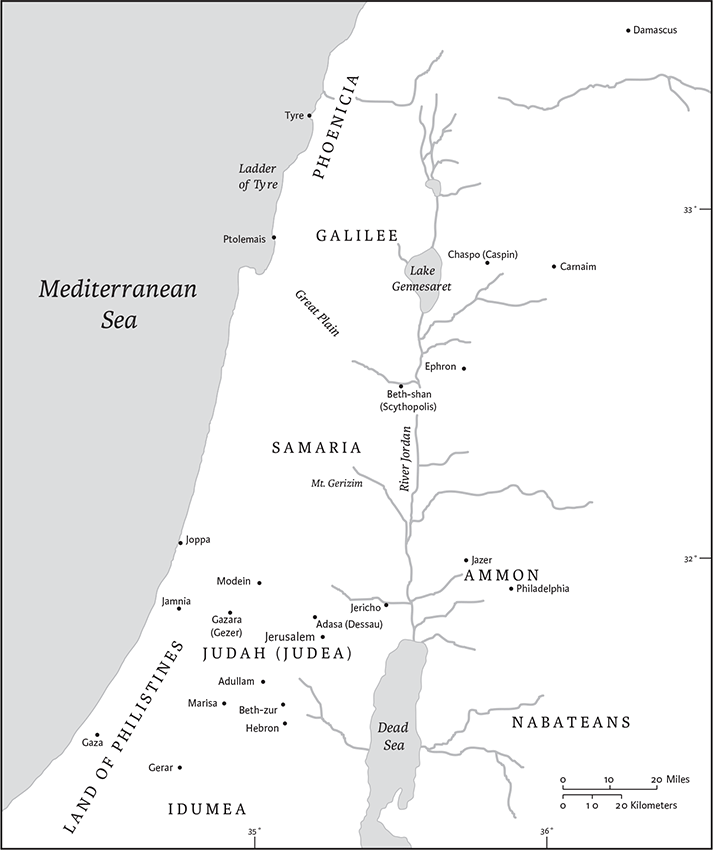
2But some of the governors in various places, Timothy and Apollonius son of Gennaeus, as well as Hieronymus and Demophon, and in addition to these Nicanor the governor of Cyprus, would not let them live quietly and in peace. 3And the people of Joppa did so ungodly a deed as this: they invited the Jews who lived among them to embark, with their wives and children, on boats that they had provided, as though there were no ill will to the Jews;b 4and this was done by public vote of the city. When they accepted, because they wished to live peaceably and suspected nothing, the people of Joppac took them out to sea and drowned them, at least two hundred. 5When Judas heard of the cruelty visited on his compatriots, he gave orders to his men 6and, calling upon God, the righteous judge, attacked the murderers of his kindred. He set fire to the harbor by night, burned the boats, and massacred those who had taken refuge there. 7Then, because the city's gates were closed, he withdrew, intending to come again and root out the whole community of Joppa. 8But learning that the people in Jamnia meant in the same way to wipe out the Jews who were living among them, 9he attacked the Jamnites by night and set fire to the harbor and the fleet, so that the glow of the light was seen in Jerusalem, thirty milesa distant.
10When they had gone more than a mileb from there, on their march against Timothy, at least five thousand Arabs with five hundred cavalry attacked them. 11After a hard fight, Judas and his companions, with God's help, were victorious. The defeated nomads begged Judas to grant them pledges of friendship, promising to give him livestock and to help his peoplec in all other ways. 12Judas, realizing that they might indeed be useful in many ways, agreed to make peace with them; and after receiving his pledges they went back to their tents.
13He also attacked a certain town that was strongly fortified with earthworksd and walls, and inhabited by all sorts of Gentiles. Its name was Caspin. 14Those who were within, relying on the strength of the walls and on their supply of provisions, behaved most insolently toward Judas and his men, railing at them and even blaspheming and saying unholy things. 15But Judas and his men, calling upon the great Sovereign of the world, who without battering rams or engines of war overthrew Jericho in the days of Joshua, rushed furiously upon the walls. 16They took the town by the will of God, and slaughtered untold numbers, so that the adjoining lake, a quarter of a milee wide, appeared to be running over with blood.
17When they had gone ninety-five milesf from there, they came to Charax, to the Jews who are called Toubiani. 18They did not find Timothy in that region, for he had by then left there without accomplishing anything, though in one place he had left a very strong garrison. 19Dositheus and Sosipater, who were captains under Maccabeus, marched out and destroyed those whom Timothy had left in the stronghold, more than ten thousand men. 20But Maccabeus arranged his army in divisions, set menc in command of the divisions, and hurried after Timothy, who had with him one hundred twenty thousand infantry and two thousand five hundred cavalry. 21When Timothy learned of the approach of Judas, he sent off the women and the children and also the baggage to a place called Carnaim; for that place was hard to besiege and difficult of access because of the narrowness of all the approaches. 22But when Judas's first division appeared, terror and fear came over the enemy at the manifestation to them of him who sees all things. In their flight they rushed headlong in every direction, so that often they were injured by their own men and pierced by the points of their own swords. 23Judas pressed the pursuit with the utmost vigor, putting the sinners to the sword, and destroyed as many as thirty thousand.
24Timothy himself fell into the hands of Dositheus and Sosipater and their men. With great guile he begged them to let him go in safety, because he held the parents of most of them, and the brothers of some, to whom no consideration would be shown. 25And when with many words he had confirmed his solemn promise to restore them unharmed, they let him go, for the sake of saving their kindred.
26Then Judasa marched against Carnaim and the temple of Atargatis, and slaughtered twenty-five thousand people. 27After the rout and destruction of these, he marched also against Ephron, a fortified town where Lysias lived with multitudes of people of all nationalities.b Stalwart young men took their stand before the walls and made a vigorous defense; and great stores of war engines and missiles were there. 28But the Jewsc called upon the Sovereign who with power shatters the might of his enemies, and they got the town into their hands, and killed as many as twenty-five thousand of those who were in it.
29Setting out from there, they hastened to Scythopolis, which is seventy-five milesd from Jerusalem. 30But when the Jews who lived there bore witness to the goodwill that the people of Scythopolis had shown them and their kind treatment of them in times of misfortune, 31they thanked them and exhorted them to be well disposed to their race in the future also. Then they went up to Jerusalem, as the festival of weeks was close at hand.
32After the festival called Pentecost, they hurried against Gorgias, the governor of Idumea, 33who came out with three thousand infantry and four hundred cavalry. 34When they joined battle, it happened that a few of the Jews fell. 35But a certain Dositheus, one of Bacenor's men, who was on horseback and was a strong man, caught hold of Gorgias, and grasping his cloak was dragging him off by main strength, wishing to take the accursed man alive, when one of the Thracian cavalry bore down on him and cut off his arm; so Gorgias escaped and reached Marisa.
36As Esdris and his men had been fighting for a long time and were weary, Judas called upon the Lord to show himself their ally and leader in the battle. 37In the language of their ancestors he raised the battle cry, with hymns; then he charged against Gorgias's troops when they were not expecting it, and put them to flight.
38Then Judas assembled his army and went to the city of Adullam. As the seventh day was coming on, they purified themselves according to the custom, and kept the sabbath there.
39On the next day, as had now become necessary, Judas and his men went to take up the bodies of the fallen and to bring them back to lie with their kindred in the sepulchres of their ancestors. 40Then under the tunic of each one of the dead they found sacred tokens of the idols of Jamnia, which the law forbids the Jews to wear. And it became clear to all that this was the reason these men had fallen. 41So they all blessed the ways of the Lord, the righteous judge, who reveals the things that are hidden; 42and they turned to supplication, praying that the sin that had been committed might be wholly blotted out. The noble Judas exhorted the people to keep themselves free from sin, for they had seen with their own eyes what had happened as the result of the sin of those who had fallen. 43He also took up a collection, man by man, to the amount of two thousand drachmas of silver, and sent it to Jerusalem to provide for a sin offering. In doing this he acted very well and honorably, taking account of the resurrection. 44For if he were not expecting that those who had fallen would rise again, it would have been superfluous and foolish to pray for the dead. 45But if he was looking to the splendid reward that is laid up for those who fall asleep in godliness, it was a holy and pious thought. Therefore he made atonement for the dead, so that they might be delivered from their sin.
13
In the one hundred forty-ninth yeara word came to Judas and his men that Antiochus Eupator was coming with a great army against Judea, 2and with him Lysias, his guardian, who had charge of the government. Each of them had a Greek force of one hundred ten thousand infantry, five thousand three hundred cavalry, twenty-two elephants, and three hundred chariots armed with scythes.
3Menelaus also joined them and with utter hypocrisy urged Antiochus on, not for the sake of his country's welfare, but because he thought that he would be established in office. 4But the King of kings aroused the anger of Antiochus against the scoundrel; and when Lysias informed him that this man was to blame for all the trouble, he ordered them to take him to Beroea and to put him to death by the method that is customary in that place. 5For there is a tower there, fifty cubits high, full of ashes, and it has a rim running around it that on all sides inclines precipitously into the ashes. 6There they all push to destruction anyone guilty of sacrilege or notorious for other crimes. 7By such a fate it came about that Menelaus the lawbreaker died, without even burial in the earth. 8And this was eminently just; because he had committed many sins against the altar whose fire and ashes were holy, he met his death in ashes.
9The king with barbarous arrogance was coming to show the Jews things far worse than those that had been doneb in his father's time. 10But when Judas heard of this, he ordered the people to call upon the Lord day and night, now if ever to help those who were on the point of being deprived of the law and their country and the holy temple, 11and not to let the people who had just begun to revive fall into the hands of the blasphemous Gentiles. 12When they had all joined in the same petition and had implored the merciful Lord with weeping and fasting and lying prostrate for three days without ceasing, Judas exhorted them and ordered them to stand ready.
13After consulting privately with the elders, he determined to march out and decide the matter by the help of God before the king's army could enter Judea and get possession of the city. 14So, committing the decision to the Creator of the world and exhorting his troops to fight bravely to the death for the laws, temple, city, country, and commonwealth, he pitched his camp near Modein. 15He gave his troops the watchword, “God's victory,” and with a picked force of the bravest young men, he attacked the king's pavilion at night and killed as many as two thousand men in the camp. He stabbeda the leading elephant and its rider. 16In the end they filled the camp with terror and confusion and withdrew in triumph. 17This happened, just as day was dawning, because the Lord's help protected him.
18The king, having had a taste of the daring of the Jews, tried strategy in attacking their positions. 19He advanced against Bethzur, a strong fortress of the Jews, was turned back, attacked again,b and was defeated. 20Judas sent in to the garrison whatever was necessary. 21But Rhodocus, a man from the ranks of the Jews, gave secret information to the enemy; he was sought for, caught, and put in prison. 22The king negotiated a second time with the people in Beth-zur, gave pledges, received theirs, withdrew, attacked Judas and his men, was defeated; 23he got word that Philip, who had been left in charge of the government, had revolted in Antioch; he was dismayed, called in the Jews, yielded and swore to observe all their rights, settled with them and offered sacrifice, honored the sanctuary and showed generosity to the holy place. 24He received Maccabeus, left Hegemonides as governor from Ptolemais to Gerar, 25and went to Ptolemais. The people of Ptolemais were indignant over the treaty; in fact they were so angry that they wanted to annul its terms.a26Lysias took the public platform, made the best possible defense, convinced them, appeased them, gained their goodwill, and set out for Antioch. This is how the king's attack and withdrawal turned out.
14
Three years later, word came to Judas and his men that Demetrius son of Seleucus had sailed into the harbor of Tripolis with a strong army and a fleet, 2and had taken possession of the country, having made away with Antiochus and his guardian Lysias.
3Now a certain Alcimus, who had formerly been high priest but had willfully defiled himself in the times of separation,c realized that there was no way for him to be safe or to have access again to the holy altar, 4and went to King Demetrius in about the one hundred fifty-first year,a presenting to him a crown of gold and a palm, and besides these some of the customary olive branches from the temple. During that day he kept quiet. 5But he found an opportunity that furthered his mad purpose when he was invited by Demetrius to a meeting of the council and was asked about the attitude and intentions of the Jews. He answered:
6“Those of the Jews who are called Hasideans, whose leader is Judas Maccabeus, are keeping up war and stirring up sedition, and will not let the kingdom attain tranquility. 7Therefore I have laid aside my ancestral glory—I mean the high priesthood—and have now come here, 8first because I am genuinely concerned for the interests of the king, and second because I have regard also for my compatriots. For through the folly of those whom I have mentioned our whole nation is now in no small misfortune. 9Since you are acquainted, O king, with the details of this matter, may it please you to take thought for our country and our hard-pressed nation with the gracious kindness that you show to all. 10For as long as Judas lives, it is impossible for the government to find peace.” 11When he had said this, the rest of the king's Friends,b who were hostile to Judas, quickly inflamed Demetrius still more. 12He immediately chose Nicanor, who had been in command of the elephants, appointed him governor of Judea, and sent him off 13with orders to kill Judas and scatter his troops, and to install Alcimus as high priest of the greatc temple. 14And the Gentiles throughout Judea, who had fled befored Judas, flocked to join Nicanor, thinking that the misfortunes and calamities of the Jews would mean prosperity for themselves.
15When the Jewse heard of Nicanor's coming and the gathering of the Gentiles, they sprinkled dust on their heads and prayed to him who established his own people forever and always upholds his own heritage by manifesting himself. 16At the command of the leader, theyf set out from there immediately and engaged them in battle at a village called Dessau.d17Simon, the brother of Judas, had encountered Nicanor, but had been temporarilyg checked because of the sudden consternation created by the enemy.
18Nevertheless Nicanor, hearing of the valor of Judas and his troops and their courage in battle for their country, shrank from deciding the issue by bloodshed. 19Therefore he sent Posidonius, Theodotus, and Mattathias to give and receive pledges of friendship. 20When the terms had been fully considered, and the leader had informed the people, and it had appeared that they were of one mind, they agreed to the covenant. 21The leadersh set a day on which to meet by themselves. A chariot came forward from each army; seats of honor were set in place; 22Judas posted armed men in readiness at key places to prevent sudden treachery on the part of the enemy; so they duly held the consultation.
23Nicanor stayed on in Jerusalem and did nothing out of the way, but dismissed the flocks of people that had gathered. 24And he kept Judas always in his presence; he was warmly attached to the man. 25He urged him to marry and have children; so Judasa married, settled down, and shared the common life.
26But when Alcimus noticed their goodwill for one another, he took the covenant that had been made and went to Demetrius. He told him that Nicanor was disloyal to the government, since he had appointed that conspirator against the kingdom, Judas, to be his successor. 27The king became excited and, provoked by the false accusations of that depraved man, wrote to Nicanor, stating that he was displeased with the covenant and commanding him to send Maccabeus to Antioch as a prisoner without delay.
28When this message came to Nicanor, he was troubled and grieved that he had to annul their agreement when the man had done no wrong. 29Since it was not possible to oppose the king, he watched for an opportunity to accomplish this by a stratagem. 30But Maccabeus, noticing that Nicanor was more austere in his dealings with him and was meeting him more rudely than had been his custom, concluded that this austerity did not spring from the best motives. So he gathered not a few of his men, and went into hiding from Nicanor. 31When the latter became aware that he had been cleverly outwitted by the man, he went to the greatb and holy temple while the priests were offering the customary sacrifices, and commanded them to hand the man over. 32When they declared on oath that they did not know where the man was whom he wanted, 33he stretched out his right hand toward the sanctuary, and swore this oath: “If you do not hand Judas over to me as a prisoner, I will level this shrine of God to the ground and tear down the altar, and build here a splendid temple to Dionysus.”
34Having said this, he went away. Then the priests stretched out their hands toward heaven and called upon the constant Defender of our nation, in these words: 35“O Lord of all, though you have need of nothing, you were pleased that there should be a temple for your habitation among us; 36so now, O holy One, Lord of all holiness, keep undefiled forever this house that has been so recently purified.”
37A certain Razis, one of the elders of Jerusalem, was denounced to Nicanor as a man who loved his compatriots and was very well thought of and for his goodwill was called father of the Jews. 38In former times, when there was no mingling with the Gentiles, he had been accused of Judaism, and he had most zealously risked body and life for Judaism. 39Nicanor, wishing to exhibit the enmity that he had for the Jews, sent more than five hundred soldiers to arrest him; 40for he thought that by arrestingc him he would do them an injury. 41When the troops were about to capture the tower and were forcing the door of the courtyard, they ordered that fire be brought and the doors burned. Being surrounded, Razisa fell upon his own sword, 42preferring to die nobly rather than to fall into the hands of sinners and suffer outrages unworthy of his noble birth. 43But in the heat of the struggle he did not hit exactly, and the crowd was now rushing in through the doors. He courageously ran up on the wall, and bravely threw himself down into the crowd. 44But as they quickly drew back, a space opened and he fell in the middle of the empty space. 45Still alive and aflame with anger, he rose, and though his blood gushed forth and his wounds were severe he ran through the crowd; and standing upon a steep rock, 46with his blood now completely drained from him, he tore out his entrails, took them in both hands and hurled them at the crowd, calling upon the Lord of life and spirit to give them back to him again. This was the manner of his death.
15
When Nicanor heard that Judas and his troops were in the region of Samaria, he made plans to attack them with complete safety on the day of rest. 2When the Jews who were compelled to follow him said, “Do not destroy so savagely and barbarously, but show respect for the day that he who sees all things has honored and hallowed above other days,” 3the thrice-accursed wretch asked if there were a sovereign in heaven who had commanded the keeping of the sabbath day. 4When they declared, “It is the living Lord himself, the Sovereign in heaven, who ordered us to observe the seventh day,” 5he replied, “But I am a sovereign also, on earth, and I command you to take up arms and finish the king's business.” Nevertheless, he did not succeed in carrying out his abominable design.
6This Nicanor in his utter boastfulness and arrogance had determined to erect a public monument of victory over Judas and his forces. 7But Maccabeus did not cease to trust with all confidence that he would get help from the Lord. 8He exhorted his troops not to fear the attack of the Gentiles, but to keep in mind the former times when help had come to them from heaven, and so to look for the victory that the Almighty would give them. 9Encouraging them from the law and the prophets, and reminding them also of the struggles they had won, he made them the more eager. 10When he had aroused their courage, he issued his orders, at the same time pointing out the perfidy of the Gentiles and their violation of oaths. 11He armed each of them not so much with confidence in shields and spears as with the inspiration of brave words, and he cheered them all by relating a dream, a sort of vision,a which was worthy of belief.
12What he saw was this: Onias, who had been high priest, a noble and good man, of modest bearing and gentle manner, one who spoke fittingly and had been trained from childhood in all that belongs to excellence, was praying with outstretched hands for the whole body of the Jews. 13Then in the same fashion another appeared, distinguished by his gray hair and dignity, and of marvelous majesty and authority. 14And Onias spoke, saying, “This is a man who loves the family of Israel and prays much for the people and the holy city—Jeremiah, the prophet of God.” 15Jeremiah stretched out his right hand and gave to Judas a golden sword, and as he gave it he addressed him thus: 16“Take this holy sword, a gift from God, with which you will strike down your adversaries.”
17Encouraged by the words of Judas, so noble and so effective in arousing valor and awaking courage in the souls of the young, they determined not to carry on a campaigna but to attack bravely, and to decide the matter by fighting hand to hand with all courage, because the city and the sanctuary and the temple were in danger. 18Their concern for wives and children, and also for brothers and sistersb and relatives, lay upon them less heavily; their greatest and first fear was for the consecrated sanctuary. 19And those who had to remain in the city were in no little distress, being anxious over the encounter in the open country.
20When all were now looking forward to the coming issue, and the enemy was already close at hand with their army drawn up for battle, the elephantsc strategically stationed and the cavalry deployed on the flanks, 21Maccabeus, observing the masses that were in front of him and the varied supply of arms and the savagery of the elephants, stretched out his hands toward heaven and called upon the Lord who works wonders; for he knew that it is not by arms, but as the Lordd decides, that he gains the victory for those who deserve it. 22He called upon him in these words: “O Lord, you sent your angel in the time of King Hezekiah of Judea, and he killed fully one hundred eighty-five thousand in the camp of Sennacherib. 23So now, O Sovereign of the heavens, send a good angel to spread terror and trembling before us. 24By the might of your arm may these blasphemers who come against your holy people be struck down.” With these words he ended his prayer.
25Nicanor and his troops advanced with trumpets and battle songs, 26but Judas and his troops met the enemy in battle with invocations to God and prayers. 27So, fighting with their hands and praying to God in their hearts, they laid low at least thirty-five thousand, and were greatly gladdened by God's manifestation.
28When the action was over and they were returning with joy, they recognized Nicanor, lying dead, in full armor. 29Then there was shouting and tumult, and they blessed the Sovereign Lord in the language of their ancestors. 30Then the man who was ever in body and soul the defender of his people, the man who maintained his youthful goodwill toward his compatriots, ordered them to cut off Nicanor's head and arm and carry them to Jerusalem. 31When he arrived there and had called his compatriots together and stationed the priests before the altar, he sent for those who were in the citadel. 32He showed them the vile Nicanor's head and that profane man's arm, which had been boastfully stretched out against the holy house of the Almighty. 33He cut out the tongue of the ungodly Nicanor and said that he would feed it piecemeal to the birds and would hang up these rewards of his folly opposite the sanctuary. 34And they all, looking to heaven, blessed the Lord who had manifested himself, saying, “Blessed is he who has kept his own place undefiled!” 35Judase hung Nicanor's head from the citadel, a clear and conspicuous sign to everyone of the help of the Lord. 36And they all decreed by public vote never to let this day go unobserved, but to celebrate the thirteenth day of the twelfth month—which is called Adar in the Aramaic language—the day before Mordecai's day.
37This, then, is how matters turned out with Nicanor, and from that time the city has been in the possession of the Hebrews. So I will here end my story.
38If it is well told and to the point, that is what I myself desired; if it is poorly done and mediocre, that was the best I could do. 39For just as it is harmful to drink wine alone, or, again, to drink water alone, while wine mixed with water is sweet and delicious and enhances one's enjoyment, so also the style of the story delights the ears of those who read the work. And here will be the end.